Friday, November 2, 2012

Batman: The Movie (1966)


Years before the Christopher Nolan Batman films there were the Tim Burton Batman films; years before the Tim Burton Batman films there was this: 1966's gloriously campy and compulsively watchable Batman: The Movie.  Directed by Leslie H. Martin, it stars Adam West as Batman and Burt Ward as Robin the Boy Wonder in addition to a (pardon this, I am in the mood for wordplay) fearsome foursome of foes: the Joker, the Riddler, the Penguin, and Catwoman.  Sporting a incoherent plot and holy-let's-just-go-with-it-Batman attitude, it stands in stark contrast to the much darker and grittier Nolan films and serves as an example of how to properly do a campy superhero movie (take note, Joel Schumacher).

The plot of the film involves the standard superhero plot: deadly villains, theme gadgets, and a taking-the-world-hostage sort of evil scheme.  Batman and Robin answer an urgent cry to save a stolen ship (with deadly new invention aboard) and end up battling a shark (mid-air) while the ship apparently disappears.  Following vague clues, they manage to deduce that the scheme has been formulated by the Penguin, the Joker, the Riddler, and Catwoman (Burgess Meredith, Cesar Romero, Frank Gorshin, and Lee Meredith).  The villains hatch a plan to lure Batman to them by having Catwoman, under the guise of the Russian Miss Kitka, seduce a millionaire and, through kidnapping him, bait Batman.  Naturally, the millionaire chosen is none other than Bruce Wayne, Batman's alter-ego.  Being the ladies man he is, he deems the seductive "Kitka" worthy of (actual dialogue) "International Relations."  He promptly escapes their grasp and seeks to stop there dastardly scheme.  The specifics of the scheme are not important, some key points are as follows: a billion dollars, a penguin-based submarine, and a means of dehydrating world leaders.

The plot of the film, though clearly ridiculous, is ideal for the campy tone and is utterly hilarious when viewing the final product.  The scheming done by the four antagonists is so out-there and incomprehensible it would make the writers of the James Bond films starring Roger Moore blush.  All that being said, the writing of the film is so ridiculous and over-the-top that it becomes endearing.  "What is six ounces, sits in a tree, and is extremely dangerous? A sparrow with a machine gun."  By the end of the film the Riddler's ridiculous riddles, such as that one, that Batman and Robin solve with apparent ease, almost make sense, almost.  For this, the writers must be given credit, nothing except for good writing could account for such a miraculous and shocking thing.

The acting of the film is excessive, hammy, and unbelievably fun to watch.  As our caped crusaders, Adam West and Burt Ward embrace the material with a veracity that inspires not a small amount of awe, and not a small amount of pity.  The quartet of villains also go hammy and generally succeed in doing so; though they are not quite as successful as one would hope.  Of the four, only Lee Meriwether as Catwoman really stands out.  The other three villainous roles seem as if they could have been condensed into one without losing much of their effect.  Meriwether replaced Julie Newmar (who appeared as Catwoman on the television series) and she created the cat-suit that was to be filled when Michelle Pfeiffer would slip into it over thirty-five years later.

Another facet of the film that must be mentioned is the amount of bat-gadgets that are in the film.  I counted four different vehicles used by the Dynamic Duo: the Bat-Mobile, the Bat-Copter, the Bat-Cycle, and the Bat-Boat.  In addition to that, they have a Bat-Ladder (a rope ladder with a sign that says "Bat-Ladder") and Shark Repellent Bat-Spray among many, many others.

Overall the film is highly enjoyable and so campy it makes one want to start singing "Camptown Races" around a fire.  If you want to see a gritty Batman film that also creates a realistic human-drama: see Christopher Nolan's Batman Begins and The Dark Knight.  If you want to see a hammy, over-the-top action film with physical comedy taken directly from the films of Charlie Chaplin: see Batman: The Movie.  As a parody of the super-hero genre, it is, to quote my favorite villainous feline, "Purr-fect."

8/10

Note: Though the official name of the film is Batman, it was marketed as Batman: The Movie.  I credited as the latter to avoid confusion with the Tim Burton film of the same name that I will eventually review.

Additional Note: This review was previously posted on another blog I wrote.

The Mark of Zorro (1920)


A tavern full of corrupt soldiers complains of a masked vigilante fighting for the poor and the oppressed: Zorro.  Douglas Fairbanks stars as the dashing hero in one of his first swashbuckling roles (in one of the first swashbucklers) in the first cinematic adaptation of the iconic Zorro character: The Mark of Zorro.  Directed by Fred Niblo, one of early cinema's most important innovators, the silent film was released in 1920 and became a huge hit at the box office, turning the athletic Fairbanks from a comic actor into a swashbuckling superstar.

The film is set in a Spanish controlled California, where the government has been increasingly oppressive and corrupt to the natives and the poor.  A few months prior to the beginning of the film, the apparently foppish Don Diego Vega has returned home from being educated in Spain.  Shortly thereafter, reports began circulating about a masked vigilante, Zorro, terrorizing those who abuse their power and oppress the weak.  Don Diego's father, frustrated with his effete and seemingly idle son, informs him that he needs to marry; the lovely Lolita Pulido, of a good family with current financial troubles, is his fiancé-to-be of choice.  Lolita despises (with good reason) Don Diego for his behavior and rudeness, (while courting, it is probably best not to say finding a wife is "such a nuisance") but falls for the charming and dashing Zorro.  As the manhunt for Zorro heats up, Lolita and everyone else will be shocked by Zorro's (timely) revelation of his true identity: Don Diego Vega.

Douglas Fairbanks, though not a great actor in the traditional sense, had the tools that made him a (if not the) ideal swashbuckling hero: he sparkled with ebullience in every scene, he had a charisma and natural screen-presence almost unmatched among the screen-stars of any decade, and he had a prodigious athletic ability that make his stunts (done without the use of special effects) breathtaking both then and now.  The supporting players are game and charismatic, the two qualities required of a supporting actor in a film such as this.  Though every performer does their job well, Fairbanks truly steals the show; it is no mystery why he was asked to portray many of the other great swashbuckling heroes after this film (D'Artagnan, Robin Hood, the son of Zorro).

Though The Mark of Zorro is a silent film, the use of the intertitles does not slow the film's pace or hinder the enjoyment of it.  The film's lack of special effects and its relatively low quality picture could have doomed a film this action heavy, but Niblo's direction and Fairbanks athleticism prevented this high-quality adventure from being a disaster.  The sword-fighting  scenes in the film, though lacking in the (relative) realism and skill demonstrated by those performed by Basil Rathbone and Errol Flynn (among other actors) years later, are enjoyable and exhilarating nonetheless.  The score, comprised of organ music, is fitting the film and is essential is creating the correct tone for the film; the fact that it is a silent film necessitates the use of the music in setting the tone for the action.  

As the film in which Douglas Fairbanks proved his merits as a swashbuckling hero, it is fitting that The Mark of Zorro be both gloriously pulpy and entertaining from the first moment to the last: the film delivers on both counts; though the film does not contain much in the way of depth.  All in all, The Mark of Zorro is a thoroughly memorable adaptation of Johnston McCulley's classic pulp novel The Curse of Capistrano, despite the lack of special effects or spoken dialogue.

8/10

Note: This review was previously posted on another blog I wrote.

The Black Pirate (1926)


There are certain films that become truly surprising, years after their release, for reasons that have absolutely nothing to do with its storyline or acting; The Black Pirate, Albert Parker's 1926 swashbuckler starring Douglas Fairbanks, has become surprising because it is a silent film that just so happens to be in Technicolor (albeit two-tone, but Technicolor nonetheless).  One of a series of swashbuckling vehicles for Fairbanks released during the 1920s, The Black Pirate casts the athletic superstar as a young Duke seeking revenge for his father's death by taking the guise of a unnamed buccaneer and joining the company of pirates that did the deed.

A group of pirates blow up a captured ship, via the ship's powder magazine, with all of the occupants still on board.  The ship's sole survivors, a Duke and his son, are washed ashore on a deserted island; the father soon dies, leaving his signet ring and dukedom to his son, who vows to avenge his father's death.  Through a mixture of coincidence and convenience, the pirates disembark on the same island to bury their horde of treasure.  The son, adopting the mysterious (and catchy) moniker of the Black Pirate, walks up to the pirates and proclaims his desire to join the crew.  Following the proving of his worth (he has a victorious duel with the captain and he captures a large ship singlehandedly), the crew enthusiastically endorses their new recruit as fit for being their new captain, much to the dismay of the previous first mate.  What follows is a series acrobatic fights, the predictable wooing of a for-some-reason-their princess, and the inevitable revelation of his true identity.

The Black Pirate, is one Fairbanks' weaker swashbucklers in terms of both plot and character.  While almost all silent films rely on formula, formula does not have to be used in a boring manner: and The Black Pirate certainly uses it in a boring manner.  Absolutely nothing distinguishes it from the countless other revenge on the high seas flicks that have been released over the years, except for Douglas Fairbanks.  The plot of the film boils down to one clichéd scene after another, with a damsel in distress, portrayed by Billie Dove, thrown in for good measure.  Douglas Fairbanks is at his uncannily acrobatic best here (some of his stunts are jaw-dropping), though it is a shame he can't elevate the material beyond the piece of (mildly) diverting fluff it is.

The real appeal of The Black Pirate lies in the fact that it is an intriguing curio from the silent era; it is one of the first films to be released entirely in color, albeit in two-tone Technicolor (which has a limited spectrum in comparison to later Technicolor).  In fact, Fairbanks, who was heavily involved with the film's production, invested a considerable amount of money in developing the process that made color films a reality.  The Black Pirate was recently selected for preservation in the National Film Registry: it did not get that recognition because of its merits, it got it because of its (very) early use of Technicolor.

The Black Pirate is not a particularly good silent swashbuckler, especially when compared with other Fairbanks films, but it is a fairly competent if underwhelming pirate flick.  The film's primary appeal is the viewing of a 1920s silent film in color; the strangeness wears off eventually, but it is enough to make it worth a watch if you have an interest in early cinema.


5/10

Note: This review was previously posted on another blog I wrote.

Gentlemen Prefer Blondes (1953)


Lorelei Lee is the type of girl that can spot a diamond ring in a man's pocket while performing on stage underneath the bright lights.  Dorothy Shaw, her best friend and fellow showgirl, is only looking for a good time and could care less if her future husband is rich (just as long as he's good looking).  They are the two central characters at the center of Howard Hawks' amiable, if shallow, musical Gentlemen Prefer Blondes.  Marilyn Monroe and Jane Russell star as Lorelei Lee and Dorothy Shaw in the 1953 film, their costars include Charles Coburn, Elliott Reid, and Tommy Noonan.

The film begins with Lorelei and Dorothy performing a musical number on-stage to the delight of a crowd that includes Gus Esmond (Tommy Noonan), Lorelei's wealthy husband-to-be.  Lorelei's reason for loving Gus is that he is willing to do anything she wants, and he has the money to do so.  Gus' father disapproves of their union, he (correctly) thinks that Lorelei is a gold-digger; the elder Esmond forbids Gus from going on a planned trip with Lorelei and Dorothy to Paris: Lorelei and Dorothy go ahead as planned.  The elder Esmond, suspecting Lorelei may do something not becoming a respectable young lady, hires Malone (Elliott Reid), a private detective to spy on her.  While on the ship Lorelei's becomes interested in "Piggy" Beekman (Charles Coburn), the owner of a very profitable diamond mine; Dorothy is interested by the men's Olympic team...and Malone (the Olympic team has a strict curfew).  As Dorothy is charmed by Malone, Lorelei sets her sights on using her "charm" to acquire Piggy's wife's prized diamond tiara (Lorelei just can't resist diamonds).  Dorothy discovers Malone's true reason for taking the trip and plots to beat him at his own game; all the while Lorelei's success at her own "game" threatens to lead to her losing everything: Gus, her freedom, and possibly most important of all: her diamonds.

Monroe and Russell both do solid work as the showgirls looking for love and a good time.  As the ditsy Lorelei, Monroe demonstrates why she is remembered as a capable comic actress.  Russell does her job well, playing the (relatively) straight-woman to Monroe's ridiculously over the top character.  The supporting players perform admirably, but neither they, nor the leading ladies, can compensate for the fact that nearly every character is despicable.  Lorelei is a gold-digger (and proud of it) willing to coerce a man into giving up his wife's most prized possession because it looks pretty.  The film frames this act as a shrewd move by Lorelei; in reality, such an act is both wretched and malicious.  Russell's Dorothy is witty, but in her own way is as equally as shallow as Lorelei.  Elliott Reid is solid as Malone, but he really doesn't have much to do as Russell's love-interest.  Tommy Noonan is convincing as the passive Gus Esmond; but that fact does not help the movie, as a character that is supposed to be likable, it is hard to do little more than crack a bemused smirk at the way he is treated by Lorelei.

The film is beautifully filmed in Technicolor, the colors are vibrant and match the bubbly tone of the film and do the lovely leading ladies justice.  The film, directed by a seasoned Howard Hawks, has well choreographed and entertaining musical numbers; though the music itself is clichéd and underwhelming.  The most famous number, "Diamonds Are a Girl's Best Friend," is deservedly iconic as a musical number, but as the message for a film (the film's message amounts to that, essentially), it is completely superficial and utterly revolting.

Gentlemen Prefer Blondes has many of the typical trademarks of a standard fifties era musical: a predictable plot, spirited leads, and heavily choreographed musical numbers.  Despite its renown and fond place in many a memory, Gentlemen Prefer Blondes amounts to little more than mediocre musical fare with protagonists that are actually quite hard to like.  Though, Marilyn Monroe and Jane Russell truly do shine in the lead roles.

4/10

Note: This review was previously posted on another blog I wrote.
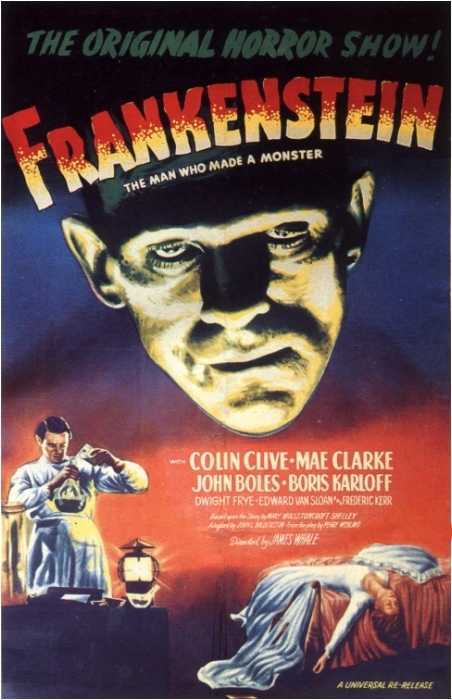
Frankenstein (1931)


The film opens with a man warning the viewers about the horrifying nature of the film that they are about to see.  The 1931 film, Frankenstein, was released to critical praise and box-office success.  One of the defining films of the horror genre, it was based (loosely) on the classic novel by Mary Shelley and released following the success of another adaptation of a horror classic: Dracula.  The film runs a mere seventy minutes and stars Boris Karloff as the monster and Colin Clive as Dr. Frankenstein.


Dr. Henry Frankenstein and his hunchbacked assistant Fritz (not Igor) rob a grave; in need of a good human brain, Frankenstein proceeds to send Fritz to steal one from the local university.  Frankenstein is working on an experiment to see if he can bring life to dead tissue: he is frighteningly optimistic.  He has been working for months in an abandoned watchtower far removed from his bride-to-be, family, and friends.  His fiancée Elizabeth is worried and enlists the help of his old mentor, Dr. Waldman, to help talk sense into him.  They arrive while Frankenstein is undergoing the final preparations for his experiment.  The experiment continues on as planned, with the exception of having three horrified onlookers; to the horror of his guests: he is successful.  The monster, made with an abnormal brain, is prone to violent outbursts.  Frankenstein is appalled by what he has created and makes futile plans with Waldman to destroy it; his subsequent return home is marred by reports of the monster killing Waldman and a little girl.  Frankenstein decides to hunt the monster himself, leading to the iconic showdown in an abandoned mill.


Frankenstein is, above all else, a product of its atmosphere; the black-in-white cinematography in tandem with the richly detailed sets provide the ideal Gothic atmosphere for an old-school horror movie.  The creation-scene has an assortment of ridiculous gadgets, from a Tesla coil to a bed that can be elevated to the sky, that somehow manage to make sense to the story.  The makeup on the actual monster is both frightening and practical; Karloff is able to convey a surprising amount of emotion through the heavy layers.  The overall design of the monster, though different from Shelley's vague description, is deservedly famous for such elements as the bolts in the neck and the flat head.  The film's actors do exactly what they need to do for the film to work: they ham it up.  Colin Clive, as the titular Frankenstein (the film is named after the doctor, not the monster), is both unhinged and obsessed, a perfect combination for the role.  Karloff, in his most famous role, is both convincing and frightening as the monster.


In terms of plot, Frankenstein is greatly lacking in both the complexity and the depth present in the novel.  The characterization of the monster is the change that has the greatest effect on the story.  In the film he is little more than a brute prone to both violence and guttural vocalizations, while in the novel he is highly intelligent and philosophical, driven to violence by cruel rejection.  The famous scene involving the little girl is perfectly representative of this change in characterization.  In the film he stumbles upon a little girl who treats him with kindness, after a few moments of playing he throws her into the lake, killing her.  In the novel, he rescues the little girl from drowning in the lake, only to be shot in the arm by her father.  This difference makes the film more cinematic (though I have hopes for a more faithful adaptation sometime in the future) and less thought-provoking.

What makes one human?  That question is posed by the film; it does not give an answer, but it does hint at something: the creature is a monstrosity, but Dr. Frankenstein is the true monster.  1931's Frankenstein is a thoroughly entertaining horror film that has held up extremely well, even though it lacks the emotional heft of its literary source-material.

7/10

Note: This review was previously posted on another blog I wrote.
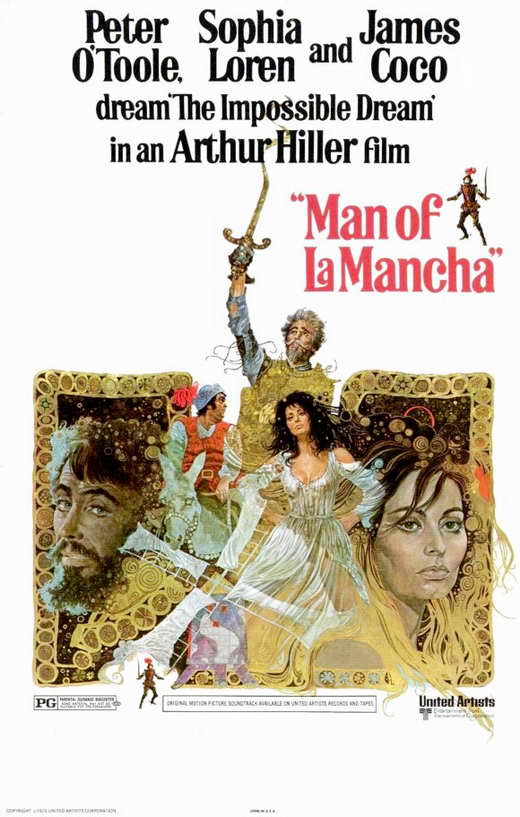
Man of La Mancha (1972)


To dream the impossible dream, that is the message (and frequently recurring lyric) that Miguel de Cervantes and Don Quixote (Peter O'Toole in a duel role) sing throughout Man of La Mancha, a 1972 movie-musical directed by Arthur Hiller.  Costarring Sophia Loren as "Dulcinea" (Aldonza), Man of La Mancha is adapted from a stage-musical that was in turn (very) loosely adapted from the novel Don Quixote, Miguel de Cervantes' magnum opus.


The film opens with Cervantes and his friend being arrested by the inquisition while performing in the street, they are brought to a prison where they are sized up by the prisoners.  The prisoners decide to hold a "trial" to determine if they are worthy or not; instead of a proper defense, Cervantes decides to put on a show performing the tale of Don Quixote with the prisoners as his troupe of players.  His story begins with Don Quixote and his portly squire Sancho Panza riding in the countryside in search of adventures befitting a knight errant.  After a battle with a savage giant (or windmill, depending on your level of sanity) he comes across an inn (castle) where he meets Aldonza ("Dulcinea"), a woman willing to do whatever it takes to survive.  As Don Quixote attempts to rid the world of evil through ill-conceived acts of chivalry, his worried family decides that they should take it upon themselves to cure him of his sudden bout with insanity; all the while, Cervantes waits to be brought before the inquisition.

It must be said that Peter O'Toole and Sophia Loren would have been perfect casting if this had not been a musical, but it is a musical, and that is where the problem lies.  The singing voices of O'Toole and Loren are clearly dubbed over, and not even with exceptionally good singing voices.  This, combined with poorly (and hardly) choreographed dance sequences, resulted in a series of thoroughly lackluster and underwhelming musical sequences.  The music in the film is passable, but hardly special when compared with music from superior musicals such as West Side Story.  


The film's narrative is strong, though the manner in which the narrative is delivered to the audience is befitting the stage and not the screen.  The plot, though differing greatly from its classic source material, has enough heft to make a both interesting and worthwhile film; and that is what makes it all the more disappointing that the film is both contrived and nearly unwatchable.

The largest problem that Man of La Mancha has is that it does not know what the message that it is promoting is.  The two separate messages it promotes are as follows: art is useful to prevent people from noticing their true problems (which is a great oversimplification of art's purpose) and that delusions are okay as long as they lead to some sense of purpose (even if the delusions are dangerous).  There are very few problems with a film that can be as fatal as not knowing what it is about (and Man of La Mancha does not have a clue).

In the end, there is only one thing that can really be said about this film: it is a failure.  Despite a cast of experienced character actors, and a pair of immensely talented leads, Man of La Mancha fails to live up to both the stage play and the novel it was based on.  I once had an impossible dream as well: I dreamed that this was a good film.

3/10

Note: This review was previously posted on another blog I wrote.

Breakfast at Tiffany's (1961)


The standard run-of-the-mill romantic comedy involves several, almost universal, details: two friends with undeniable chemistry, other romantic interests for each of the would-be lovers, and a schmaltzy scene at the end where they get together.  Blake Edwards' 1961 film Breakfast at Tiffany's is a standard run-of-the-mill romantic comedy in almost every detail, except for one: the two leads are both glorified prostitutes, and that makes all the difference.  Audrey Hepburn stars as Holly Golightly and George Peppard  plays Paul Varjak in this adaptation of Truman Capote's classic novel of the same name.  It was nominated for five Academy Awards and won two for best original score and best song.

The film centers on Paul Varjak, an aspiring (but not successful) writer and kept man, and his befriending and falling in love with his unique and off-beat neighbor Holly Golightly, an escort and gold-digger.  Holly, while intriguing and magnetic, is deeply troubled and has a hidden past that does not stay dormant for long.  Although adapted from the Truman Capote novel, the final product is considerably different from Capote's classic.  One major detail that is changed from the novel is the romance between Holly and Paul (unnamed in the novel); in the novel there isn't one.  The novel has richer themes and is more realistic in the way the plot develops, but the story is considerably less cinematic.

The acting in the film is uniformly adequate, with the exception of two performances that truly elevate the film to heights it would not have reached without them.  Audrey Hepburn, in possibly her most iconic role, as Holly Golightly is nothing short of magnificent and without her performance, the film would not be regarded as a classic.  It should be noted that Marilyn Monroe was Capote's preferred choice to play Holly, and was furious when the studio signed Hepburn.  It should also be noted: the studio made the right choice.  The other performance that must be acknowledged is the portrayal of Doc, Holly's much older husband from a past life, by Buddy Ebsen.  Ebsen makes the absolute most of his few minutes of screen-time and manages to illicit (necessary) reactions of pity and disgust from the audience.  Without Ebsen in the role of Doc, the rest of the film may not have meshed succesfully.  Peppard, though a lead, is merely adequate in his role and is completely overshadowed by Hepburn, who is at her most radiant.  An aspect of the film that detracts from the overall experience is the portrayal of Mr. Yunioshi by Mickey Rooney.  Rooney gives a broad stereotype of an Asian person that can only be described by one word: appalling.  It is completely unnecessary and his limited screen-time almost ruins the film's overall tone.

The film's score, composed by Henry Mancini, is phenomenal and sets the tone beautifully.  The song "Moon River", performed by Hepburn in character as Golightly, fits perfectly into the film and it is easy to see why both the score and the song won Oscars for Mancini.  In addition to the music, the cinematography is absolutely gorgeous and the shots of New York City captured by the crew have almost no equal in the cinema of any era.  The film is a demonstration of how good filming and a great score can elevate a film to new levels.

Breakfast at Tiffany's, though possibly not living up to its literary inspiration, is a very good example of a romantic comedy that knows what it is and makes the absolute most of it.  Though clearly not a comic or dramatic masterpiece, it is a demonstration of Audrey Hepburn in one her greatest roles and at her most luminous.  Overall it is a very good watch that has stood the test of time extremely well.

8/10

Note: This review was originally posted on another blog I wrote.