Showing posts with label Musical. Show all posts

Friday, November 2, 2012

Gentlemen Prefer Blondes (1953)


Lorelei Lee is the type of girl that can spot a diamond ring in a man's pocket while performing on stage underneath the bright lights.  Dorothy Shaw, her best friend and fellow showgirl, is only looking for a good time and could care less if her future husband is rich (just as long as he's good looking).  They are the two central characters at the center of Howard Hawks' amiable, if shallow, musical Gentlemen Prefer Blondes.  Marilyn Monroe and Jane Russell star as Lorelei Lee and Dorothy Shaw in the 1953 film, their costars include Charles Coburn, Elliott Reid, and Tommy Noonan.

The film begins with Lorelei and Dorothy performing a musical number on-stage to the delight of a crowd that includes Gus Esmond (Tommy Noonan), Lorelei's wealthy husband-to-be.  Lorelei's reason for loving Gus is that he is willing to do anything she wants, and he has the money to do so.  Gus' father disapproves of their union, he (correctly) thinks that Lorelei is a gold-digger; the elder Esmond forbids Gus from going on a planned trip with Lorelei and Dorothy to Paris: Lorelei and Dorothy go ahead as planned.  The elder Esmond, suspecting Lorelei may do something not becoming a respectable young lady, hires Malone (Elliott Reid), a private detective to spy on her.  While on the ship Lorelei's becomes interested in "Piggy" Beekman (Charles Coburn), the owner of a very profitable diamond mine; Dorothy is interested by the men's Olympic team...and Malone (the Olympic team has a strict curfew).  As Dorothy is charmed by Malone, Lorelei sets her sights on using her "charm" to acquire Piggy's wife's prized diamond tiara (Lorelei just can't resist diamonds).  Dorothy discovers Malone's true reason for taking the trip and plots to beat him at his own game; all the while Lorelei's success at her own "game" threatens to lead to her losing everything: Gus, her freedom, and possibly most important of all: her diamonds.

Monroe and Russell both do solid work as the showgirls looking for love and a good time.  As the ditsy Lorelei, Monroe demonstrates why she is remembered as a capable comic actress.  Russell does her job well, playing the (relatively) straight-woman to Monroe's ridiculously over the top character.  The supporting players perform admirably, but neither they, nor the leading ladies, can compensate for the fact that nearly every character is despicable.  Lorelei is a gold-digger (and proud of it) willing to coerce a man into giving up his wife's most prized possession because it looks pretty.  The film frames this act as a shrewd move by Lorelei; in reality, such an act is both wretched and malicious.  Russell's Dorothy is witty, but in her own way is as equally as shallow as Lorelei.  Elliott Reid is solid as Malone, but he really doesn't have much to do as Russell's love-interest.  Tommy Noonan is convincing as the passive Gus Esmond; but that fact does not help the movie, as a character that is supposed to be likable, it is hard to do little more than crack a bemused smirk at the way he is treated by Lorelei.

The film is beautifully filmed in Technicolor, the colors are vibrant and match the bubbly tone of the film and do the lovely leading ladies justice.  The film, directed by a seasoned Howard Hawks, has well choreographed and entertaining musical numbers; though the music itself is clichéd and underwhelming.  The most famous number, "Diamonds Are a Girl's Best Friend," is deservedly iconic as a musical number, but as the message for a film (the film's message amounts to that, essentially), it is completely superficial and utterly revolting.

Gentlemen Prefer Blondes has many of the typical trademarks of a standard fifties era musical: a predictable plot, spirited leads, and heavily choreographed musical numbers.  Despite its renown and fond place in many a memory, Gentlemen Prefer Blondes amounts to little more than mediocre musical fare with protagonists that are actually quite hard to like.  Though, Marilyn Monroe and Jane Russell truly do shine in the lead roles.

4/10

Note: This review was previously posted on another blog I wrote.

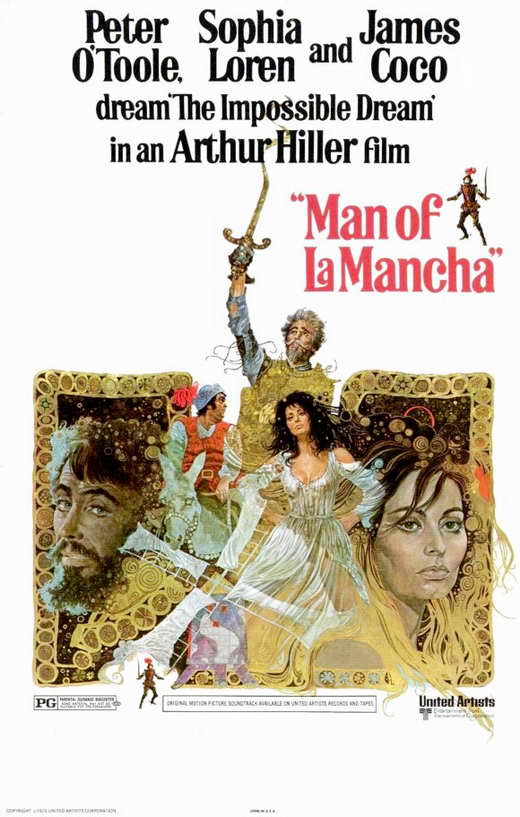
Man of La Mancha (1972)


To dream the impossible dream, that is the message (and frequently recurring lyric) that Miguel de Cervantes and Don Quixote (Peter O'Toole in a duel role) sing throughout Man of La Mancha, a 1972 movie-musical directed by Arthur Hiller.  Costarring Sophia Loren as "Dulcinea" (Aldonza), Man of La Mancha is adapted from a stage-musical that was in turn (very) loosely adapted from the novel Don Quixote, Miguel de Cervantes' magnum opus.


The film opens with Cervantes and his friend being arrested by the inquisition while performing in the street, they are brought to a prison where they are sized up by the prisoners.  The prisoners decide to hold a "trial" to determine if they are worthy or not; instead of a proper defense, Cervantes decides to put on a show performing the tale of Don Quixote with the prisoners as his troupe of players.  His story begins with Don Quixote and his portly squire Sancho Panza riding in the countryside in search of adventures befitting a knight errant.  After a battle with a savage giant (or windmill, depending on your level of sanity) he comes across an inn (castle) where he meets Aldonza ("Dulcinea"), a woman willing to do whatever it takes to survive.  As Don Quixote attempts to rid the world of evil through ill-conceived acts of chivalry, his worried family decides that they should take it upon themselves to cure him of his sudden bout with insanity; all the while, Cervantes waits to be brought before the inquisition.

It must be said that Peter O'Toole and Sophia Loren would have been perfect casting if this had not been a musical, but it is a musical, and that is where the problem lies.  The singing voices of O'Toole and Loren are clearly dubbed over, and not even with exceptionally good singing voices.  This, combined with poorly (and hardly) choreographed dance sequences, resulted in a series of thoroughly lackluster and underwhelming musical sequences.  The music in the film is passable, but hardly special when compared with music from superior musicals such as West Side Story.  


The film's narrative is strong, though the manner in which the narrative is delivered to the audience is befitting the stage and not the screen.  The plot, though differing greatly from its classic source material, has enough heft to make a both interesting and worthwhile film; and that is what makes it all the more disappointing that the film is both contrived and nearly unwatchable.

The largest problem that Man of La Mancha has is that it does not know what the message that it is promoting is.  The two separate messages it promotes are as follows: art is useful to prevent people from noticing their true problems (which is a great oversimplification of art's purpose) and that delusions are okay as long as they lead to some sense of purpose (even if the delusions are dangerous).  There are very few problems with a film that can be as fatal as not knowing what it is about (and Man of La Mancha does not have a clue).

In the end, there is only one thing that can really be said about this film: it is a failure.  Despite a cast of experienced character actors, and a pair of immensely talented leads, Man of La Mancha fails to live up to both the stage play and the novel it was based on.  I once had an impossible dream as well: I dreamed that this was a good film.

3/10

Note: This review was previously posted on another blog I wrote.

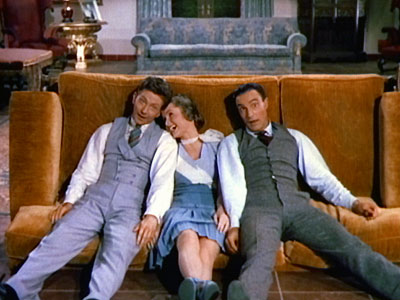
Singin' in the Rain (1952)


Gene Kelly, one of the true masters of the classic Hollywood musical (along with Fred Astaire, among a select few others), is best remembered for the 1952 classic Singin' in the Rain that he starred in and also co-directed with Stanley Donen.  Kelly's costars were Debbie Reynolds, Donald O'Connor, Jean Hagen, and Cyd Charisse (or Cyd Charisse's legs, depending on your viewpoint).


The film opens with an immensely popular on-screen duo arriving to the premier of their new movie; Don Lockwood and Lina Lamont (whose voice is only slightly less grating than nails on a chalkboard) are commonly linked romantically in their films by the studio and (falsely) by the tabloids.  After an awkward first meeting and an even more awkward second one, Lockwood becomes smitten with a talented wannabe stage-actress named Kathy Selden.  The release of The Jazz Singer heralds the age of the talkies and, as a result, the filming of the  new Lockwood and Lamont picture is fraught with many of the problems facing early sound film; the reactions of a test audience are discouraging (to say the absolute least).  Along with his best friend Cosmo, Kathy, and the studio-head, Don conspires to turn the film into a musical with Kathy dubbing all of Lina's lines and musical numbers; but in Hollywood things are never quite that simple and Lina won't take being usurped by a much more tolerable person like Kathy Selden lying down.


The musical numbers throughout the film are catchy and filled with dance sequences liable to make your jaw drop.  Numbers such as "Make 'Em Laugh" and the titular "Singin' in the Rain" earned their iconic status for their addictive lyrics and the stunning athletic ability demonstrated by the performers (Kelly and O'Connor in particular).  In addition, despite the film's (deservedly) family-friendly moniker, there is a very sultry (and quite memorable) dance sequence between Gene Kelly and Cyd Charisse.

The acting in the film is exceptional for a musical, as usually there is a choice to be made between a good actor or a good singer/dancer, but Kelly, Reynolds, and O'Connor could do both with the best of them.  At times, the film got a bit too hammy for its own good, but those moments were few and far between as Gene Kelly and Stanley Donen managed to maintain the ideal tone for a great majority of the film.  The film's plot is both enjoyable and interesting, with just a dash of historical relevance thrown in for good measure; Lina Lamont is based on an actual actress (though it is a highly unfair characterization of that said actress) that fizzled shortly after the talking pictures rose to prominence, while Don Lockwood's silent-film persona seems to be heavily based off of Douglas Fairbanks.

Remembered as the most beloved of Gene Kelly's musicals, Singin' in the Rain is an infectious and highly enjoyable ride from start to finish that has stood the test of time in a way that very few musicals have matched.  This particular tale of Hollywood celebrity is bound to leave a smile on the face of anyone who watches it, with a villain in Lamont that is just malicious enough for all the cynics out there to be satisfied.

9/10

Note: Lina Lamont constantly exasperatingly exclaims, "What do you think I am, dumb or something?" I feel the need to give her an answer: yes.

Additional Note: This review was previously posted on another blog I wrote.