Showing posts with label Drama. Show all posts

Tuesday, November 6, 2012

The Perks of Being a Wallflower (2012)

The Perks of Being a Wallflower, based Stephen Chbosky's 1999 cult favorite debut novel of the same name, has been released and misunderstood teens everywhere should probably be clamoring for a ticket right about...now. Directed by Stephen Chbosky (yes, the man who wrote the book, and the screenplay), the film stars Logan Lerman, Emma Watson, and Ezra Miller as the three leads, with an excellent supporting cast comprised of Paul Rudd, Dylan McDermott, Kate Walsh, Joan Cusack, Mae Whitman, Johnny Simmons, Nina Dobrev, and Melanie Lynsky.

Charlie, portrayed by Logan Lerman, is very much the wallflower the title implies him to be: he is quiet, shy, smart, and very perceptive. He is also still reeling from the suicide of his best friend a few months prior, and the death of his beloved Aunt Helen (Melanie Lynskey) a few years prior. In his first year of high school, Charlie's withdrawn nature is challenged by his befriending a group of off-beat seniors, particularly the extroverted, flamboyant, and gay Patrick and his quirky step-sister Sam, who has an impeccable taste in music. Others in their eclectic group include Mary-Elizabeth (a Buddhist punk), Bob (perpetually stoned and proud of it), and Craig, Sam's college student boyfriend who says things like "poetry writes me" with a straight face; he also connects with his English teacher (Paul Rudd), who encourages Charlie to read and write. As the school year goes on, Charlie experiences a lot of firsts: a first kiss, first girlfriend, first bad trip (and not of the travelling variety), and, of course, a first midnight showing of The Rocky Horror Picture Show. Experiences throughout year, such as seeing his sister, Candace (Nina Dobrev), get hit by her boyfriend and watching Patrick's painful behind closed doors relationship with star quarterback Brad (Johnny Simmons) unravel, cause Charlie to lose his innocence, though it is questionable if he ever had it to begin with.

Whoever handled the casting for this film deserves a raise, every actor inhabits their role superbly, no matter how big or small the part. Lerman is nuanced, charming, and heartbreaking as a Charlie tired of feeling numb, yet desperate to suppress the darker urges we all have. For example, in a scene in the middle of the film, where Charlie jumps to stop a brutal beating of Patrick by homophobic football players, Logan looks a touch unhinged as Charlie swiftly and brutally steps up in defense of friend where he leaves three large football players on the ground gasping and utters a blunt threat I don't doubt that he would be willing to carry out. Emma Watson, in her first major post-Harry Potter role, is able to take a what could have very easily been a cliche (the manic pixie dream girl) and injects it with enough subtlety and a slight sense of desperation to make Sam both a character worth rooting for, and a girl not hard to imagine falling for as a teenager (I mean, she listens to David Bowie and The Smiths, what's not to like). But, the true breakout star of the film is Ezra Miller as the outgoing Patrick. Miller, who was last seen terrifying audiences as a mass-murdering teenager in the excellent and under-seen We Need To Talk About Kevin, chews the scenery as the gay-and-unashamed Patrick, who can't take life seriously, because otherwise it would become too painful.


That couch is the island of misfit toys.
The rest of the cast performs well in somewhat limited roles: Paul Rudd is earnest as the supportive English teacher ideal for a young man like Charlie, though his role is limited. Dylan McDermott isn't given much to do as Charlie's father, but when he's onscreen he expertly plays a man who never knows what to say, but is desperate for his son to be happy and well. Other actors like Mae Whitman, Nina Dobrev, and Johnny Simmons are quite solid in their roles, though generally overshadowed by the other cast members.

The film, as directed and written by Chbosky, makes one extremely smart decision that elevates what could of been a very by-the-numbers, if well-acted, coming-of-age flick, into something better: Chbosky never implies that the issues and pains plaguing Charlie, Sam, and Patrick are more substantial than those facing the other characters. Charlie's sister is in an abusive relationship, Brad is closeted living in a homophobic household, and even Paul Rudd's Mr. Anderson is implied to be struggling to decide whether or not to stay as a teacher, or return to New York to chase his dreams as a playwright. Chbosky's style is remarkably assured for a director lacking much experience, though his "familiarity" with the source material definitely contributed to this. 

One thing I liked about the directorial style employed is that, like in the novel, everything is through Charlie's perspective. We see him listening to his parents' conversation in the kitchen, and then, as he leaves, we can still here the conversation going and it just trails off in the background; or we can only faintly here what Sam whispers into Patrick's ear as Charlie looks on from across the room. The film maintains the same narrative device of the novel, where Charlie is narrating his story by means of letters to an anonymous person he had heard of that "might understand." Narration, so often used as a crutch in film, is employed well here, as knowing Charlie's thoughts about what is happening around him is key to the effectiveness of the story on hand, yet those same thoughts are nearly impossible to supply without narration in the case of such an extremely withholding and introverted protagonist like Charlie.

In the end, even though I might be looking at through the eyes of a big fan of the novel (I'd be lying if I said I'd only read it once), The Perks of Being a Wallflower is a moving film about friendship and the importance of connection, and a very good, if somewhat condensed, adaptation of a truly excellent novel.

9/10

Monday, November 5, 2012

The Descendants (2011)

Alexander Payne is an interesting director with a penchant for making interesting movies. George Clooney is an interesting actor who also has a penchant for making interesting movies. Adapted from Kaui Hart Hemmings' 2007 novel of the same name, Hawaii-set The Descendants is the result of both of their talents and manages to be the rare (oscar-baiting) character study that, while not exactly a feel-good movie, certainly works as entertainment for the masses. Shailene Woodley, Beau Bridges, Judy Greer, Matthew Lillard, and Robert Forster also star.


The film centers on Matt King, a wealthy Oahu-based lawyer and native Hawaiian and his dealing with his coma-ridden wife's impending death, and the revelation that she had been having an affair prior to her tragic water-skiing accident. In addition, he also is tasked with making a decision regarding an extremely large tract of very lucrative land his extended family has owned since the eighteen-sixties and whether or not to sell (and who to) for what promises to be a vast amount. The situation on hand forces Matt to become a more hands on parent to his two rebellious daughters: Scottie, ten or so, and Alex, seventeen or so. Revelations of his wife's infidelity, that come unexpectedly from Alex, lead to Matt confronting a variety of people, including, but not limited to, self-centered friends, a standoffish father-in-law, some of his oddly named cousins, and the man his wife has been sleeping with, along with his wife. In addition, Sid, Alex's perpetually stoned and somewhat oblivious friend comes along for the ride. 

The acting in this film is exceptional, with George Clooney giving one of his best performances to date and Shailene Woodley giving what should amount to be a star-making performance (that is not on a teen-soap broadcast on ABC Family) as Matt King's teenage daughter Alex. Clooney, while certainly able to be wacky when called upon, is at his best in this type of role: understated, contemplative, and pained to the core (see: Michael Clayton or The American). Woodley is arguably given the more difficult task as the troubled Alex, in what is essentially a lead role, in playing a teenager with alot of resentment towards her parents, that does not come off as petty and lacking the typical "righteous indignation" of youth, but she manages to pull it off with aplomb. In addition, Robert Forster is excellent as an aggressive father grieving by means of rose-colored glasses. Other actors, such Nick Krause playing the stoned Sid and Beau Bridges as Cousin Hugh do well with their limited roles.

The writing in the film is whip-smart and generally sounds like real people speaking. One issue with the film is that it has a tendency to introduce characters for a scene or two, only to drop them for the remainder of the film, though this is hardly a mortal sin considering the film is, rightly, focused on Matt King and his two daughters, particularly Alex. One thing The Descendants manages to do extremely well is that it takes uncomfortable situations and is able to make them very funny without compromising the emotional heft of the scene. Instances such as Sid confusing Matt's mother-in-law's dementia for a joke, only to be punched in the face by his father-in-law could have easily fallen into the realm of slapstick, but do not.


The film, particularly the views of the scenery, is beautifully shot through its entirety and evokes a Hawaii, that while very beautiful, is not the ethereal paradise so often conveyed in film. Payne's style is well suited to the material in that it brings out the best in his actors, scenes focusing just on Clooney's face are very effective and bring the emotions he is forcing down to the forefront without having him give a lengthy monologue or break down crying. Another aspect worth noting is the score, composed entirely of Hawaiian music, is both tonally effective and ably reinforces the Hawaiian setting without having hula dancers or surfers, et cetera, to distract from the meat of the story.

The Descendants is, in the end, an excellent film, with very few faults and some legitimately powerful performances from its leads and a worthy addition to Alexander Payne's already rather impressive collection of directorial efforts.

10/10

Additional Notes:
  • "Come on, Alex. Tell her how you were drunk the other night. Tell her how maybe you're an alcoholic." -an overly excited preteen Scottie
  • "Don't be fooled. In Hawaii some of the most important people look like bums and stunt men." -a conference room bound Matt King

Friday, November 2, 2012

Romeo and Juliet (1968)


William Shakespeare, though often regarded as being history's greatest playwright, is (falsely) regarded as being too "dry" or "dated" by many modern readers.  The irony of this is that the plays of Shakespeare have as much sex (implied sex, but sex) and violence as your average soap opera.  Franco Zeffirelli's 1968 version of Romeo and Juliet is one of the most famous Shakespeare adaptations; this version is unique in that it cast appropriately aged actors to play the star-crossed lovers: the fifteen year old Olivia Hussy and the seventeen year old Leonard Whiting portrayed Juliet and her Romeo.

Romeo and Juliet are the scions of two rival noble families (the Montagues and the Capulets) in Verona, Italy.  At as masquerade ball hosted by the Capulets, a disguised Romeo manages to catch a glimpse of Juliet for the first time and becomes smitten.  The young pair quickly fall for each other and soon make secret vows to wed, though their families' violent feud threatens to derail their romantic plans.  A series of duels and a fatal miscommunication lead up to a tragic climax in the full Shakespearean fashion (everybody dies).

Franco Zeffirelli (the premiere director of Shakespearean adaptations after Laurence Olivier, who narrates this film) chose to adapt Romeo and Juliet following his critically acclaimed version of The Taming of the Shrew.  Zeffirelli did one thing in particular to allow this film to work, he cast actors that were actually of an appropriate age (previous versions had cast thirty-somethings) to play the pair.  Hussy and Whiting were fifteen and seventeen, respectively, during filming and are able to provide legitimacy to the plot; it is difficult to imagine casting thirty-year olds and having them be believable teenage lovers.  Michael York, in an early role, is great as the hot-headed Tybalt, as is John McEnery as the flamboyant Mercutio.

There is little to say about the plot other than that it fits into the mold of the standard Shakespearean tragedy; the dialogue is taken directly from the play and is brilliant (as is to be expected from the Bard).  Hussy and Whiting do well with the material, though they struggle to make their many soliloquies sound both spontaneous and natural.  The plot is considerably trimmed down and simplified from the text, as a runtime of four or five hours is unrealistic for a theatrically released film (though not unheard of).  The main problems that eliminating significant elements from the plot brought about is that it simplified the motivations of many of the characters and all but completely eliminated one of the key players.

Zeffirelli's version of Romeo and Juliet is a competent, if simplified, take on Shakespeare's tragedy about the two lovers that has attractive leads and a talented cast.  The film runs into many of the problems that typically face Shakespeare plays that have been brought to the big screen, but that is to be expected.  In the end, it is perfect for the role that it has been serving for years: being the film that high school students see after reading the play, with twenty-seconds where the teacher "accidentally" fast forwards over nudity.

7/10

Note: This review was previously posted on another blog that I wrote.

The Pride of the Yankees (1942)


There are a select few baseball players that are remembered for their character off of the field as much as their prowess on it: Lou Gehrig was one of those players.  Directed by Sam Wood, The Pride of the Yankees starred Gary Cooper as the iconic first baseman with Teresa Wright playing Eleanor, his beloved wife.  The film was released to critical acclaim in 1942, the year after Gehrig tragically died.  Equal parts of baseball, romance, and tragedy make The Pride of the Yankees refreshingly different from most of the inspiring sports movies that have frequented cineplexes for decades.


Lou Gehrig is a typical American child, he desires only to play baseball for the New York Yankees and to please his domineering mother.  His problem is that in order to please his mother, he must give up baseball (though he has prodigious skill with the bat) and become an engineer like his Uncle Otto.  He manages to juggle both his studies and baseball until monetary issues force his hand while he is a student at Columbia: his mother's hospital bills necessitate quick cash that a signing bonus from the Yankees can provide.  Gehrig quickly rises through the minor leagues and is called up to the majors.  He meets the charming Eleanor on the way up to his first at-bat; he trips and she quickly christens him "Tanglefoot" to Gehrig's embarrassment and the crowd's delight.  As Gehrig develops into one of the game's most beloved stars, he falls in love with and eventually weds Eleanor.  Gehrig leads a blissfully happy life, accumulating accolades for his play and respect for his character while setting the record for the most consecutive games played.  One day, illness causes Gehrig to take himself out of the lineup (for the first time in 2130 games) so as to not be a detriment to the team.  A visit to the doctor reveals that the "Iron Horse" is dying; the Yankees host a "Lou Gehrig Day" at the ballpark to commemorate the man.  The film ends with Gehrig's famous speech to the crowd.

The film's greatest strength is Gary Cooper in the lead role, his stiff and often awkward demeanor in the film is ideal  for Gehrig and his apparently sinless existence.  The sole downside of casting Cooper was his age, he was around forty when he played Gehrig: his age distracted from his performance for much of the film's runtime.  It was, and is, nearly impossible to have a forty-something actor play an eighteen year old college student.  Teresa Wright (in one of her first roles) is charming as Lou Gehrig's beloved Eleanor and Walter Brennan does his typical good work in his supporting role as Gehrig's sport-writer friend.  Not to forget Babe Ruth, the film's most famous cast member, who appears on screen in several (brief) scenes; though his appearance appears as more of a novelty than a tribute to Gehrig.


The film is immensely predictable in both the romance and sports portions of the plot, the main difference between the The Pride of the Yankees and other sports films of the same variety is the tragic element that comes into play during the final act.  The romantic portion of the film (which is most of it) is characterized by the fairy-tale-esque relationship that develops between Gehrig and Eleanor.  A scene takes place where Gehrig suggests that he goes to spring training without her so she does not get bored, not ten seconds pass before they run into each others arms because they could not possibly stand to be apart for that long: if it wasn't so gosh darn sweet it would be sickening.  The relationship between Gehrig and his mother has heavy Oedipal overtones during the first half of the film, but abandons them midway through it.  It was a mistake to include them at all.  It was not sweet.  It was just creepy.  A film's portrayal of a domineering mother's relationship with her son does not have to be Oedipal to be effective.  One thing to be noted is that there has rarely been a movie character to approach death with the amount of dignity that Cooper's Gehrig does in The Pride of the Yankees.

The Pride of the Yankees is one thing above all else: a tribute to the man, and in that manner the film works.  Though in the end Gehrig's life story makes for merely an interesting film and not an essential one, with the well-cast Cooper and Wright doing good work despite the (unavoidably) clichéd nature of the film. 

6/10

Note: This review was previously posted on another blog that I wrote.

Ben-Hur (1959)


When one thinks of a big Hollywood spectacle, Ben-Hur, the 1959 (and third) adaptation of Lew Wallace's 1880 novel Ben-Hur: A Tale of the Christ is one of the first films to pop into one's mind.  At the Academy Awards it won a record eleven Oscars (a feat that has been equaled twice, but never surpassed) and was the highest grossing film of 1959.  For the film, director William Wyler won his third directing Oscar and star Charlton Heston won his only acting Oscar.

The film focuses on the trials and tribulations of Judah Ben-Hur, a rich and respected Jew living in Jerusalem who seeks both peace and vengeance.  The film opens with the nativity scene and then skips to the reuniting of Judah and his childhood friend Messala.  Messala has returned a proud and ambitious Roman seeking nothing more than to appear impressive to the emperor.  Driven by his ambition, he tries to force Judah to give up names of dissenting Jews in Jerusalem.  Judah refuses and Messala has him sent to the galleys and his mother and sister are imprisoned; Judah never loses his desire for vengeance.  All the while, there is talk of a new prophet throughout the land.

The film is considerably long, at over three and a half hours, and tends to drag considerably at points.  The story is a complex one and necessitates the lengthy runtime, although I cannot help but feel that the shaving off of thirty minutes or so could have helped the film move more quickly.  The religious themes will be appreciated by many, though others may find them overly abrasive.  As it stands, Ben-Hur has a sufficient story to support its vast scope and ambitious vision.


One element of the film that must be mentioned is the phenomenal chariot-race scene.  The scene, filmed over fifty years ago over the course of three months, is still a wonder to behold, all the more impressive because it was filmed decades before the use CGI in cinema.  I have yet to see a match for it in any film since in terms of thrills and ability to awe.

The acting in the film was exceptional throughout, particularly the work done by Charlton Heston in the lead role of Judah Ben-Hur.  Heston, one the greater movie stars of the era, gave the performance that has come to define his career in the years since in this film.  The supporting cast also did an admirable job in their roles; particularly Stephen Boyd  in the role of Messala and Jack Hawkins as Quintus Arrias.

The film, though possibly not of best picture quality, is one of the stand-outs of the epic and sword-and-sandal genres.  While not without its faults, Ben-Hur is an epic that is well worth the time to watch it and shows star Charlton Heston and director William Wyler in top form.

7/10

Note: This review was previously posted on another blog I wrote.

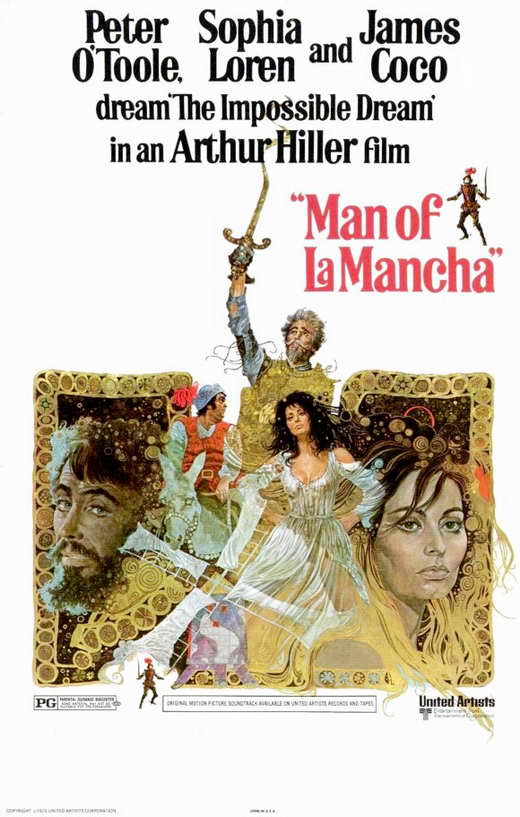
Man of La Mancha (1972)


To dream the impossible dream, that is the message (and frequently recurring lyric) that Miguel de Cervantes and Don Quixote (Peter O'Toole in a duel role) sing throughout Man of La Mancha, a 1972 movie-musical directed by Arthur Hiller.  Costarring Sophia Loren as "Dulcinea" (Aldonza), Man of La Mancha is adapted from a stage-musical that was in turn (very) loosely adapted from the novel Don Quixote, Miguel de Cervantes' magnum opus.


The film opens with Cervantes and his friend being arrested by the inquisition while performing in the street, they are brought to a prison where they are sized up by the prisoners.  The prisoners decide to hold a "trial" to determine if they are worthy or not; instead of a proper defense, Cervantes decides to put on a show performing the tale of Don Quixote with the prisoners as his troupe of players.  His story begins with Don Quixote and his portly squire Sancho Panza riding in the countryside in search of adventures befitting a knight errant.  After a battle with a savage giant (or windmill, depending on your level of sanity) he comes across an inn (castle) where he meets Aldonza ("Dulcinea"), a woman willing to do whatever it takes to survive.  As Don Quixote attempts to rid the world of evil through ill-conceived acts of chivalry, his worried family decides that they should take it upon themselves to cure him of his sudden bout with insanity; all the while, Cervantes waits to be brought before the inquisition.

It must be said that Peter O'Toole and Sophia Loren would have been perfect casting if this had not been a musical, but it is a musical, and that is where the problem lies.  The singing voices of O'Toole and Loren are clearly dubbed over, and not even with exceptionally good singing voices.  This, combined with poorly (and hardly) choreographed dance sequences, resulted in a series of thoroughly lackluster and underwhelming musical sequences.  The music in the film is passable, but hardly special when compared with music from superior musicals such as West Side Story.  


The film's narrative is strong, though the manner in which the narrative is delivered to the audience is befitting the stage and not the screen.  The plot, though differing greatly from its classic source material, has enough heft to make a both interesting and worthwhile film; and that is what makes it all the more disappointing that the film is both contrived and nearly unwatchable.

The largest problem that Man of La Mancha has is that it does not know what the message that it is promoting is.  The two separate messages it promotes are as follows: art is useful to prevent people from noticing their true problems (which is a great oversimplification of art's purpose) and that delusions are okay as long as they lead to some sense of purpose (even if the delusions are dangerous).  There are very few problems with a film that can be as fatal as not knowing what it is about (and Man of La Mancha does not have a clue).

In the end, there is only one thing that can really be said about this film: it is a failure.  Despite a cast of experienced character actors, and a pair of immensely talented leads, Man of La Mancha fails to live up to both the stage play and the novel it was based on.  I once had an impossible dream as well: I dreamed that this was a good film.

3/10

Note: This review was previously posted on another blog I wrote.

Breakfast at Tiffany's (1961)


The standard run-of-the-mill romantic comedy involves several, almost universal, details: two friends with undeniable chemistry, other romantic interests for each of the would-be lovers, and a schmaltzy scene at the end where they get together.  Blake Edwards' 1961 film Breakfast at Tiffany's is a standard run-of-the-mill romantic comedy in almost every detail, except for one: the two leads are both glorified prostitutes, and that makes all the difference.  Audrey Hepburn stars as Holly Golightly and George Peppard  plays Paul Varjak in this adaptation of Truman Capote's classic novel of the same name.  It was nominated for five Academy Awards and won two for best original score and best song.

The film centers on Paul Varjak, an aspiring (but not successful) writer and kept man, and his befriending and falling in love with his unique and off-beat neighbor Holly Golightly, an escort and gold-digger.  Holly, while intriguing and magnetic, is deeply troubled and has a hidden past that does not stay dormant for long.  Although adapted from the Truman Capote novel, the final product is considerably different from Capote's classic.  One major detail that is changed from the novel is the romance between Holly and Paul (unnamed in the novel); in the novel there isn't one.  The novel has richer themes and is more realistic in the way the plot develops, but the story is considerably less cinematic.

The acting in the film is uniformly adequate, with the exception of two performances that truly elevate the film to heights it would not have reached without them.  Audrey Hepburn, in possibly her most iconic role, as Holly Golightly is nothing short of magnificent and without her performance, the film would not be regarded as a classic.  It should be noted that Marilyn Monroe was Capote's preferred choice to play Holly, and was furious when the studio signed Hepburn.  It should also be noted: the studio made the right choice.  The other performance that must be acknowledged is the portrayal of Doc, Holly's much older husband from a past life, by Buddy Ebsen.  Ebsen makes the absolute most of his few minutes of screen-time and manages to illicit (necessary) reactions of pity and disgust from the audience.  Without Ebsen in the role of Doc, the rest of the film may not have meshed succesfully.  Peppard, though a lead, is merely adequate in his role and is completely overshadowed by Hepburn, who is at her most radiant.  An aspect of the film that detracts from the overall experience is the portrayal of Mr. Yunioshi by Mickey Rooney.  Rooney gives a broad stereotype of an Asian person that can only be described by one word: appalling.  It is completely unnecessary and his limited screen-time almost ruins the film's overall tone.

The film's score, composed by Henry Mancini, is phenomenal and sets the tone beautifully.  The song "Moon River", performed by Hepburn in character as Golightly, fits perfectly into the film and it is easy to see why both the score and the song won Oscars for Mancini.  In addition to the music, the cinematography is absolutely gorgeous and the shots of New York City captured by the crew have almost no equal in the cinema of any era.  The film is a demonstration of how good filming and a great score can elevate a film to new levels.

Breakfast at Tiffany's, though possibly not living up to its literary inspiration, is a very good example of a romantic comedy that knows what it is and makes the absolute most of it.  Though clearly not a comic or dramatic masterpiece, it is a demonstration of Audrey Hepburn in one her greatest roles and at her most luminous.  Overall it is a very good watch that has stood the test of time extremely well.

8/10

Note: This review was originally posted on another blog I wrote.

The Heiress (1949)


Shy and plain, the wealthy Catherine Sloper is courted by the charming and handsome Morris Townsend; her successful father suspects other motives than love for the attention Morris lavishes upon his daughter.  Adapted from Washington Square, the classic novel by Henry James, William Wyler's 1949 film The Heiress stars Olivia de Havilland, Montgomery Clift, and Ralph Richardson.  An examination the relationships between Catherine and Morris and between Catherine and her father, The Heiress showcases Wyler, de Havilland, and Richardson at their absolute best.

The film begins with Catherine Sloper (Olivia de Havilland) preparing for a party she is attending with her father (Ralph Richardson) and aunt, she decides to wear one of her mother's dresses: her father says she looks good in the dress, but not nearly as good as her mother did.  Catherine is both plain and painfully shy, and her father believes that she is of little worth aside from her wealth and will never find a respectable husband, though her aunt seems to believe otherwise.  At the party she meets the charming Morris Townsend (Montgomery Clift), who seems to be very much interested.  Over the course of a few days, Morris calls on Catherine several times, eventually her father invites him to dine with the family; at dinner it becomes apparent that he is penniless, while Catherine is poised to inherit a substantial sum. Morris and Catherine become engaged shortly thereafter, prompting much strife with her bitter father who believes (with very good reason) that he is only after her money.  Catherine and her father's battle of wills leads to a revelation that will shake Catherine to her core, and do irreparable damage to their (already strained) relationship and the relationship between Catherine and Morris.

Olivia de Havilland, as the heiress of the title, is simply phenomenal in the lead; she convincingly portrayed Catherine as the naive and emotionally starved girl she was at the beginning, as well as the bitter and jaded spinster she is at the end.  As the emotionally abusive Dr. Sloper, Ralph Richardson is great; he successfully conveyed  the disappointment, the bitterness, and the longing for the unattainable necessary to make the character work. In particular, his conveyance of the character's idealized vision of his late wife was subtle, but very effective.  It is hardly a stretch to imagine a child would be neglected in a household in which they are not worthy unless they equal the father's idealized vision of the late mother.  As Morris, Catherine's morally ambiguous would-be husband, Montgomery Clift gives one of his best early performances, though he is overshadowed by the masterful performances given by both de Havilland and Richardson.

The film's storyline has the right mix of drama, romance, and surprise to make it both a riveting and a memorable watch.  In contrast to most films of any era, I was unable to discern the ending of The Heiress until a final scene that is both triumphant and sorrowful.  The romance between Catherine and Morris is sweet at the beginning, it is hard not to smile while the love-starved Catherine is being wooed for the first time in her life, and extremely bitter at the end.  Though most romance films focusing on a gold-digging men trying to seduce a homely, but wealthy, woman are typically very black and white in their morality; that is not the case in The Heiress.  It begs a question often dismissed: can a marriage based on looks (Morris) and money (Catherine) be happy, or is love necessary?  Wyler does a very wise thing in the film: he asks that question, but chooses not to answer it, and that makes the film truly memorable.  

The technical aspects of the film are exceptional, it is filmed to great effect in black and white befitting the subject matter.  The makeup on Olivia de Havilland is done well; it makes her look plain (which she wasn't) and like herself, which is often difficult for makeup artists to do, even with today's technology.  The (Academy Award winning) costumes are phenomenal, the entire cast is able to perform well without looking out of place in the 19th century dress.

William Wyler, one of the most versatile directors in cinematic history, crafted a romantic-drama that is disturbing, shocking, and thoroughly memorable.  All in all, The Heiress is a masterpiece of the highest order, featuring one of the greatest performances by Olivia de Havilland (deservedly winning her second Oscar for the film), one of cinema's greatest actresses.

10/10

Note: This review was previously posted on another blog I wrote.

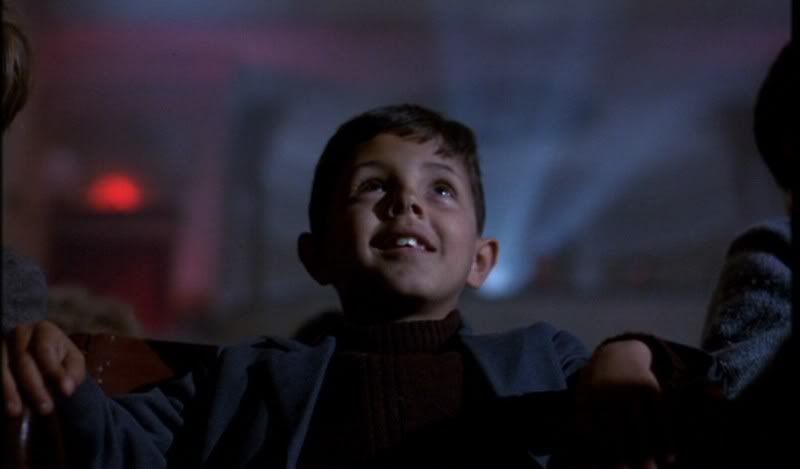
Cinema Paradiso (1988)


In a list of great films about the raw power of cinema, Italian director Giuseppe Tornatore's 1988 film Cinema Paradiso would almost always come in first.  There is not much I could say about this film that has not already been said, it won the Best Foreign Language Film Oscar and the Special Jury Prize at the Cannes Film Festival among countless other honors.  If you appreciate the power of the silver screen Cinema Paradiso will undoubtedly make you smile.


The film primarily concerns the growing up of young Salvatore "Toto" Di Vita and his relationships with his mentor Alfredo, his first love Elena, and his town's movie theater (the titular Cinema Paradiso).  Told mostly through flashbacks, Salvatore is a successful film director returning home for the first time in thirty years for the funeral of Alfredo.  It focuses on Salvatore as a young boy when he first made a connection with Alfredo (the theater's projectionist) and his adolescent years when he became the theater's projectionist and experienced the pangs of young love.  

The film is enjoyable all of the way through; that being said, the first half regarding the younger Salvatore and his falling in love with cinema is by far superior to the portion focusing on the adolescent Salvatore (which is also quite good).  The story is unabashedly manipulative, and while I usually dislike that particular trait: it works.  Some parts of the film tend to drag, but it is by no means a boring film and I can all but guarantee that a smile will form on your face (if one hadn't already) the moment the credits begin to roll.


If the film has a weak element, of which there are almost none, it would be the acting.  The actors that play Salvatore (all three ages) and Alfredo do exemplary jobs; and in the case of Alfredo: an extraordinary job.  Philippe Noiret can only be described as masterful in this heartbreaking performance (you will tear up when he says his goodbyes to Salvatore).  In stark contrast to Noiret's performance, many of the supporting characters are portrayed as wooden or caricatured and while it does not hinder the film on the whole, it is frustrating none the less.  

The film, while clichéd and manipulative, has a raw power that is just unmatched when it comes to almost every other film about the coming of age of a young man.  Part of this power must be attributed to the medium through which Salvatore finds himself: cinema.  The kiss-montage at the end of the film exemplifies this perfectly and gives the film a fitting send-off.  

As a fan of all genres, there are few traits I relish more in a film than the ability to blend genres successfully: Cinema Paradiso is near-perfect blend of drama, comedy, and romance.  If you are a fan of cinema and understand that a good film is so much more than just a time-waster: Cinema Paradiso demands to be seen.

9/10

Note: I felt it fitting that my blog, which sprung from my love of film, begins with the review of a film about the love of film.

Additional Note: This review was previously posted on another blog I wrote.

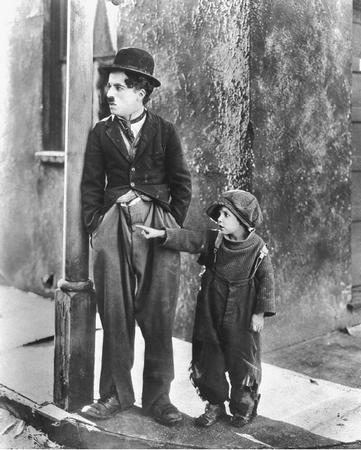
The Kid (1921)


Charlie Chaplin, potentially the biggest star to have ever come out of Hollywood, secured his enduring and unrivaled legacy with The Kid (he received a twelve minute standing ovation when he accepted his honorary Academy Award), a feature film that managed to seamlessly blend Chaplin's (considerable) comedic and dramatic talents.  Released in 1921, the film costarred the popular child-actor Jackie Coogan as the titular kid and Chaplin's frequent collaborator Edna Purviance as the kid's long-lost mother.


The film opens with a women holding a newborn son wandering around a city without a place to go or a means to feed her child; she reluctantly (and tearfully) leaves her child in a nice automobile located in an affluent area with a note pleading for them to take care of the child.  Through unforeseen events, the child winds up with the Tramp, Chaplin's lovable vagabond, who, after trying to pass off the infant on several people, becomes attached to the child and christens him John (Coogan's given name).  A few years pass and the Kid has become the Tramp's partner in crime and surrogate son.  A doctor, apalled at the squalor the two live in, informs the government that the Kid is not the Tramps biological son and has him taken away.  The Tramp's desperate attempts to recover the only family he has coincide with the mother's (who has become a success on the stage, that constantly regrets giving up her child) realization that the plucky child she befriended on the poor side of town is actually her long lost son.


Chaplin, one of the three great silent comics during the twenties (along with Buster Keaton and Harold Lloyd), set himself apart from the pack for two main reasons: his being the ultimate auteur (he produced, directed, wrote, scored, and acted for The Kid) and his understanding that gags can make a comedy funny, but pathos can make a comedy great.  His performance in The Kid is one of his best: it is at times incredibly funny, at times tragic, and at times both.  A rooftop chase to regain the Kid is both incredibly emotional and laced with humor throughout, very few actors can do this well, and none could do this as well as Chaplin.

The plot is simple (as is often the case with silent films), though it is both highly effective and fitting for Chaplin's strengths as an actor and director as well as fitting for the Tramp persona.  Hardly an hour long (give or take a few minutes), The Kid may lack complexity, but it more than makes up for it with its raw emotional power and the performances of Chaplin and Jackie Coogan as the lovable ne'er-do-wells at the heart of the story.  The Kid is also admirable because of its economy, there is not a scene in the film that does not forward the plot or develop the characters in some way (though there is a dream sequence that runs a bit long), and in an age of incessant CGI and transforming robots, that is something that should be cherished.

The Kid is Charlie Chaplin's first feature film, as well as being one of the best, most enduring films he ever made, and just about every film he made can be classified as a cinematic classic.  The Kid is, and will remain, a great film that should be seen by everybody at some point, even if they don't really care for silent film.

10/10

Note: This review was previously posted in another blog I wrote.

Batman (1989)


A mugging in a dark alley in the crime-ridden streets of Gotham, the muggers think they pulled it off without hitch, little do they know, the night hides someone else watching: the Batman.  Tim Burton's 1989 film Batman, starring Michael Keaton and Jack Nicholson, is often heralded (along with 1978's Superman) as one of the primary inspirations for the modern superhero film.  The film focuses on Batman's attempts to thwart the sinister plots of the newest and most deadly member of his rogues gallery: the Joker.  All the while, his alter-ego Bruce Wayne tries to charm Vicki Vale.  The supporting actors include Kim Basinger, Michael Gough, Jack Palance, and Billy Dee Williams.


The film begins with reports of a shadowy Batman stalking criminals in the night trickling through Gotham's underbelly: petty thieves, corrupt cops, and tabloid journalists.  A high-level mobster, Jack Napier, is betrayed by the mob boss Carl Grissom (Jack Palance) and is left horribly scarred.  Bruce Wayne meets and falls for Vicki Vale, the paper's new star photojournalist.  Napier, taking on the name "Joker," plots to take over the city's organized crime with a (substantial) bit of pizazz.  As Batman becomes something of an icon in the city of Gotham, the Joker, not one to be outdone, seeks to become all the more outrageous in order to become the favored "freak" among the citizenry; but Batman will not ignore the Joker's crimes and remain in his cave for very long.

The acting in the film is good, but not great.  Michael Keaton does good work in the lead, despite his being miscast; he only truly encompasses one (important) facet of the Batman character: the inner turmoil.  Batman is supposed to be one thing in particular, which Michael Keaton is not: physically intimidating.  Jack Nicholson is good as the Joker, even though Burton commits the (oft committed) fatal flaw of focusing on the villain and not the hero.  Kim Basinger does her job; her job being to portray the type of character first addressed as follows: "Hello Legs."  Michael Gough is good as the faithful butler Alfred, even if the character is underused and does some objectionable things that a superhero's confidante should never do (at least according to the generally agreed upon comic-book rules).


The Gotham city that Tim Burton and his crew created for the film is absolutely wonderful to behold.  Despite the obvious (and necessary) use of some matte paintings, the Gotham city seen in the film is both (relatively) realistic and comic-bookish.  Wayne Manor, Bruce Wayne's mansion home, is both luxuriant and slightly creepy, which is befitting the Gothic nature of the titular character and his alter-ego.  The vehicles used in the film are befittingly ridiculous and outlandish, but it would not be a Batman film without them; though I did find the Bat-plane a tad unnecessary and particularly outlandish.

The film's plot is fairly standard and does not do either the actors or the characters justice.  Many details of the plot seem unnecessary and forced (such as the Joker being the one who killed Bruce Wayne's parents).  The score, one of the earliest by Danny Elfman, is both good musically and is an excellent fit for the film in terms of subject matter and tone.

Despite having a severely miscast lead (though Michael Keaton does a great job, he just wasn't right for the role) and a confusion of who the film is about, 1989's Batman is a decent Batman flick, but is nowhere near the seminal superhero film many seem to remember it as; it is inferior to its sequel Batman Returns (granted it is far superior to both Batman Forever and Batman and Robin) and is far inferior to the Christopher Nolan films released in recent years.

6/10

Note: This review was previously posted on another blog I wrote.

Grave of the Fireflies (1988)


There is seldom a film that cannot only make viewers feel saddened, but that can also make them grieve: Grave of the Fireflies is one of those rare films.  Released in 1988 and directed by Isao Takahata, Grave of the Fireflies is one of the most acclaimed films from a studio (Studio Ghibli) that releases nearly every original effort to unanimous acclaim.  Focusing on a pair of young Japanese siblings during World War II that are forced by circumstance to fend for themselves amidst all of the falling bombs and limited food rations.


The film begins with a starving boy dying alone in a train station among a crowd that hardly gives him a passing glance, he then begins to narrate his tragic story.  During an air raid, Seita, a twelve year old boy, manages to guide himself and his five year old sister, Setsuko, to safety.  Upon returning to a makeshift medical clinic, Seita discovers that their mother has been severely wounded (their father is fighting in the war) and their house has been consumed by the flames.  Their mother's death leads to them being sent to live with an aunt in the countryside, with a select few possessions that they had buried in their backyard for safety.  Soon, however, an initially warm welcome turns to coldness and, eventually, open hostility against the children for not doing their part in the war effort.  Seita and Setsuko soon move out of their Aunt's home and take up shelter in an abandoned bomb shelter.  A new lease on life quickly becomes desperation as the children slowly succumb to starvation.

Takahata crafted one of the most beautiful (and heartbreaking) animated films to ever be released; set primarily in the Japanese countryside, the gorgeous scenery manages to offset the horrific subject matter just enough to avoid distracting from the film's darker aspects.  In the typical anime fashion, the characters have enlarged eyes and exaggerated facial features; these details allow for the effective and easy conveyance of emotions, and the technique is very effective here.  The animation, though beautiful, is at times both shocking and horrifying, such as when Seita sees his mother's bloodied and bandaged body after the air raid.


The film's greatest strength is its acknowledgment of what war can really do to the people left behind.  Many films about the non-soldiering victims of war seem to portray the adversity as a means towards the affirmation of some noble character's morality (think Schindler's List).  In Grave of the Fireflies there is no moral issue, the anti-war message being an exception, the only issue for the characters in this particular film is survival.  Throughout the film, Seita and Setsuko demonstrate their desperation and their willingness to do whatever it takes to survive, whether it be scavenging for food or theft.


The film's narrative is strong, though the story is not inherent to WWII Japan; the same narrative (with some tweaks) could have taken place in nearly any war-torn country on the recieving side of an invasion.  The supposed anti-American message that some people claim to perceive in the film, is non-existent.  In fact, I do not believe that there is any mention of the United States at any time during the film.

Grave of the Fireflies is a truly great film and, despite its being animated (which is not a medium only for children), is both a very adult and profoundly moving effort from director Isao Takahata and Studio Ghibli.  I have only one thing to say to you if you are not saddened by this film: you are not human.


10/10

Note: This review was previously posted on another blog I wrote.

Thursday, November 1, 2012

High Noon (1952)


Cinema, despite its indisputable international nature, often has genres or themes that are closely tied with a particular region or nation; perhaps no instance of this is as notable as the Western's intimate link, both thematically and geographically, with the United States.  High Noon is a Western film unlike any other that had preceded it, its inherent uniqueness primarily stems from its nearly unheard of decision to allow its characters to move beyond the typical stereotypes of the fearless hero, the dutiful sidekick, and the supportive wife and townspeople.  Directed by Fred Zinnemann, the film stars Gary Cooper as Sheriff Will Kane with Grace Kelly, and Lloyd Bridges in supporting roles as his new bride and his deputy, respectively.


The film opens with Will Kane, a respected and highly competent sheriff in a small town, being married to his young Quaker bride Amy in a courthouse.  The newlyweds plan on leaving town that morning to open a general store somewhere where his violent profession and her haunted memories (both her father and brother were gunned down previously) will not sour their marriage.  Their happiness is short-lived as news comes in that the most dangerous man Kane ever put behind bars, Frank Miller, is out on a legal technicality and arriving on a train that morning with the intent to murder Kane and reclaim the town he once controlled.  Kane determines to stay in town to face both his enemy and his fears, while the townspeople remain inactive due to their own fear of Miller's retribution.  Amy, a pacifist, refuses to accept Kane's reasoning that Miller would follow them until Kane was dead if he did not face him now and threatens to leave without him.  His deputy sees Kane's bravery and determination as insulting to his own character, causing him to back away from his duties and lash out against Kane; this causes a rift with his lover Helen Ramirez, who had been involved with the honor-bound sheriff in the past.  As the clock ticks along, Kane's internal struggle with his fears, his duties, and the revelation of the true character of all of the people that he had protected during his years as sheriff comes to a head when he goes out alone to face the man intent on making his new bride a widow.

High Noon, at first glance, appears to be a standard, run-of-the-mill Western film, of the sort that Cooper had starred in prior to (and after, for that matter) High Noon.  The changes to the standard format implemented by Zinnemann and the writers are inspired.  The use of real time allowed for the tension that the audience feels while watching to build in tandem with the fear and hesitation felt by Kane.  Real time, though not unique to the film, is used in such a way that the film is able to seem both frantic and meditative simultaneously; the combined effect packs a blow aimed squarely at those blacklisting artists in Hollywood powerful enough to cause those who were preaching in favor of McCarthyism to lash out in protest and rage. John Wayne and Howard Hawks were appalled enough by the film to make Rio Bravo in protest, the film was decent but is hardly the masterwork or genre-transcending film that High Noon is.

The greatest strength that High Noon as a film possesses is the performance of Will Kane given by Gary Cooper.  Cooper, one of cinema's most beloved and enduring stars, took the character of the small town sheriff and did something unheard of at the time: he portrayed the hero as human.  Kane asked for help, he showed apprehension, and he struggled with his choices, but he still showed up to face his fears and defend himself and the town that essentially turned his back on him.  The willingness to have the hero be a character worth admiring and emulating, as well as someone with the potential for fear and failure elevated High Noon into the  upper echelons of Western cinema, and cinema in general.  The other actors in the film perform ably, especially Lloyd Bridges as the immature and petty deputy who cannot conceive of why Kane would stand and fight alone when he could so easily run.  Grace Kelly is nice to look at, but her performance as the pacifistic Amy is stale and does not demonstrate her skills as an actress like later films (particulalry those directed by Alfred Hitchcock) would.

All in all, High Noon is both an enjoyable Western and a fascinating parable on the foolishness of assuming that those around you are also willing to protect and assist you in times of crisis (whether that crisis is a villain arriving on a train or a senator obsessed with rooting out communists).  Gary Cooper gives one of his best performances as Will Kane and proved, for the umpteenth time, why he was and is one of America's favorite movie stars.  High Noon is not a long film, but it still remains one of the biggest ones, in terms of importance and daring, to have ever been filmed.


10/10

Note: This review was previously posted on another blog I wrote.