Showing posts with label Action. Show all posts

Wednesday, November 7, 2012

Arrow S1/E05: "Damaged" Review

Arrow has been a certifiable hit for The CW, and "Damaged", the series' fifth episode, makes a pretty good case as to why. Picking up where the previous episode left off, Oliver has been arrested for being "the Hood" (what a ridiculous notion) by Detective Lance, who is not keeping his personal feelings separate from his work. As always, spoilers ahead.

Oliver's stint as a vigilante may be at an end as he had been caught on camera with some of his Green Arrow-gear...or not, most likely not, especially since getting caught is all a part of his larger plan. Flashing back to his time on the island, the show reveals the first time he shot an arrow (badly), how he met Deathstroke and recieved some of his first scars (painfully), and indicates that the Oliver of the old was not completely the selfish cad he had been indicated to be. In the present, however, Oliver has drafted Laurel as his defense attorney (despite the six or seven conflicts of interest) and is planning to throw a prison-themed party while under house-arrest. Meanwhile, Walter is uncovering some of his wife's dirty secrets, Moira is still dealing with the cryptic "well dressed man", Thea is becoming suspicious of Oliver, and Diggle dawns the hood while Oliver is trapped at home.

The series, though still maintaining a villain of the week, seems to be moving towards a more a serialized narrative. The focus in this episode is on character progression, with the taking down of a nasty arms dealer seeming to be more of an afterthought than anything. The only major character actually not receiving any sort of legitimate development is Tommy, who is onscreen only briefly. The episode's A-plot is predictable, though solidly handled, but the subplots are more surprising, which keeps the episode tense throughout.
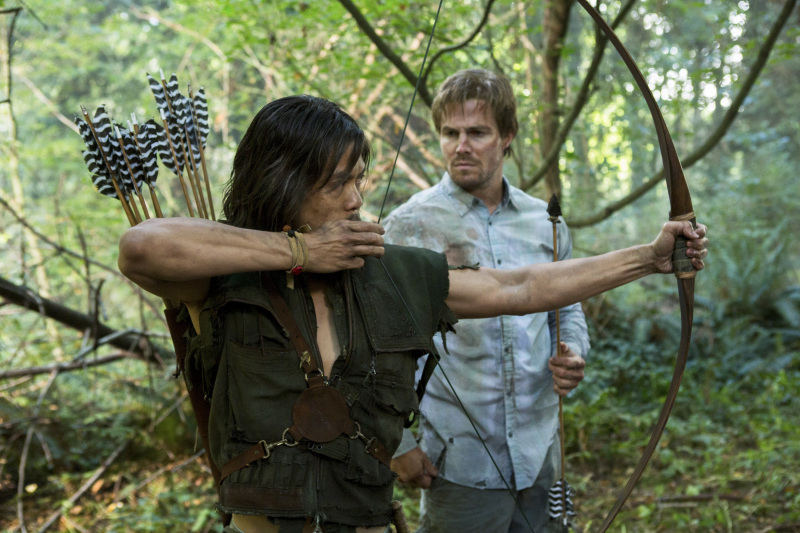


The episode also addresses some issues with the characters I had noted from the previous episodes, and new wrinkles to characters at risk of becoming stale. Laurel has finally asked if Oliver suffered like she did during the five years he was on the island (he definitely did), which, for a character seemingly quite intelligent and compassionate, was overdue. Thea has become legitimately skeptical of Oliver's story, and appears to be researching the arrowhead "trinket" Oliver gave her, despite his assurances that it was bought at the airport. In addition, Moira may not be the villain she originally appeared and Walter seems to be a legitimately good fellow (which was a nice surprise). And maybe most importantly, this episode establishes that Diggle is going to be a partner, and not a sidekick: he had very little trouble donning the hood and stopping an arms deal all by himself.


Two of the highlights of "Damaged" were the fight scenes between Oliver's island mentor and a silent Deathstroke, as well as between Oliver and an assassin sent to take him out. The fight choreographer deserves special praise for the sequences: they lack the fast cuts and use of stunt doubles so common in television hand to hand sequences. There is also some good attention to detail: Oliver and Lao Fei, his mentor, both use a couple of the same moves during their bouts.

The acting on the show has improved as the characters have become more fleshed out, particularly the performance of Stephen Amell as Oliver Queen. Amell, who I had thought a bit wooden, ably plays the different versions of Oliver: the naive and immature Oliver of five years ago, the brutal and confident vigilante Oliver, and the light-hearted, slightly withdrawn Oliver he presents to his family and the world. Katie Cassidy, as Laurel, does good-work, though she tends towards the melodramatic. Willa Holland, as Thea, is doing a good job with the limited screen time she gets and Paul Blackthorne is solid in the somewhat thankless role of Detective Lance.

Arrow is improving as it goes, and considering it was good to start with, the CW may have something special on their hands should they keep up the good work.

8/10

Additional Notes:

  • Laurel: "Ah, yes. I wore those horrible fishnets." (if only she knew the outfits to come)
  • Oliver: "You know us billionaire vigilantes, we do love our toys."

Friday, November 2, 2012

Ben-Hur (1959)


When one thinks of a big Hollywood spectacle, Ben-Hur, the 1959 (and third) adaptation of Lew Wallace's 1880 novel Ben-Hur: A Tale of the Christ is one of the first films to pop into one's mind.  At the Academy Awards it won a record eleven Oscars (a feat that has been equaled twice, but never surpassed) and was the highest grossing film of 1959.  For the film, director William Wyler won his third directing Oscar and star Charlton Heston won his only acting Oscar.

The film focuses on the trials and tribulations of Judah Ben-Hur, a rich and respected Jew living in Jerusalem who seeks both peace and vengeance.  The film opens with the nativity scene and then skips to the reuniting of Judah and his childhood friend Messala.  Messala has returned a proud and ambitious Roman seeking nothing more than to appear impressive to the emperor.  Driven by his ambition, he tries to force Judah to give up names of dissenting Jews in Jerusalem.  Judah refuses and Messala has him sent to the galleys and his mother and sister are imprisoned; Judah never loses his desire for vengeance.  All the while, there is talk of a new prophet throughout the land.

The film is considerably long, at over three and a half hours, and tends to drag considerably at points.  The story is a complex one and necessitates the lengthy runtime, although I cannot help but feel that the shaving off of thirty minutes or so could have helped the film move more quickly.  The religious themes will be appreciated by many, though others may find them overly abrasive.  As it stands, Ben-Hur has a sufficient story to support its vast scope and ambitious vision.


One element of the film that must be mentioned is the phenomenal chariot-race scene.  The scene, filmed over fifty years ago over the course of three months, is still a wonder to behold, all the more impressive because it was filmed decades before the use CGI in cinema.  I have yet to see a match for it in any film since in terms of thrills and ability to awe.

The acting in the film was exceptional throughout, particularly the work done by Charlton Heston in the lead role of Judah Ben-Hur.  Heston, one the greater movie stars of the era, gave the performance that has come to define his career in the years since in this film.  The supporting cast also did an admirable job in their roles; particularly Stephen Boyd  in the role of Messala and Jack Hawkins as Quintus Arrias.

The film, though possibly not of best picture quality, is one of the stand-outs of the epic and sword-and-sandal genres.  While not without its faults, Ben-Hur is an epic that is well worth the time to watch it and shows star Charlton Heston and director William Wyler in top form.

7/10

Note: This review was previously posted on another blog I wrote.

Batman: The Movie (1966)


Years before the Christopher Nolan Batman films there were the Tim Burton Batman films; years before the Tim Burton Batman films there was this: 1966's gloriously campy and compulsively watchable Batman: The Movie.  Directed by Leslie H. Martin, it stars Adam West as Batman and Burt Ward as Robin the Boy Wonder in addition to a (pardon this, I am in the mood for wordplay) fearsome foursome of foes: the Joker, the Riddler, the Penguin, and Catwoman.  Sporting a incoherent plot and holy-let's-just-go-with-it-Batman attitude, it stands in stark contrast to the much darker and grittier Nolan films and serves as an example of how to properly do a campy superhero movie (take note, Joel Schumacher).

The plot of the film involves the standard superhero plot: deadly villains, theme gadgets, and a taking-the-world-hostage sort of evil scheme.  Batman and Robin answer an urgent cry to save a stolen ship (with deadly new invention aboard) and end up battling a shark (mid-air) while the ship apparently disappears.  Following vague clues, they manage to deduce that the scheme has been formulated by the Penguin, the Joker, the Riddler, and Catwoman (Burgess Meredith, Cesar Romero, Frank Gorshin, and Lee Meredith).  The villains hatch a plan to lure Batman to them by having Catwoman, under the guise of the Russian Miss Kitka, seduce a millionaire and, through kidnapping him, bait Batman.  Naturally, the millionaire chosen is none other than Bruce Wayne, Batman's alter-ego.  Being the ladies man he is, he deems the seductive "Kitka" worthy of (actual dialogue) "International Relations."  He promptly escapes their grasp and seeks to stop there dastardly scheme.  The specifics of the scheme are not important, some key points are as follows: a billion dollars, a penguin-based submarine, and a means of dehydrating world leaders.

The plot of the film, though clearly ridiculous, is ideal for the campy tone and is utterly hilarious when viewing the final product.  The scheming done by the four antagonists is so out-there and incomprehensible it would make the writers of the James Bond films starring Roger Moore blush.  All that being said, the writing of the film is so ridiculous and over-the-top that it becomes endearing.  "What is six ounces, sits in a tree, and is extremely dangerous? A sparrow with a machine gun."  By the end of the film the Riddler's ridiculous riddles, such as that one, that Batman and Robin solve with apparent ease, almost make sense, almost.  For this, the writers must be given credit, nothing except for good writing could account for such a miraculous and shocking thing.

The acting of the film is excessive, hammy, and unbelievably fun to watch.  As our caped crusaders, Adam West and Burt Ward embrace the material with a veracity that inspires not a small amount of awe, and not a small amount of pity.  The quartet of villains also go hammy and generally succeed in doing so; though they are not quite as successful as one would hope.  Of the four, only Lee Meriwether as Catwoman really stands out.  The other three villainous roles seem as if they could have been condensed into one without losing much of their effect.  Meriwether replaced Julie Newmar (who appeared as Catwoman on the television series) and she created the cat-suit that was to be filled when Michelle Pfeiffer would slip into it over thirty-five years later.

Another facet of the film that must be mentioned is the amount of bat-gadgets that are in the film.  I counted four different vehicles used by the Dynamic Duo: the Bat-Mobile, the Bat-Copter, the Bat-Cycle, and the Bat-Boat.  In addition to that, they have a Bat-Ladder (a rope ladder with a sign that says "Bat-Ladder") and Shark Repellent Bat-Spray among many, many others.

Overall the film is highly enjoyable and so campy it makes one want to start singing "Camptown Races" around a fire.  If you want to see a gritty Batman film that also creates a realistic human-drama: see Christopher Nolan's Batman Begins and The Dark Knight.  If you want to see a hammy, over-the-top action film with physical comedy taken directly from the films of Charlie Chaplin: see Batman: The Movie.  As a parody of the super-hero genre, it is, to quote my favorite villainous feline, "Purr-fect."

8/10

Note: Though the official name of the film is Batman, it was marketed as Batman: The Movie.  I credited as the latter to avoid confusion with the Tim Burton film of the same name that I will eventually review.

Additional Note: This review was previously posted on another blog I wrote.

The Mark of Zorro (1920)


A tavern full of corrupt soldiers complains of a masked vigilante fighting for the poor and the oppressed: Zorro.  Douglas Fairbanks stars as the dashing hero in one of his first swashbuckling roles (in one of the first swashbucklers) in the first cinematic adaptation of the iconic Zorro character: The Mark of Zorro.  Directed by Fred Niblo, one of early cinema's most important innovators, the silent film was released in 1920 and became a huge hit at the box office, turning the athletic Fairbanks from a comic actor into a swashbuckling superstar.

The film is set in a Spanish controlled California, where the government has been increasingly oppressive and corrupt to the natives and the poor.  A few months prior to the beginning of the film, the apparently foppish Don Diego Vega has returned home from being educated in Spain.  Shortly thereafter, reports began circulating about a masked vigilante, Zorro, terrorizing those who abuse their power and oppress the weak.  Don Diego's father, frustrated with his effete and seemingly idle son, informs him that he needs to marry; the lovely Lolita Pulido, of a good family with current financial troubles, is his fiancĂ©-to-be of choice.  Lolita despises (with good reason) Don Diego for his behavior and rudeness, (while courting, it is probably best not to say finding a wife is "such a nuisance") but falls for the charming and dashing Zorro.  As the manhunt for Zorro heats up, Lolita and everyone else will be shocked by Zorro's (timely) revelation of his true identity: Don Diego Vega.

Douglas Fairbanks, though not a great actor in the traditional sense, had the tools that made him a (if not the) ideal swashbuckling hero: he sparkled with ebullience in every scene, he had a charisma and natural screen-presence almost unmatched among the screen-stars of any decade, and he had a prodigious athletic ability that make his stunts (done without the use of special effects) breathtaking both then and now.  The supporting players are game and charismatic, the two qualities required of a supporting actor in a film such as this.  Though every performer does their job well, Fairbanks truly steals the show; it is no mystery why he was asked to portray many of the other great swashbuckling heroes after this film (D'Artagnan, Robin Hood, the son of Zorro).

Though The Mark of Zorro is a silent film, the use of the intertitles does not slow the film's pace or hinder the enjoyment of it.  The film's lack of special effects and its relatively low quality picture could have doomed a film this action heavy, but Niblo's direction and Fairbanks athleticism prevented this high-quality adventure from being a disaster.  The sword-fighting  scenes in the film, though lacking in the (relative) realism and skill demonstrated by those performed by Basil Rathbone and Errol Flynn (among other actors) years later, are enjoyable and exhilarating nonetheless.  The score, comprised of organ music, is fitting the film and is essential is creating the correct tone for the film; the fact that it is a silent film necessitates the use of the music in setting the tone for the action.  

As the film in which Douglas Fairbanks proved his merits as a swashbuckling hero, it is fitting that The Mark of Zorro be both gloriously pulpy and entertaining from the first moment to the last: the film delivers on both counts; though the film does not contain much in the way of depth.  All in all, The Mark of Zorro is a thoroughly memorable adaptation of Johnston McCulley's classic pulp novel The Curse of Capistrano, despite the lack of special effects or spoken dialogue.

8/10

Note: This review was previously posted on another blog I wrote.

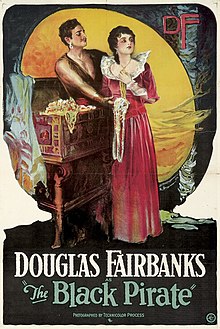
The Black Pirate (1926)


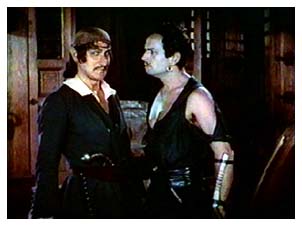
There are certain films that become truly surprising, years after their release, for reasons that have absolutely nothing to do with its storyline or acting; The Black Pirate, Albert Parker's 1926 swashbuckler starring Douglas Fairbanks, has become surprising because it is a silent film that just so happens to be in Technicolor (albeit two-tone, but Technicolor nonetheless).  One of a series of swashbuckling vehicles for Fairbanks released during the 1920s, The Black Pirate casts the athletic superstar as a young Duke seeking revenge for his father's death by taking the guise of a unnamed buccaneer and joining the company of pirates that did the deed.

A group of pirates blow up a captured ship, via the ship's powder magazine, with all of the occupants still on board.  The ship's sole survivors, a Duke and his son, are washed ashore on a deserted island; the father soon dies, leaving his signet ring and dukedom to his son, who vows to avenge his father's death.  Through a mixture of coincidence and convenience, the pirates disembark on the same island to bury their horde of treasure.  The son, adopting the mysterious (and catchy) moniker of the Black Pirate, walks up to the pirates and proclaims his desire to join the crew.  Following the proving of his worth (he has a victorious duel with the captain and he captures a large ship singlehandedly), the crew enthusiastically endorses their new recruit as fit for being their new captain, much to the dismay of the previous first mate.  What follows is a series acrobatic fights, the predictable wooing of a for-some-reason-their princess, and the inevitable revelation of his true identity.

The Black Pirate, is one Fairbanks' weaker swashbucklers in terms of both plot and character.  While almost all silent films rely on formula, formula does not have to be used in a boring manner: and The Black Pirate certainly uses it in a boring manner.  Absolutely nothing distinguishes it from the countless other revenge on the high seas flicks that have been released over the years, except for Douglas Fairbanks.  The plot of the film boils down to one clichĂ©d scene after another, with a damsel in distress, portrayed by Billie Dove, thrown in for good measure.  Douglas Fairbanks is at his uncannily acrobatic best here (some of his stunts are jaw-dropping), though it is a shame he can't elevate the material beyond the piece of (mildly) diverting fluff it is.

The real appeal of The Black Pirate lies in the fact that it is an intriguing curio from the silent era; it is one of the first films to be released entirely in color, albeit in two-tone Technicolor (which has a limited spectrum in comparison to later Technicolor).  In fact, Fairbanks, who was heavily involved with the film's production, invested a considerable amount of money in developing the process that made color films a reality.  The Black Pirate was recently selected for preservation in the National Film Registry: it did not get that recognition because of its merits, it got it because of its (very) early use of Technicolor.

The Black Pirate is not a particularly good silent swashbuckler, especially when compared with other Fairbanks films, but it is a fairly competent if underwhelming pirate flick.  The film's primary appeal is the viewing of a 1920s silent film in color; the strangeness wears off eventually, but it is enough to make it worth a watch if you have an interest in early cinema.


5/10

Note: This review was previously posted on another blog I wrote.

Captain Blood (1935)


Errol Flynn and Swashbucklers, has there ever been an actor more associated with a particular genre?  Possibly, but that does not change the fact that Flynn epitomized the swashbuckling hero in a way no other actor (with the possible exception of Douglas Fairbanks) to ever grace the silver screen has.  Michael Curtiz's 1935 film Captain Blood, based on Rafel Sabatini's classic novel of the same name, was Flynn's first starring role, and he tackled it with the gusto of a seasoned professional; his costar (in the first of their eight pairings) was Olivia de Havilland, with the villains portrayed by Lionel Atwill and Basil Rathbone.

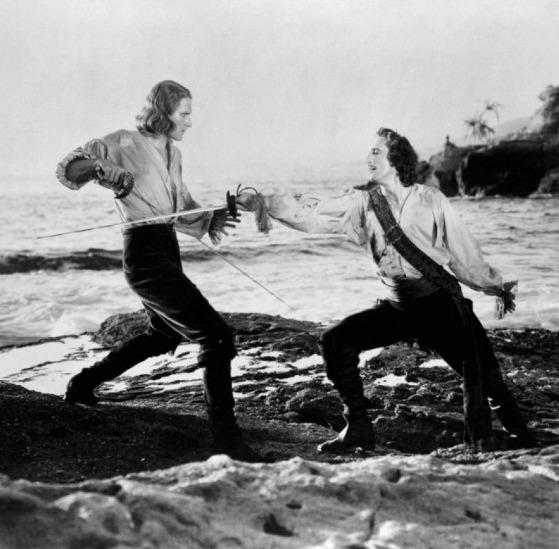
The film opens with Dr. Peter Blood being summoned in the night by Jeremy Pitt (Ross Alexander); he then proceeds to aid a friend wounded in the Monmouth rebellion.  He is arrested for treason and condemned to death by hanging along with countless other "true rebels".  On a whim of King James, Blood and a few others are sent to be sold as slaves in the Caribbean.  He is bought by the lovely Arabella Bishop (Olivia de Havilland) and is sent to work on the plantation of her uncle: Colonel Bishop (a deliciously sinister Lionel Atwill).  Sparks fly between Blood and the young Miss Bishop, even as Blood resents her immensely for her name and her ownership of him.  As luck would have it, the governor of the island has the gout and requires the care of a skilled physician: enter Peter Blood.  Blood and his fellow slaves plot escape, and an attack by the Spanish provides them an ideal opportunity.  Sneaking aboard their ship in the night, they are able to capture the ship and decimate the Spanish with cannon-fire.  Their coup is completed by their being able to escape with the ransom paid for by Colonel Bishop and by their humiliating the Colonel (Can you swim, Colonel?).  Desperation dictates their path: they become a crew of buccaneers led by Captain Blood.  While Captain Blood's fearsome reputation spreads rapidly throughout the Spanish main, he never forgets Arabella and despises the nature of his profession (he has a strict code of conduct for his crew that other pirates scoff at).   An alliance with another pirate, Levasseur (Basil Rathbone), sets Captain Blood on a collision course with both Arabella and the possibility of redemption.

Errol Flynn and Olivia de Havilland, in their first starring roles, are magnetic as Captain Blood and Arabella Bishop.  As Colonel Bishop, Lionel Atwill does a wondrous job as a man with both power and an inflated ego that has been spurned and humiliated by a (gasp) slave.  Basil Rathbone is adequate, in terms of acting, as the French buccaneer Levasseur, but does what he was really hired to do (Rathbone had a reputation as the best fencer in Hollywood) magnificently.  The duel between Captain Blood and Levasseur was both exhilarating and remarkably complex for a film from the thirties.  The supporting players (Guy Kibbee, Ross Alexander, Henry Stephenson, among others) all do good jobs with their limited screen-time.  Though the other performers give good performances, Flynn dominates the picture with his swagger and charisma.  While watching, it comes as a surprise to note that this was his first lead (or even substantial) role; it is not a surprise that this is the role made him a star.  Olivia de Havilland is radiant in the role of Arabella Bishop and makes the most of her limited screen-time.  The on-screen pairing of de Havilland and Flynn was a risk, as both were unknowns, but the decision was brilliant: who else but Flynn could have played Blood?

The direction in the film is phenomenal, from the action scenes to the clever use of shadows, Curtiz does some of his best work in Captain Blood.  Better known for his films Casablanca and The Adventures of Robin Hood (which also stars Flynn, de Havilland, and Rathbone), Michael Curtiz is often regarded as one of the most important and popular directors of early Hollywood.  The naval battle scenes (filmed with complex and accurate miniatures) are fantastic and surprisingly realistic considering the lack of CGI.  The set design is outstanding: it lends the film a considerable amount of legitimacy and effect on sight, something many other swashbuckling films lack.

A facet of the film that is of particular note is the score, one of the first composed by Erich Wolfgang Korngold.  The score is both rousing and memorable, and is a large part of what makes the film so immensely enjoyable.  The scores of Korngold are matched in influence only by (possibly) the scores of John Williams, such as those he composed for Star Wars and Superman.  What makes Korngold's feat all the more impressive is that the score, which is over ninety percent original material, was composed in a mere three weeks.  

Though it may lack the production values and fantastical elements of more recent pirate films (The Pirates of the Caribbean franchise, for example), Captain Blood still sets the bar for pirate adventures, with Flynn and de Havilland truly making it a (please forgive me for this lone nautical pun) voyage to remember.

8/10

Note: This review was previously posted on another blog I wrote.

Batman (1989)


A mugging in a dark alley in the crime-ridden streets of Gotham, the muggers think they pulled it off without hitch, little do they know, the night hides someone else watching: the Batman.  Tim Burton's 1989 film Batman, starring Michael Keaton and Jack Nicholson, is often heralded (along with 1978's Superman) as one of the primary inspirations for the modern superhero film.  The film focuses on Batman's attempts to thwart the sinister plots of the newest and most deadly member of his rogues gallery: the Joker.  All the while, his alter-ego Bruce Wayne tries to charm Vicki Vale.  The supporting actors include Kim Basinger, Michael Gough, Jack Palance, and Billy Dee Williams.


The film begins with reports of a shadowy Batman stalking criminals in the night trickling through Gotham's underbelly: petty thieves, corrupt cops, and tabloid journalists.  A high-level mobster, Jack Napier, is betrayed by the mob boss Carl Grissom (Jack Palance) and is left horribly scarred.  Bruce Wayne meets and falls for Vicki Vale, the paper's new star photojournalist.  Napier, taking on the name "Joker," plots to take over the city's organized crime with a (substantial) bit of pizazz.  As Batman becomes something of an icon in the city of Gotham, the Joker, not one to be outdone, seeks to become all the more outrageous in order to become the favored "freak" among the citizenry; but Batman will not ignore the Joker's crimes and remain in his cave for very long.

The acting in the film is good, but not great.  Michael Keaton does good work in the lead, despite his being miscast; he only truly encompasses one (important) facet of the Batman character: the inner turmoil.  Batman is supposed to be one thing in particular, which Michael Keaton is not: physically intimidating.  Jack Nicholson is good as the Joker, even though Burton commits the (oft committed) fatal flaw of focusing on the villain and not the hero.  Kim Basinger does her job; her job being to portray the type of character first addressed as follows: "Hello Legs."  Michael Gough is good as the faithful butler Alfred, even if the character is underused and does some objectionable things that a superhero's confidante should never do (at least according to the generally agreed upon comic-book rules).


The Gotham city that Tim Burton and his crew created for the film is absolutely wonderful to behold.  Despite the obvious (and necessary) use of some matte paintings, the Gotham city seen in the film is both (relatively) realistic and comic-bookish.  Wayne Manor, Bruce Wayne's mansion home, is both luxuriant and slightly creepy, which is befitting the Gothic nature of the titular character and his alter-ego.  The vehicles used in the film are befittingly ridiculous and outlandish, but it would not be a Batman film without them; though I did find the Bat-plane a tad unnecessary and particularly outlandish.

The film's plot is fairly standard and does not do either the actors or the characters justice.  Many details of the plot seem unnecessary and forced (such as the Joker being the one who killed Bruce Wayne's parents).  The score, one of the earliest by Danny Elfman, is both good musically and is an excellent fit for the film in terms of subject matter and tone.

Despite having a severely miscast lead (though Michael Keaton does a great job, he just wasn't right for the role) and a confusion of who the film is about, 1989's Batman is a decent Batman flick, but is nowhere near the seminal superhero film many seem to remember it as; it is inferior to its sequel Batman Returns (granted it is far superior to both Batman Forever and Batman and Robin) and is far inferior to the Christopher Nolan films released in recent years.

6/10

Note: This review was previously posted on another blog I wrote.

Castle in the Sky (1986)


A gang of pirates, a group of mysterious government agents chasing an orphaned young girl, a stone with mystical powers, and a plethora of familiar tropes from the steampunk aesthetic are just a few of the many pleasures that Hayao Miyazaki's 1986 film Castle in the Sky offers.  The first release from Studio Ghibli, the famed Japanese animation powerhouse founded by the renowned animation directors Hayao Miyazaki and Isao Takahata.  Made before Miyazaki became the world's premier animator with films such as Princess Mononoke and Spirited Away, it shows him while he was just beginning to incorporate many of the themes and elements present in his later films (as does his previous effort, Nausicaä of the Valley of the Wind).


The film begins with a girl, Sheeta,  under strict watch aboard an airship; a pirate raid provides her with a chance to escape, however she slips off the side of the ship and falls.  As a mysterious stone she wears as a pendant begins to glow and slow her fall to a safe speed, a boy of the same age, Pazu, sees her as she falls and catches her.  The next morning she wakes up in the boy's home (he is an orphan and lives alone); they become fast friends, though the pirates and government agents are hot on her trail.  Sheeta and Pazu make their escape and realize that Sheeta is being pursued because of her connection to the mythical floating island of Laputa.  Sheeta is captured by the government agents, led by the dastardly Colonel Muska.  Pazu teams up with the pirates to rescue Sheeta, beginning a race to Laputa between Muska and the young pair, with consequences far greater than who gets the treasure.

The animation in the film, as is the case with all Miyazaki films, is both impeccable and gorgeous.  The world in which the story takes place, similar to Europe of the early twentieth century (my best guess), is beautifully realized with vivid colors and a level of detail normally not usually seen in animated films.  An example of this is present on the airship of the pirate gang, unlike the many films that make advanced vehicles spotless and images of efficiency.  That is not the case here; it is how I would imagine a pirate ship would be: it is cluttered, in desperate need of repair, but it gets the job done (not unlike the Millennium Falcon in the Star Wars trilogy). Many of the scenes taking place in the clouds are shockingly realistic, particularly for a hand-drawn animated film.

The two lead characters are well-rounded and likable; both of characters are intelligent, brave, self-sufficient, and spunky.  It is also refreshing to see orphaned children on film that developed into strong young people and not bitter young people.  Pazu is a character that many people can identify with; he works (hard) in a mine, but dreams of the sky.  Pazu is reminiscent of many a young man, when he is told to sneak out the back-door with Sheeta: he is appalled at the apparent cowardice of the act; when he is told to protect her: he swells with pride, and proceeds to sneak out the back-door with Sheeta.  Muska is one of Miyazaki's only traditional villains; he lacks any redeeming qualities, though he does provide a sense of legitimate menace (he pulls a gun on a child, and fires)  that is often lacking in both animated and family films.  The gang of pirates is different from most others portrayed on film for two reasons: it is led by a woman, and it is a family affair (a mother, a father, and a bunch of sons).

If one is familiar with other Miyazaki works, many of the themes present will be familiar.  There is a subtle environmental message, although it is far less prevalent than in some of his other works.  A more prominent theme is that (the prospect of) absolute power corrupts absolutely.  Miyazaki, a feminist, has a penchant for having strong, young female characters as the protagonist (in this case, one of the protagonists); Sheeta fits into this category well, courageous and intelligent, she demonstrates from the opening scene she is not a mere damsel in distress.

Castle in the Sky is a thoroughly entertaining animated fantasy film that happens to be the rare family film that is actually enjoyable for the entire family, and not just the little kids.  Though it lacks some of the subtlety that has been trademark of more recent Miyazaki films, it is still a truly exceptional family film and a rollicking adventure story that just so happens to be a wonderful to look at.

9/10

Note: I watched the film in the original Japanese with English subtitles and not with the English dubbing.

Additional Note: This review was previously posted on another blog I wrote.

Mad Max (1979)


An empty highway in a dystopian Australia, marked only by the few small settlements alongside it: this is the bleak world that George Miller's 1979 cult classic Mad Max inhabits.  One of the great low-budget success stories of all time, Mad Max made a star of Mel Gibson, in his first major as Max Rockatansky (the titular "Mad Max"), a policeman patrolling the barren highway.  As one of the films that brought Australian cinema to the attention international audiences, Mad Max spawned two sequels (with a third in development) and has had an immense influence on action films in the years since its release.


The film opens with several policemen, in heavily modified vehicles, chasing a criminal (The "Nightrider") and his girlfriend, in an equally heavily modified vehicle.  After four policemen wreck their cars in their attempts, they call in Max to finish the job: he completes the job with ease (and style).  Max wishes to retire from his dangerous profession, he has a wife and infant son depending on him, but circumstance rarely bends to one's wishes.  A nomadic and sadistic biker gang seeks revenge for the Nightrider's death; their destructive spree ends with the raping sand savage beating of a young couple.  Max and his friend "Goose" take one of the perpetrators into custody, but he is released due to the lack of evidence.  The man arrested was the leader's ("Toecutter") prodigy: they brutally murder Goose in retaliation.  Max becomes disillusioned with the nature of his profession and decides to take an extended vacation with his wife and child: but he can't avoid Toecutter and his gang forever.

The action scenes in the film are exemplary, made all the more impressive by the limited budget the filmmakers had to work with.  The car stunts present in the film are complex and precise, something rarely seen in films made outside of a major studio.  The film cleverly stretches the budget to allow for a feature-length running time.  The setting of the film was a very clever way to stretch the budget without compromising its vision, the bleakness of the natural environment makes it a believable setting for an oil-starved dystopia.  The cinematography of the film does exactly what it should: it evokes loneliness and the necessity for the brutality many of the characters exhibit.  The fact that most of the action scenes were done without the need for extensive special effects lends them a sense of realism that most action scenes in films of today lack (just stop, Michael Bay).


The acting in the film is outright cringe-worthy.  Most of the actors that performed in the film were unknowns, it should come as no surprise that most of them remained so for the entirety of their careers.  Mel Gibson is the only actor that truly does what can be considered "good work."  That being said, his acting has greatly improved in the three decades since he made this film and his performance as Max lacks any sense of real nuance.  Luckily for George Miller, his film is remembered for the action-scenes that made its reputation and not the "acting" that could easily have given it a totally different one.  A (minimal) facet of the film that should have been scrapped was the intensely unnecessary music played every time the police headquarters was shown: I could not help but to think of a corny '70s police procedural (Starsky would agree).

The film's message is a worthy one, inspired by the oil crisis of 1973, and holds ever truer by the day; the possibilities of an oil-starved future become all the more real by the day.  Alas, the message is overshadowed by Max's (complicated) exploits on the road.  The inspiration for the film is not apparent in the slightest in the finished product (with the exception of a few brief scenes) and I cannot help but feel that if more time was spent explaining why the world was like it was, it would be a much richer film.  I must give the filmmakers credit, they craft a (relatively) realistic future that does not bend the limits of believability (Waterworld, why did he have gills? why?).

Overall, Mad Max functions as a good action film, despite its low-budget, but fails as a warning of the possibilities of what our reliance on oil could cause.  That is truly a shame, as Mad Max could have been a defining film of the dystopian genre, and not just Mel Gibson's star-making vehicle (a 1974 Ford Falcon, to be precise).  The film is great as a mindless action film, but as a cautionary tale: Mad Max is truly underwhelming.

6/10

Note: This review was previously posted on another blog I wrote.

Thursday, November 1, 2012

Yojimbo (1961)


It is a truly strange thing for a Samurai film to have all but invented a new genre of film: the Spaghetti Western.  It may be strange, but Akira Kurosawa's Yojimbo was directly adapted into Sergio Leone's A Fistful of Dollars and star Toshiro Mifune's unnamed protagonist was the basis for Clint Eastwood's star-making character: the Man with No Name.  Released in 1961, Yojimbo was one of the sixteen collaborations between Kurosawa and Mifune (of which nearly every one is a classic).

The film opens with a ronin (Toshiro Mifune), or masterless samurai, walking along a dirt road in the Japanese countryside until he stumbles upon a quiet town.  He learns from a local restaurateur that the town has two crime lords currently at war; the ronin decides to become a bodyguard to one of them.  The man gives his name as Kuwabatake Sanjuro (or Mulberry Field thirty-year-old) and is hired after a demonstration of his unmatched prowess with the blade.  At alternate points he is hired out to both crime lords, maneuvering to have the bosses engage in battles that will rid the town of both of their gangs.  Eventually, when his work is done, he leaves the town as suddenly as he arrived, with the town free from crime once more.

Greatly influenced by American Western films, particularly those directed by John Ford, Yojimbo is much more "Western" than most Japanese films.  The setting of the film is undeniably influenced by the Western: a small dusty town riddled with crime.  The main differences are that the drink of choice is sake instead of whiskey, and the fights involve samurai swords, not revolvers.  Although Yojimbo is a homage to the Western genre, it has a significant element of parody; for example, Kurosawa totally disregards the morality presented in most Westerns.  Toshiro Mifune's unnamed hero is almost completely amoral and is one of cinema's prime examples of the anti-hero.


Toshiro Mifune, the most famous Japanese actor of his time, does some of his best work in the film playing the morally-ambiguous samurai that becomes nearly superhuman with a blade in his hand.  Mifune, a skilled dramatic actor, also has great comic timing that shines through the entire film.  His interactions with most of the characters are marked by their humor: from the restaurant owner who gives him free food to the crime lords bidding for his services.  The humor present throughout the film is what makes it a particularly special movie-going experience: it combines the virtues of the over-serious Westerns that were Yojimbo's primary inspirations with light parody.  The humor in the film comes in between moments of gritty realism: the first thing the protagonist sees when he walks into the town is a dog with a severed human hand in its mouth.

The film is an example of crowd-pleaser in its purest form; it has a lead with a sharp tongue and an even sharper sword, plenty of action sequences, villains you love to hate, and a lead with legitimate star-power.  Yojimbo is hardly Kurosawa's most important or greatest film, but it is enjoyable from start to finish and enormously influential.

8/10

Note: This review was previously posted on another blog I wrote.

Superman (1978)


Pure spectacle, and little else, 1978's Superman rode the wave of renewed interest in science-fiction films all of the way to the bank.  Directed by Richard Donner, it can be (accurately) deemed the first modern superhero movie and is beloved by many, but not by me.  The Man of Steel is played by Christopher Reeve, his costars include Gene Hackman, Marlon Brando, Margot Kidder, Ned Beatty, and Terence Stamp.  Wildly influential and iconic, it is difficult to imagine a film that is a better representation of the superhero genre's virtues and limitations.

The film begins with Jor-El (Marlon Brando) of Krypton warning the other Kryptonian leaders of an upcoming planetary disaster; they dismiss him and Jor-El accepts his fate.  He does not, however, accept it for his son; he sends him in a spaceship to the planet earth, where he can blend in (in appearance), but not truly belong.  He crash lands on earth, and is discovered by a kindly couple living in a small town (Smallville).  He grows up as Clark Kent, aware of, but unable to flaunt, his abilities; following his adoptive father's death, he leaves in search of who he is.  In the grand superhero tradition, he finds it in a convenient location (a ready-made "fortress of solitude").  Jor-El educates him from beyond the grave, and he becomes Superman.  He arrives in the city of Metropolis (New York) and begins to work at the Daily Planet newspaper.  He meets, falls in the love with, and embarrasses himself repeatedly in front of his coworker Lois Lane (Margot Kidder).  All the while, the sinister Lex Luthor (Gene Hackman) plots to destroy the west coast in an evil plot to make a lot of money off of a manipulated land deal.  In many instances, Superman proves himself by saving the day; Lois takes notice (but ignores Clark) and becomes infatuated with Superman (she begins an interview with: Are you married?).  As Luthor's plot comes to fruition, the lives of Superman, Lois, and millions of people are put into danger.  

The film's story is competent and interesting enough for the film's purposes, but does not truly reach its potential.  The first half of the film focuses entirely on the man; his upbringing, his loneliness, his confusion; the second half of the film focuses on the cape.  Much of the film sacrifices character development for special effects.  This is a fatal flaw that has been repeated countless times in the superhero genre.  Superman, as a superhero, is remarkably boring and all but invincible.  Superman, as a man, is rife for a proper character study (note: I do not have high hopes for such a thing in the upcoming Zack Snyder reboot) and could be the center of a fascinating movie focusing on the isolation of a man within a crowd.  This is not that movie.  In fact, I do not believe that I can properly assess Christopher Reeve's performance; the Clark Kent/Superman role in this film requires little more than charisma.  Not to put down Reeve's work in the film, it was just what the screenplay required of the character; it is hard to imagine anyone other than Reeve in the role (no cigar, Brandon Routh).  Gene Hackman is at his scenery-chewing best as Lex Luthor and the only bad thing to remark about his character is that he deserved more screen-time and a less ridiculous sidekick.  Marlon Brando is adequate as Jor-El but the role did not require an actor of his caliber (and he did not deserve the ridiculous salary he recieved).  One character that was not given their proper due was Lois Lane: she completely ignores Clark and rudely brushes him off several times.  This makes it hard for her to be a likable love-interest and makes it unrealistic that Superman would become so smitten.

The score of the film, composed by John Williams, is grand, rousing, and memorable.  The score is perfectly suited to the film and is almost as iconic as the film itself.  John Williams, a composer of particular renown for his many memorable scores, composed one of his best in Superman.  The film's special-effects are magnificent, groundbreaking, and excessive at times (you can't re-form the San Andreas fault through mere strength, you just can't).  The special-effects are now a little dated, but still hold up well enough to not hinder the enjoyment of the film. 

Overall, Superman is a fairly enjoyable superhero epic unmatched in terms of influence and scope.  The film, though influential, has a shallow screenplay that does not exploit the large amount of potential a film based on the Superman character has.  Compared to later films of the superhero genre, such as The Dark Knight and Iron Man; Superman lacks dramatic merit, but it is still wonderful to look at.

5/10

Note: This review was previously posted on another blog I wrote.