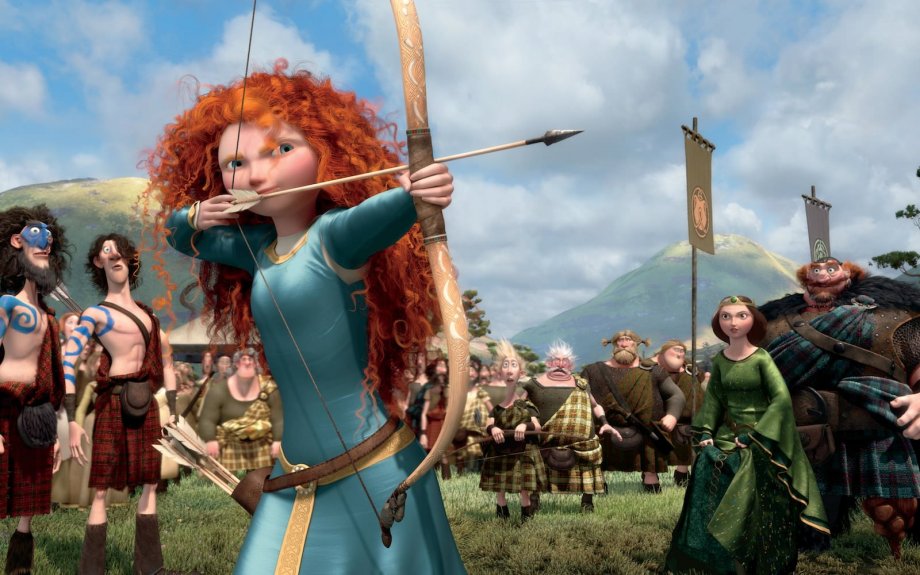
Pixar Animation's 2012 effort is Brave, a fantasy adventure set in Scotland directed by Mark Andrews and Brenda Chapman (who was replaced in the middle of production). Kelly Macdonald voices the flame-haired protagonist, Merida, while Emma Thompson, Billy Connolly, Kevin McKidd, Robbie Coltrane, Julie Walters, and Craig Ferguson also provide voices.
The film opens with a very young Merida, our tomboyish hero, playing hide and seek with her mother (Emma Thompson) while her father, the king (Billy Connolly), looks on. Shortly after recieving her birthday present, a bow, they are attacked by a large bear. Cutting to years later, Merida and her mother can now barely stand each other and her father is missing a leg from their encounter with the bear. Merida spends every spare moment she has practicing archery in the forest, when she doesn't have to practice being a proper, passive princess with her mother. Upon Merida finding out she is to be betrothed very soon (she isn't told until the suitors are practically on their doorstop), her contentious relationship with her mother comes to head. So, naturally, she encounters a witch and accidentally gets her mother turned into a bear, she gets a deadline to reverse the spell, and mother/daughter bonding ensues.
Firstly, I have to say, the animation is up to the usual high standards Pixar sets, though just about every other animation studio now active is up to those same high standards. The Scottish landscapes, in particular, are quite beautiful and detailed. The characters are expressive and fairly realistic looking, but some of the designs are distorted enough to provide a more wacky feel at times. The animation in the action-oriented sequences is very fluid, while not scrimping on the level of detail to be found in the landscapes.
The story, however, is extremely slight and seems like a first, and nowhere near a final, draft. The main problem with the script is that none of the characters are, well, likable: Merida is a spoiled brat, her mother is a tyrannical shrew, and her father (a king no less) is essentially a non-factor in her life aside from approving of her archery. Other issues with the film include no true villain, except for a bear with a way too convenient connection to the main plot, and a vague, poorly defined system of magic that doesn't seem to be a part of the universe at all aside from being a plot contrivance once or twice per act. The moral of the story, parents and children should talk to, not at, each other, is solid but the means of getting to that point are illogical. Merida and her mother both seemingly cave from their previous positions out of guilt, not understanding, when neither has been given a proper reason to do so.
The voice acting is solid, though it seems a bit exaggerated when it comes to the Scottish-ness of it all, even though most of the voice actors are Scottish (or at least British), so I may just be hearing things. Kelly Macdonald is a convincing teenaged girl not wanting to be betrothed to an idiot (all of her choices are very much idiots) but she can't change the content of the paper-thin material she was given to work with. Every one else is competent but not extraordinary in voicing their roles.
In the end, Brave is probably the weakest Pixar film to date, and after a couple of mediocre outings, this is the first film they have done I would say is legitimately bad. Though the spunky heroine and the beautiful animation should keep kids entertained, even if it may be a bit dark for the very young, adults will probably wonder why a ninety minute film could have been able to have had forty minutes cut without losing any of the plot.
3/10
Showing posts with label Movies. Show all posts
Sunday, November 18, 2012
Saturday, November 10, 2012
Grosse Pointe Blank (1997)
Martin Blank kills people and he is rather good at it, but after an encounter with a "colleague" who is in favor of unionizing their trade and a visit to his terrified therapist (who wouldn't be with a hit-man for a client), he decides to go home for his high school reunion. Blank had disappeared on prom night ten years prior in order to join the army, surprising everyone he knew and leaving Debi, his girlfriend dumbfounded and crushed. Reconnecting with some old friends and, especially, Debi, Martin is forced to take stock of what his life has become and maybe find his way back to something akin to a normal life, though not until he kills a bunch of (bad) people, of course.
This is a film that lives and dies on the lead performance, and, luckily for the producers of Grosse Pointe Blank, Cusack knocked it out of the park. Cusack imbues Martin with regret, a touch of neurosis, a certain amorality, and a deep, icy calm that only seems to appear when someone is trying to kill him, which is rather often. Blank is not particularly torn up about what he does, even if he is a little tired of it: I get the sense that he sees himself as the murder weapon, and not the murderer, which is understandable from a certain point of view. Minnie Driver is charming and appealing as Debi, the girl Martin left behind, though she is a bit thinly drawn compared to Martin. Alan Arkin is very funny as Martin's disturbed therapist, though he is onscreen for only a few scenes. Dan Aykroyd is solid as Martin Blank's rival, though I feel he is miscast as an assassin.
Grosse Pointe Blank's greatest strength, aside from John Cusack, is the whip-smart dialogue present throughout the entire film. Consistently funny and clever, the script manages to maintain its witty tone without becoming overbearing in its execution, which can certainly be an issue in cases where dialogue is written as such (cough, Sorkin, cough). The plot, however, goes from refreshingly unique to shockingly derivative over the course of a third act where all is resolved and everyone good is happy and bad is dead, which is a shame, because it was almost great.
George Armitage's Grosse Pointe Blank works competently as a romantic-comedy and superbly as a vehicle for John Cusack. The film is definitely worth watching, and is indisputably fun, but an uninspired final act prevents it from becoming a classic. Oh, and the soundtrack is pretty good as well (hooray for Ska).
7/10
Friday, November 9, 2012
Harry Potter and the Deathly Hallows - Part 1 (2010)
The adventures of Harry, Ron, and Hermione begin to come to a close in Harry Potter and the Deathly Hallows - Part 1, the first installment of the two-part conclusion to the eight film saga. Directed by David Yates (director of the final four films in the series), it stars Daniel Radcliffe, Rupert Grint, and Emma Watson, along with a regular who's who of quality British thespians.
Dumbledore is dead, Voldemort grows stronger by the day, and Harry Potter, left only with the vague mission of destroying the remaining horcruxes (pieces of Voldemort's soul embedded in hidden objects that make him, effectively, immortal). Joining him, as always, are his best friends Ron Weasley and Hermione Granger, as they both choose to leave behind their homes to help Harry fight the battles to come. A series of trials and tragedies befall the trio, including an aerial escape, a daring heist, and a fight with a rather large snake, as their bonds of friendship are tested and their wills are pushed to the limit. All the while, Voldemort is putting the final pieces on the board for his final push to controlling the wizarding world.
The acting in Harry Potter and the Deathly - Part 1 may be the best in the entire series, despite a noticeable lack of Alan Rickman. Radcliffe, Grint, and Watson have grown as actors as they have aged, and all give excellent performances. Warner Brothers got truly lucky when they cast these actors a decade (or so) ago, because all of them have serious chops and all of them still look like the characters from the book. Additionally, Ralph Fiennes is wonderful as Lord Voldemort the few times he's onscreen: he is charismatic, darkly funny, and indisputably terrifying, all without a proper nose. Considering the large cast I will just list off some of the other fantastic actors working in this movie: Alan Rickman, Jason Isaacs, Brendan Gleeson, Julie Walters, Helen Bonham Carter, Bill Nighy, Imelda Staunton, John Hurt, Rhys Ifans, and many more.
Harry Potter, while ostensibly a series for children, got progressively darker as its protagonists aged, and this is the darkest one yet. Harry's snow-white owl Hedwig gets killed as collateral damage, Ron's brother loses an ear, the three are forced to abandon friends to potential imprisonment and death: it is not light fare, fantasy or no (which is a very unfair stereotype, by the way). I don't mean to spoil, but there is a scene where a derogatory term is literally carved into someone's arm. The interpersonal issues the group face are less superficial and more personal and befitting of seventeen-year-olds; essentially Harry, Ron, and Hermione are sexual beings by this point and are preoccupied with such things (also saving the worlds and overthrowing dark lords).
This seventh film is the most restrained, though still possessing a substantial amount of special effects (handled beautifully), and is more reliant on atmosphere and mood then any of the previous entries. Whereas before the films would take place in a brightly lit castle, this one is set primarily in sparse, cold locations, from the dismal home Harry inherited from his godfather (Gary Oldman, we do so miss ye) to the forests they flee to. As the penultimate entry in such a vast franchise, much of the film is spent moving the pieces into place for the grand finale to come, which causes the film to lack a clear resolution, though it picks a good place to end.
This seventh of the eight films making up the Harry Potter epic is the most down to earth (relatively) and the most personal (definitely), but it still can't help but feel like it's missing a third act, which is to be expected considering that there is also a Harry Potter and the Deathly Hallows - Part 2. In the end, though, Harry Potter and the Deathly Hallows - Part 1 works as one of the stronger entries in an already very strong franchise.
8/10
Tuesday, November 6, 2012
The Perks of Being a Wallflower (2012)
The Perks of Being a Wallflower, based Stephen Chbosky's 1999 cult favorite debut novel of the same name, has been released and misunderstood teens everywhere should probably be clamoring for a ticket right about...now. Directed by Stephen Chbosky (yes, the man who wrote the book, and the screenplay), the film stars Logan Lerman, Emma Watson, and Ezra Miller as the three leads, with an excellent supporting cast comprised of Paul Rudd, Dylan McDermott, Kate Walsh, Joan Cusack, Mae Whitman, Johnny Simmons, Nina Dobrev, and Melanie Lynsky.
Charlie, portrayed by Logan Lerman, is very much the wallflower the title implies him to be: he is quiet, shy, smart, and very perceptive. He is also still reeling from the suicide of his best friend a few months prior, and the death of his beloved Aunt Helen (Melanie Lynskey) a few years prior. In his first year of high school, Charlie's withdrawn nature is challenged by his befriending a group of off-beat seniors, particularly the extroverted, flamboyant, and gay Patrick and his quirky step-sister Sam, who has an impeccable taste in music. Others in their eclectic group include Mary-Elizabeth (a Buddhist punk), Bob (perpetually stoned and proud of it), and Craig, Sam's college student boyfriend who says things like "poetry writes me" with a straight face; he also connects with his English teacher (Paul Rudd), who encourages Charlie to read and write. As the school year goes on, Charlie experiences a lot of firsts: a first kiss, first girlfriend, first bad trip (and not of the travelling variety), and, of course, a first midnight showing of The Rocky Horror Picture Show. Experiences throughout year, such as seeing his sister, Candace (Nina Dobrev), get hit by her boyfriend and watching Patrick's painful behind closed doors relationship with star quarterback Brad (Johnny Simmons) unravel, cause Charlie to lose his innocence, though it is questionable if he ever had it to begin with.
Whoever handled the casting for this film deserves a raise, every actor inhabits their role superbly, no matter how big or small the part. Lerman is nuanced, charming, and heartbreaking as a Charlie tired of feeling numb, yet desperate to suppress the darker urges we all have. For example, in a scene in the middle of the film, where Charlie jumps to stop a brutal beating of Patrick by homophobic football players, Logan looks a touch unhinged as Charlie swiftly and brutally steps up in defense of friend where he leaves three large football players on the ground gasping and utters a blunt threat I don't doubt that he would be willing to carry out. Emma Watson, in her first major post-Harry Potter role, is able to take a what could have very easily been a cliche (the manic pixie dream girl) and injects it with enough subtlety and a slight sense of desperation to make Sam both a character worth rooting for, and a girl not hard to imagine falling for as a teenager (I mean, she listens to David Bowie and The Smiths, what's not to like). But, the true breakout star of the film is Ezra Miller as the outgoing Patrick. Miller, who was last seen terrifying audiences as a mass-murdering teenager in the excellent and under-seen We Need To Talk About Kevin, chews the scenery as the gay-and-unashamed Patrick, who can't take life seriously, because otherwise it would become too painful.
The rest of the cast performs well in somewhat limited roles: Paul Rudd is earnest as the supportive English teacher ideal for a young man like Charlie, though his role is limited. Dylan McDermott isn't given much to do as Charlie's father, but when he's onscreen he expertly plays a man who never knows what to say, but is desperate for his son to be happy and well. Other actors like Mae Whitman, Nina Dobrev, and Johnny Simmons are quite solid in their roles, though generally overshadowed by the other cast members.
The film, as directed and written by Chbosky, makes one extremely smart decision that elevates what could of been a very by-the-numbers, if well-acted, coming-of-age flick, into something better: Chbosky never implies that the issues and pains plaguing Charlie, Sam, and Patrick are more substantial than those facing the other characters. Charlie's sister is in an abusive relationship, Brad is closeted living in a homophobic household, and even Paul Rudd's Mr. Anderson is implied to be struggling to decide whether or not to stay as a teacher, or return to New York to chase his dreams as a playwright. Chbosky's style is remarkably assured for a director lacking much experience, though his "familiarity" with the source material definitely contributed to this.
One thing I liked about the directorial style employed is that, like in the novel, everything is through Charlie's perspective. We see him listening to his parents' conversation in the kitchen, and then, as he leaves, we can still here the conversation going and it just trails off in the background; or we can only faintly here what Sam whispers into Patrick's ear as Charlie looks on from across the room. The film maintains the same narrative device of the novel, where Charlie is narrating his story by means of letters to an anonymous person he had heard of that "might understand." Narration, so often used as a crutch in film, is employed well here, as knowing Charlie's thoughts about what is happening around him is key to the effectiveness of the story on hand, yet those same thoughts are nearly impossible to supply without narration in the case of such an extremely withholding and introverted protagonist like Charlie.
In the end, even though I might be looking at through the eyes of a big fan of the novel (I'd be lying if I said I'd only read it once), The Perks of Being a Wallflower is a moving film about friendship and the importance of connection, and a very good, if somewhat condensed, adaptation of a truly excellent novel.
9/10
Charlie, portrayed by Logan Lerman, is very much the wallflower the title implies him to be: he is quiet, shy, smart, and very perceptive. He is also still reeling from the suicide of his best friend a few months prior, and the death of his beloved Aunt Helen (Melanie Lynskey) a few years prior. In his first year of high school, Charlie's withdrawn nature is challenged by his befriending a group of off-beat seniors, particularly the extroverted, flamboyant, and gay Patrick and his quirky step-sister Sam, who has an impeccable taste in music. Others in their eclectic group include Mary-Elizabeth (a Buddhist punk), Bob (perpetually stoned and proud of it), and Craig, Sam's college student boyfriend who says things like "poetry writes me" with a straight face; he also connects with his English teacher (Paul Rudd), who encourages Charlie to read and write. As the school year goes on, Charlie experiences a lot of firsts: a first kiss, first girlfriend, first bad trip (and not of the travelling variety), and, of course, a first midnight showing of The Rocky Horror Picture Show. Experiences throughout year, such as seeing his sister, Candace (Nina Dobrev), get hit by her boyfriend and watching Patrick's painful behind closed doors relationship with star quarterback Brad (Johnny Simmons) unravel, cause Charlie to lose his innocence, though it is questionable if he ever had it to begin with.
Whoever handled the casting for this film deserves a raise, every actor inhabits their role superbly, no matter how big or small the part. Lerman is nuanced, charming, and heartbreaking as a Charlie tired of feeling numb, yet desperate to suppress the darker urges we all have. For example, in a scene in the middle of the film, where Charlie jumps to stop a brutal beating of Patrick by homophobic football players, Logan looks a touch unhinged as Charlie swiftly and brutally steps up in defense of friend where he leaves three large football players on the ground gasping and utters a blunt threat I don't doubt that he would be willing to carry out. Emma Watson, in her first major post-Harry Potter role, is able to take a what could have very easily been a cliche (the manic pixie dream girl) and injects it with enough subtlety and a slight sense of desperation to make Sam both a character worth rooting for, and a girl not hard to imagine falling for as a teenager (I mean, she listens to David Bowie and The Smiths, what's not to like). But, the true breakout star of the film is Ezra Miller as the outgoing Patrick. Miller, who was last seen terrifying audiences as a mass-murdering teenager in the excellent and under-seen We Need To Talk About Kevin, chews the scenery as the gay-and-unashamed Patrick, who can't take life seriously, because otherwise it would become too painful.
![]() |
| That couch is the island of misfit toys. |
The film, as directed and written by Chbosky, makes one extremely smart decision that elevates what could of been a very by-the-numbers, if well-acted, coming-of-age flick, into something better: Chbosky never implies that the issues and pains plaguing Charlie, Sam, and Patrick are more substantial than those facing the other characters. Charlie's sister is in an abusive relationship, Brad is closeted living in a homophobic household, and even Paul Rudd's Mr. Anderson is implied to be struggling to decide whether or not to stay as a teacher, or return to New York to chase his dreams as a playwright. Chbosky's style is remarkably assured for a director lacking much experience, though his "familiarity" with the source material definitely contributed to this.
One thing I liked about the directorial style employed is that, like in the novel, everything is through Charlie's perspective. We see him listening to his parents' conversation in the kitchen, and then, as he leaves, we can still here the conversation going and it just trails off in the background; or we can only faintly here what Sam whispers into Patrick's ear as Charlie looks on from across the room. The film maintains the same narrative device of the novel, where Charlie is narrating his story by means of letters to an anonymous person he had heard of that "might understand." Narration, so often used as a crutch in film, is employed well here, as knowing Charlie's thoughts about what is happening around him is key to the effectiveness of the story on hand, yet those same thoughts are nearly impossible to supply without narration in the case of such an extremely withholding and introverted protagonist like Charlie.
In the end, even though I might be looking at through the eyes of a big fan of the novel (I'd be lying if I said I'd only read it once), The Perks of Being a Wallflower is a moving film about friendship and the importance of connection, and a very good, if somewhat condensed, adaptation of a truly excellent novel.
9/10
Monday, November 5, 2012
The Descendants (2011)
Alexander Payne is an interesting director with a penchant for making interesting movies. George Clooney is an interesting actor who also has a penchant for making interesting movies. Adapted from Kaui Hart Hemmings' 2007 novel of the same name, Hawaii-set The Descendants is the result of both of their talents and manages to be the rare (oscar-baiting) character study that, while not exactly a feel-good movie, certainly works as entertainment for the masses. Shailene Woodley, Beau Bridges, Judy Greer, Matthew Lillard, and Robert Forster also star.
The film centers on Matt King, a wealthy Oahu-based lawyer and native Hawaiian and his dealing with his coma-ridden wife's impending death, and the revelation that she had been having an affair prior to her tragic water-skiing accident. In addition, he also is tasked with making a decision regarding an extremely large tract of very lucrative land his extended family has owned since the eighteen-sixties and whether or not to sell (and who to) for what promises to be a vast amount. The situation on hand forces Matt to become a more hands on parent to his two rebellious daughters: Scottie, ten or so, and Alex, seventeen or so. Revelations of his wife's infidelity, that come unexpectedly from Alex, lead to Matt confronting a variety of people, including, but not limited to, self-centered friends, a standoffish father-in-law, some of his oddly named cousins, and the man his wife has been sleeping with, along with his wife. In addition, Sid, Alex's perpetually stoned and somewhat oblivious friend comes along for the ride.
The acting in this film is exceptional, with George Clooney giving one of his best performances to date and Shailene Woodley giving what should amount to be a star-making performance (that is not on a teen-soap broadcast on ABC Family) as Matt King's teenage daughter Alex. Clooney, while certainly able to be wacky when called upon, is at his best in this type of role: understated, contemplative, and pained to the core (see: Michael Clayton or The American). Woodley is arguably given the more difficult task as the troubled Alex, in what is essentially a lead role, in playing a teenager with alot of resentment towards her parents, that does not come off as petty and lacking the typical "righteous indignation" of youth, but she manages to pull it off with aplomb. In addition, Robert Forster is excellent as an aggressive father grieving by means of rose-colored glasses. Other actors, such Nick Krause playing the stoned Sid and Beau Bridges as Cousin Hugh do well with their limited roles.
The writing in the film is whip-smart and generally sounds like real people speaking. One issue with the film is that it has a tendency to introduce characters for a scene or two, only to drop them for the remainder of the film, though this is hardly a mortal sin considering the film is, rightly, focused on Matt King and his two daughters, particularly Alex. One thing The Descendants manages to do extremely well is that it takes uncomfortable situations and is able to make them very funny without compromising the emotional heft of the scene. Instances such as Sid confusing Matt's mother-in-law's dementia for a joke, only to be punched in the face by his father-in-law could have easily fallen into the realm of slapstick, but do not.
The film, particularly the views of the scenery, is beautifully shot through its entirety and evokes a Hawaii, that while very beautiful, is not the ethereal paradise so often conveyed in film. Payne's style is well suited to the material in that it brings out the best in his actors, scenes focusing just on Clooney's face are very effective and bring the emotions he is forcing down to the forefront without having him give a lengthy monologue or break down crying. Another aspect worth noting is the score, composed entirely of Hawaiian music, is both tonally effective and ably reinforces the Hawaiian setting without having hula dancers or surfers, et cetera, to distract from the meat of the story.
The Descendants is, in the end, an excellent film, with very few faults and some legitimately powerful performances from its leads and a worthy addition to Alexander Payne's already rather impressive collection of directorial efforts.
10/10
Additional Notes:
- "Come on, Alex. Tell her how you were drunk the other night. Tell her how maybe you're an alcoholic." -an overly excited preteen Scottie
- "Don't be fooled. In Hawaii some of the most important people look like bums and stunt men." -a conference room bound Matt King
Friday, November 2, 2012
Romeo and Juliet (1968)
William Shakespeare, though often regarded as being history's greatest playwright, is (falsely) regarded as being too "dry" or "dated" by many modern readers. The irony of this is that the plays of Shakespeare have as much sex (implied sex, but sex) and violence as your average soap opera. Franco Zeffirelli's 1968 version of Romeo and Juliet is one of the most famous Shakespeare adaptations; this version is unique in that it cast appropriately aged actors to play the star-crossed lovers: the fifteen year old Olivia Hussy and the seventeen year old Leonard Whiting portrayed Juliet and her Romeo.
Romeo and Juliet are the scions of two rival noble families (the Montagues and the Capulets) in Verona, Italy. At as masquerade ball hosted by the Capulets, a disguised Romeo manages to catch a glimpse of Juliet for the first time and becomes smitten. The young pair quickly fall for each other and soon make secret vows to wed, though their families' violent feud threatens to derail their romantic plans. A series of duels and a fatal miscommunication lead up to a tragic climax in the full Shakespearean fashion (everybody dies).
Franco Zeffirelli (the premiere director of Shakespearean adaptations after Laurence Olivier, who narrates this film) chose to adapt Romeo and Juliet following his critically acclaimed version of The Taming of the Shrew. Zeffirelli did one thing in particular to allow this film to work, he cast actors that were actually of an appropriate age (previous versions had cast thirty-somethings) to play the pair. Hussy and Whiting were fifteen and seventeen, respectively, during filming and are able to provide legitimacy to the plot; it is difficult to imagine casting thirty-year olds and having them be believable teenage lovers. Michael York, in an early role, is great as the hot-headed Tybalt, as is John McEnery as the flamboyant Mercutio.
There is little to say about the plot other than that it fits into the mold of the standard Shakespearean tragedy; the dialogue is taken directly from the play and is brilliant (as is to be expected from the Bard). Hussy and Whiting do well with the material, though they struggle to make their many soliloquies sound both spontaneous and natural. The plot is considerably trimmed down and simplified from the text, as a runtime of four or five hours is unrealistic for a theatrically released film (though not unheard of). The main problems that eliminating significant elements from the plot brought about is that it simplified the motivations of many of the characters and all but completely eliminated one of the key players.
Zeffirelli's version of Romeo and Juliet is a competent, if simplified, take on Shakespeare's tragedy about the two lovers that has attractive leads and a talented cast. The film runs into many of the problems that typically face Shakespeare plays that have been brought to the big screen, but that is to be expected. In the end, it is perfect for the role that it has been serving for years: being the film that high school students see after reading the play, with twenty-seconds where the teacher "accidentally" fast forwards over nudity.
7/10
Note: This review was previously posted on another blog that I wrote.
The Pride of the Yankees (1942)
There are a select few baseball players that are remembered for their character off of the field as much as their prowess on it: Lou Gehrig was one of those players. Directed by Sam Wood, The Pride of the Yankees starred Gary Cooper as the iconic first baseman with Teresa Wright playing Eleanor, his beloved wife. The film was released to critical acclaim in 1942, the year after Gehrig tragically died. Equal parts of baseball, romance, and tragedy make The Pride of the Yankees refreshingly different from most of the inspiring sports movies that have frequented cineplexes for decades.
The film's greatest strength is Gary Cooper in the lead role, his stiff and often awkward demeanor in the film is ideal for Gehrig and his apparently sinless existence. The sole downside of casting Cooper was his age, he was around forty when he played Gehrig: his age distracted from his performance for much of the film's runtime. It was, and is, nearly impossible to have a forty-something actor play an eighteen year old college student. Teresa Wright (in one of her first roles) is charming as Lou Gehrig's beloved Eleanor and Walter Brennan does his typical good work in his supporting role as Gehrig's sport-writer friend. Not to forget Babe Ruth, the film's most famous cast member, who appears on screen in several (brief) scenes; though his appearance appears as more of a novelty than a tribute to Gehrig.
The Pride of the Yankees is one thing above all else: a tribute to the man, and in that manner the film works. Though in the end Gehrig's life story makes for merely an interesting film and not an essential one, with the well-cast Cooper and Wright doing good work despite the (unavoidably) clichéd nature of the film.
6/10
Note: This review was previously posted on another blog that I wrote.
Ben-Hur (1959)
When one thinks of a big Hollywood spectacle, Ben-Hur, the 1959 (and third) adaptation of Lew Wallace's 1880 novel Ben-Hur: A Tale of the Christ is one of the first films to pop into one's mind. At the Academy Awards it won a record eleven Oscars (a feat that has been equaled twice, but never surpassed) and was the highest grossing film of 1959. For the film, director William Wyler won his third directing Oscar and star Charlton Heston won his only acting Oscar.
The film focuses on the trials and tribulations of Judah Ben-Hur, a rich and respected Jew living in Jerusalem who seeks both peace and vengeance. The film opens with the nativity scene and then skips to the reuniting of Judah and his childhood friend Messala. Messala has returned a proud and ambitious Roman seeking nothing more than to appear impressive to the emperor. Driven by his ambition, he tries to force Judah to give up names of dissenting Jews in Jerusalem. Judah refuses and Messala has him sent to the galleys and his mother and sister are imprisoned; Judah never loses his desire for vengeance. All the while, there is talk of a new prophet throughout the land.The film is considerably long, at over three and a half hours, and tends to drag considerably at points. The story is a complex one and necessitates the lengthy runtime, although I cannot help but feel that the shaving off of thirty minutes or so could have helped the film move more quickly. The religious themes will be appreciated by many, though others may find them overly abrasive. As it stands, Ben-Hur has a sufficient story to support its vast scope and ambitious vision.
One element of the film that must be mentioned is the phenomenal chariot-race scene. The scene, filmed over fifty years ago over the course of three months, is still a wonder to behold, all the more impressive because it was filmed decades before the use CGI in cinema. I have yet to see a match for it in any film since in terms of thrills and ability to awe.
The acting in the film was exceptional throughout, particularly the work done by Charlton Heston in the lead role of Judah Ben-Hur. Heston, one the greater movie stars of the era, gave the performance that has come to define his career in the years since in this film. The supporting cast also did an admirable job in their roles; particularly Stephen Boyd in the role of Messala and Jack Hawkins as Quintus Arrias.
The film, though possibly not of best picture quality, is one of the stand-outs of the epic and sword-and-sandal genres. While not without its faults, Ben-Hur is an epic that is well worth the time to watch it and shows star Charlton Heston and director William Wyler in top form.
7/10
Note: This review was previously posted on another blog I wrote.
Batman: The Movie (1966)
Years before the Christopher Nolan Batman films there were the Tim Burton Batman films; years before the Tim Burton Batman films there was this: 1966's gloriously campy and compulsively watchable Batman: The Movie. Directed by Leslie H. Martin, it stars Adam West as Batman and Burt Ward as Robin the Boy Wonder in addition to a (pardon this, I am in the mood for wordplay) fearsome foursome of foes: the Joker, the Riddler, the Penguin, and Catwoman. Sporting a incoherent plot and holy-let's-just-go-with-it-Batman attitude, it stands in stark contrast to the much darker and grittier Nolan films and serves as an example of how to properly do a campy superhero movie (take note, Joel Schumacher).
The plot of the film involves the standard superhero plot: deadly villains, theme gadgets, and a taking-the-world-hostage sort of evil scheme. Batman and Robin answer an urgent cry to save a stolen ship (with deadly new invention aboard) and end up battling a shark (mid-air) while the ship apparently disappears. Following vague clues, they manage to deduce that the scheme has been formulated by the Penguin, the Joker, the Riddler, and Catwoman (Burgess Meredith, Cesar Romero, Frank Gorshin, and Lee Meredith). The villains hatch a plan to lure Batman to them by having Catwoman, under the guise of the Russian Miss Kitka, seduce a millionaire and, through kidnapping him, bait Batman. Naturally, the millionaire chosen is none other than Bruce Wayne, Batman's alter-ego. Being the ladies man he is, he deems the seductive "Kitka" worthy of (actual dialogue) "International Relations." He promptly escapes their grasp and seeks to stop there dastardly scheme. The specifics of the scheme are not important, some key points are as follows: a billion dollars, a penguin-based submarine, and a means of dehydrating world leaders.
The plot of the film, though clearly ridiculous, is ideal for the campy tone and is utterly hilarious when viewing the final product. The scheming done by the four antagonists is so out-there and incomprehensible it would make the writers of the James Bond films starring Roger Moore blush. All that being said, the writing of the film is so ridiculous and over-the-top that it becomes endearing. "What is six ounces, sits in a tree, and is extremely dangerous? A sparrow with a machine gun." By the end of the film the Riddler's ridiculous riddles, such as that one, that Batman and Robin solve with apparent ease, almost make sense, almost. For this, the writers must be given credit, nothing except for good writing could account for such a miraculous and shocking thing.
Another facet of the film that must be mentioned is the amount of bat-gadgets that are in the film. I counted four different vehicles used by the Dynamic Duo: the Bat-Mobile, the Bat-Copter, the Bat-Cycle, and the Bat-Boat. In addition to that, they have a Bat-Ladder (a rope ladder with a sign that says "Bat-Ladder") and Shark Repellent Bat-Spray among many, many others.
Overall the film is highly enjoyable and so campy it makes one want to start singing "Camptown Races" around a fire. If you want to see a gritty Batman film that also creates a realistic human-drama: see Christopher Nolan's Batman Begins and The Dark Knight. If you want to see a hammy, over-the-top action film with physical comedy taken directly from the films of Charlie Chaplin: see Batman: The Movie. As a parody of the super-hero genre, it is, to quote my favorite villainous feline, "Purr-fect."
8/10
Note: Though the official name of the film is Batman, it was marketed as Batman: The Movie. I credited as the latter to avoid confusion with the Tim Burton film of the same name that I will eventually review.
Additional Note: This review was previously posted on another blog I wrote.
The Mark of Zorro (1920)
A tavern full of corrupt soldiers complains of a masked vigilante fighting for the poor and the oppressed: Zorro. Douglas Fairbanks stars as the dashing hero in one of his first swashbuckling roles (in one of the first swashbucklers) in the first cinematic adaptation of the iconic Zorro character: The Mark of Zorro. Directed by Fred Niblo, one of early cinema's most important innovators, the silent film was released in 1920 and became a huge hit at the box office, turning the athletic Fairbanks from a comic actor into a swashbuckling superstar.
The film is set in a Spanish controlled California, where the government has been increasingly oppressive and corrupt to the natives and the poor. A few months prior to the beginning of the film, the apparently foppish Don Diego Vega has returned home from being educated in Spain. Shortly thereafter, reports began circulating about a masked vigilante, Zorro, terrorizing those who abuse their power and oppress the weak. Don Diego's father, frustrated with his effete and seemingly idle son, informs him that he needs to marry; the lovely Lolita Pulido, of a good family with current financial troubles, is his fiancé-to-be of choice. Lolita despises (with good reason) Don Diego for his behavior and rudeness, (while courting, it is probably best not to say finding a wife is "such a nuisance") but falls for the charming and dashing Zorro. As the manhunt for Zorro heats up, Lolita and everyone else will be shocked by Zorro's (timely) revelation of his true identity: Don Diego Vega.
Douglas Fairbanks, though not a great actor in the traditional sense, had the tools that made him a (if not the) ideal swashbuckling hero: he sparkled with ebullience in every scene, he had a charisma and natural screen-presence almost unmatched among the screen-stars of any decade, and he had a prodigious athletic ability that make his stunts (done without the use of special effects) breathtaking both then and now. The supporting players are game and charismatic, the two qualities required of a supporting actor in a film such as this. Though every performer does their job well, Fairbanks truly steals the show; it is no mystery why he was asked to portray many of the other great swashbuckling heroes after this film (D'Artagnan, Robin Hood, the son of Zorro).
Though The Mark of Zorro is a silent film, the use of the intertitles does not slow the film's pace or hinder the enjoyment of it. The film's lack of special effects and its relatively low quality picture could have doomed a film this action heavy, but Niblo's direction and Fairbanks athleticism prevented this high-quality adventure from being a disaster. The sword-fighting scenes in the film, though lacking in the (relative) realism and skill demonstrated by those performed by Basil Rathbone and Errol Flynn (among other actors) years later, are enjoyable and exhilarating nonetheless. The score, comprised of organ music, is fitting the film and is essential is creating the correct tone for the film; the fact that it is a silent film necessitates the use of the music in setting the tone for the action.
As the film in which Douglas Fairbanks proved his merits as a swashbuckling hero, it is fitting that The Mark of Zorro be both gloriously pulpy and entertaining from the first moment to the last: the film delivers on both counts; though the film does not contain much in the way of depth. All in all, The Mark of Zorro is a thoroughly memorable adaptation of Johnston McCulley's classic pulp novel The Curse of Capistrano, despite the lack of special effects or spoken dialogue.
8/10
Note: This review was previously posted on another blog I wrote.
8/10
Note: This review was previously posted on another blog I wrote.
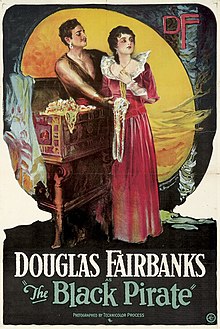
The Black Pirate (1926)
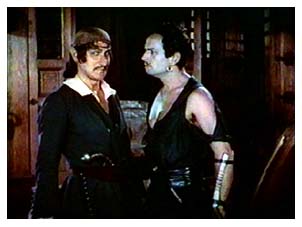
There are certain films that become truly surprising, years after their release, for reasons that have absolutely nothing to do with its storyline or acting; The Black Pirate, Albert Parker's 1926 swashbuckler starring Douglas Fairbanks, has become surprising because it is a silent film that just so happens to be in Technicolor (albeit two-tone, but Technicolor nonetheless). One of a series of swashbuckling vehicles for Fairbanks released during the 1920s, The Black Pirate casts the athletic superstar as a young Duke seeking revenge for his father's death by taking the guise of a unnamed buccaneer and joining the company of pirates that did the deed.
A group of pirates blow up a captured ship, via the ship's powder magazine, with all of the occupants still on board. The ship's sole survivors, a Duke and his son, are washed ashore on a deserted island; the father soon dies, leaving his signet ring and dukedom to his son, who vows to avenge his father's death. Through a mixture of coincidence and convenience, the pirates disembark on the same island to bury their horde of treasure. The son, adopting the mysterious (and catchy) moniker of the Black Pirate, walks up to the pirates and proclaims his desire to join the crew. Following the proving of his worth (he has a victorious duel with the captain and he captures a large ship singlehandedly), the crew enthusiastically endorses their new recruit as fit for being their new captain, much to the dismay of the previous first mate. What follows is a series acrobatic fights, the predictable wooing of a for-some-reason-their princess, and the inevitable revelation of his true identity.
The Black Pirate, is one Fairbanks' weaker swashbucklers in terms of both plot and character. While almost all silent films rely on formula, formula does not have to be used in a boring manner: and The Black Pirate certainly uses it in a boring manner. Absolutely nothing distinguishes it from the countless other revenge on the high seas flicks that have been released over the years, except for Douglas Fairbanks. The plot of the film boils down to one clichéd scene after another, with a damsel in distress, portrayed by Billie Dove, thrown in for good measure. Douglas Fairbanks is at his uncannily acrobatic best here (some of his stunts are jaw-dropping), though it is a shame he can't elevate the material beyond the piece of (mildly) diverting fluff it is.
The real appeal of The Black Pirate lies in the fact that it is an intriguing curio from the silent era; it is one of the first films to be released entirely in color, albeit in two-tone Technicolor (which has a limited spectrum in comparison to later Technicolor). In fact, Fairbanks, who was heavily involved with the film's production, invested a considerable amount of money in developing the process that made color films a reality. The Black Pirate was recently selected for preservation in the National Film Registry: it did not get that recognition because of its merits, it got it because of its (very) early use of Technicolor.
The Black Pirate is not a particularly good silent swashbuckler, especially when compared with other Fairbanks films, but it is a fairly competent if underwhelming pirate flick. The film's primary appeal is the viewing of a 1920s silent film in color; the strangeness wears off eventually, but it is enough to make it worth a watch if you have an interest in early cinema.
5/10
Note: This review was previously posted on another blog I wrote.
Gentlemen Prefer Blondes (1953)
Lorelei Lee is the type of girl that can spot a diamond ring in a man's pocket while performing on stage underneath the bright lights. Dorothy Shaw, her best friend and fellow showgirl, is only looking for a good time and could care less if her future husband is rich (just as long as he's good looking). They are the two central characters at the center of Howard Hawks' amiable, if shallow, musical Gentlemen Prefer Blondes. Marilyn Monroe and Jane Russell star as Lorelei Lee and Dorothy Shaw in the 1953 film, their costars include Charles Coburn, Elliott Reid, and Tommy Noonan.
The film is beautifully filmed in Technicolor, the colors are vibrant and match the bubbly tone of the film and do the lovely leading ladies justice. The film, directed by a seasoned Howard Hawks, has well choreographed and entertaining musical numbers; though the music itself is clichéd and underwhelming. The most famous number, "Diamonds Are a Girl's Best Friend," is deservedly iconic as a musical number, but as the message for a film (the film's message amounts to that, essentially), it is completely superficial and utterly revolting.
Gentlemen Prefer Blondes has many of the typical trademarks of a standard fifties era musical: a predictable plot, spirited leads, and heavily choreographed musical numbers. Despite its renown and fond place in many a memory, Gentlemen Prefer Blondes amounts to little more than mediocre musical fare with protagonists that are actually quite hard to like. Though, Marilyn Monroe and Jane Russell truly do shine in the lead roles.
4/10
Note: This review was previously posted on another blog I wrote.
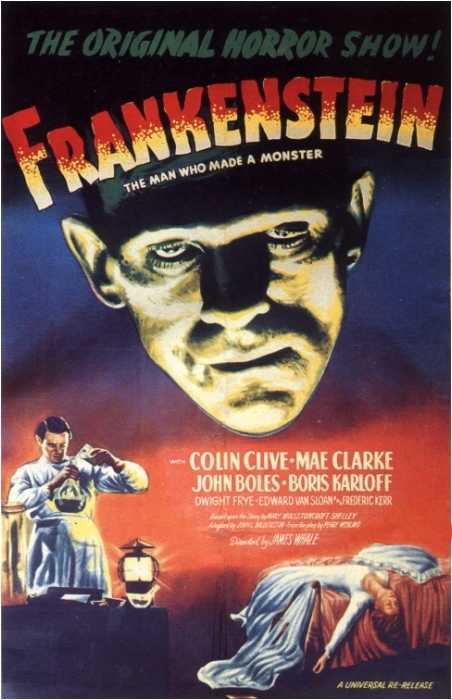
Frankenstein (1931)
The film opens with a man warning the viewers about the horrifying nature of the film that they are about to see. The 1931 film, Frankenstein, was released to critical praise and box-office success. One of the defining films of the horror genre, it was based (loosely) on the classic novel by Mary Shelley and released following the success of another adaptation of a horror classic: Dracula. The film runs a mere seventy minutes and stars Boris Karloff as the monster and Colin Clive as Dr. Frankenstein.
Dr. Henry Frankenstein and his hunchbacked assistant Fritz (not Igor) rob a grave; in need of a good human brain, Frankenstein proceeds to send Fritz to steal one from the local university. Frankenstein is working on an experiment to see if he can bring life to dead tissue: he is frighteningly optimistic. He has been working for months in an abandoned watchtower far removed from his bride-to-be, family, and friends. His fiancée Elizabeth is worried and enlists the help of his old mentor, Dr. Waldman, to help talk sense into him. They arrive while Frankenstein is undergoing the final preparations for his experiment. The experiment continues on as planned, with the exception of having three horrified onlookers; to the horror of his guests: he is successful. The monster, made with an abnormal brain, is prone to violent outbursts. Frankenstein is appalled by what he has created and makes futile plans with Waldman to destroy it; his subsequent return home is marred by reports of the monster killing Waldman and a little girl. Frankenstein decides to hunt the monster himself, leading to the iconic showdown in an abandoned mill.
Frankenstein is, above all else, a product of its atmosphere; the black-in-white cinematography in tandem with the richly detailed sets provide the ideal Gothic atmosphere for an old-school horror movie. The creation-scene has an assortment of ridiculous gadgets, from a Tesla coil to a bed that can be elevated to the sky, that somehow manage to make sense to the story. The makeup on the actual monster is both frightening and practical; Karloff is able to convey a surprising amount of emotion through the heavy layers. The overall design of the monster, though different from Shelley's vague description, is deservedly famous for such elements as the bolts in the neck and the flat head. The film's actors do exactly what they need to do for the film to work: they ham it up. Colin Clive, as the titular Frankenstein (the film is named after the doctor, not the monster), is both unhinged and obsessed, a perfect combination for the role. Karloff, in his most famous role, is both convincing and frightening as the monster.
In terms of plot, Frankenstein is greatly lacking in both the complexity and the depth present in the novel. The characterization of the monster is the change that has the greatest effect on the story. In the film he is little more than a brute prone to both violence and guttural vocalizations, while in the novel he is highly intelligent and philosophical, driven to violence by cruel rejection. The famous scene involving the little girl is perfectly representative of this change in characterization. In the film he stumbles upon a little girl who treats him with kindness, after a few moments of playing he throws her into the lake, killing her. In the novel, he rescues the little girl from drowning in the lake, only to be shot in the arm by her father. This difference makes the film more cinematic (though I have hopes for a more faithful adaptation sometime in the future) and less thought-provoking.
What makes one human? That question is posed by the film; it does not give an answer, but it does hint at something: the creature is a monstrosity, but Dr. Frankenstein is the true monster. 1931's Frankenstein is a thoroughly entertaining horror film that has held up extremely well, even though it lacks the emotional heft of its literary source-material.
7/10
Note: This review was previously posted on another blog I wrote.
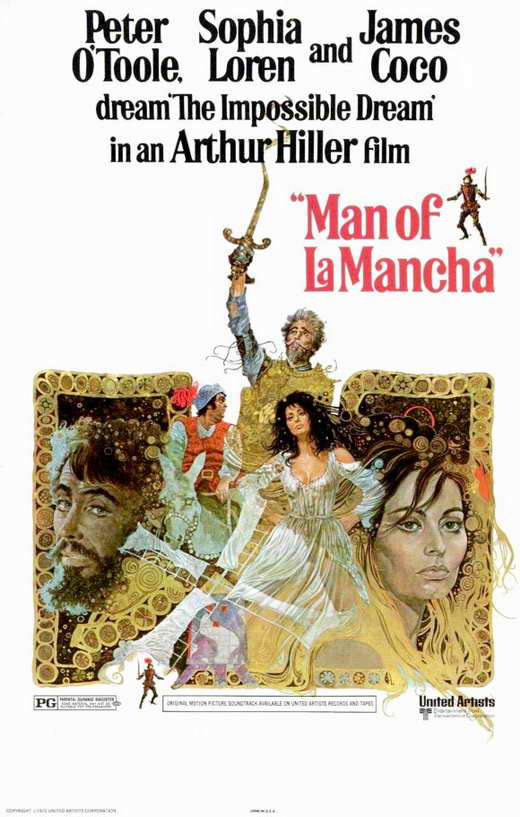
Man of La Mancha (1972)
To dream the impossible dream, that is the message (and frequently recurring lyric) that Miguel de Cervantes and Don Quixote (Peter O'Toole in a duel role) sing throughout Man of La Mancha, a 1972 movie-musical directed by Arthur Hiller. Costarring Sophia Loren as "Dulcinea" (Aldonza), Man of La Mancha is adapted from a stage-musical that was in turn (very) loosely adapted from the novel Don Quixote, Miguel de Cervantes' magnum opus.
The film opens with Cervantes and his friend being arrested by the inquisition while performing in the street, they are brought to a prison where they are sized up by the prisoners. The prisoners decide to hold a "trial" to determine if they are worthy or not; instead of a proper defense, Cervantes decides to put on a show performing the tale of Don Quixote with the prisoners as his troupe of players. His story begins with Don Quixote and his portly squire Sancho Panza riding in the countryside in search of adventures befitting a knight errant. After a battle with a savage giant (or windmill, depending on your level of sanity) he comes across an inn (castle) where he meets Aldonza ("Dulcinea"), a woman willing to do whatever it takes to survive. As Don Quixote attempts to rid the world of evil through ill-conceived acts of chivalry, his worried family decides that they should take it upon themselves to cure him of his sudden bout with insanity; all the while, Cervantes waits to be brought before the inquisition.
It must be said that Peter O'Toole and Sophia Loren would have been perfect casting if this had not been a musical, but it is a musical, and that is where the problem lies. The singing voices of O'Toole and Loren are clearly dubbed over, and not even with exceptionally good singing voices. This, combined with poorly (and hardly) choreographed dance sequences, resulted in a series of thoroughly lackluster and underwhelming musical sequences. The music in the film is passable, but hardly special when compared with music from superior musicals such as West Side Story.
The largest problem that Man of La Mancha has is that it does not know what the message that it is promoting is. The two separate messages it promotes are as follows: art is useful to prevent people from noticing their true problems (which is a great oversimplification of art's purpose) and that delusions are okay as long as they lead to some sense of purpose (even if the delusions are dangerous). There are very few problems with a film that can be as fatal as not knowing what it is about (and Man of La Mancha does not have a clue).
In the end, there is only one thing that can really be said about this film: it is a failure. Despite a cast of experienced character actors, and a pair of immensely talented leads, Man of La Mancha fails to live up to both the stage play and the novel it was based on. I once had an impossible dream as well: I dreamed that this was a good film.
3/10
Note: This review was previously posted on another blog I wrote.
Breakfast at Tiffany's (1961)
The standard run-of-the-mill romantic comedy involves several, almost universal, details: two friends with undeniable chemistry, other romantic interests for each of the would-be lovers, and a schmaltzy scene at the end where they get together. Blake Edwards' 1961 film Breakfast at Tiffany's is a standard run-of-the-mill romantic comedy in almost every detail, except for one: the two leads are both glorified prostitutes, and that makes all the difference. Audrey Hepburn stars as Holly Golightly and George Peppard plays Paul Varjak in this adaptation of Truman Capote's classic novel of the same name. It was nominated for five Academy Awards and won two for best original score and best song.
The film centers on Paul Varjak, an aspiring (but not successful) writer and kept man, and his befriending and falling in love with his unique and off-beat neighbor Holly Golightly, an escort and gold-digger. Holly, while intriguing and magnetic, is deeply troubled and has a hidden past that does not stay dormant for long. Although adapted from the Truman Capote novel, the final product is considerably different from Capote's classic. One major detail that is changed from the novel is the romance between Holly and Paul (unnamed in the novel); in the novel there isn't one. The novel has richer themes and is more realistic in the way the plot develops, but the story is considerably less cinematic.
The acting in the film is uniformly adequate, with the exception of two performances that truly elevate the film to heights it would not have reached without them. Audrey Hepburn, in possibly her most iconic role, as Holly Golightly is nothing short of magnificent and without her performance, the film would not be regarded as a classic. It should be noted that Marilyn Monroe was Capote's preferred choice to play Holly, and was furious when the studio signed Hepburn. It should also be noted: the studio made the right choice. The other performance that must be acknowledged is the portrayal of Doc, Holly's much older husband from a past life, by Buddy Ebsen. Ebsen makes the absolute most of his few minutes of screen-time and manages to illicit (necessary) reactions of pity and disgust from the audience. Without Ebsen in the role of Doc, the rest of the film may not have meshed succesfully. Peppard, though a lead, is merely adequate in his role and is completely overshadowed by Hepburn, who is at her most radiant. An aspect of the film that detracts from the overall experience is the portrayal of Mr. Yunioshi by Mickey Rooney. Rooney gives a broad stereotype of an Asian person that can only be described by one word: appalling. It is completely unnecessary and his limited screen-time almost ruins the film's overall tone.
The film's score, composed by Henry Mancini, is phenomenal and sets the tone beautifully. The song "Moon River", performed by Hepburn in character as Golightly, fits perfectly into the film and it is easy to see why both the score and the song won Oscars for Mancini. In addition to the music, the cinematography is absolutely gorgeous and the shots of New York City captured by the crew have almost no equal in the cinema of any era. The film is a demonstration of how good filming and a great score can elevate a film to new levels.
Breakfast at Tiffany's, though possibly not living up to its literary inspiration, is a very good example of a romantic comedy that knows what it is and makes the absolute most of it. Though clearly not a comic or dramatic masterpiece, it is a demonstration of Audrey Hepburn in one her greatest roles and at her most luminous. Overall it is a very good watch that has stood the test of time extremely well.
8/10
Note: This review was originally posted on another blog I wrote.
The Heiress (1949)
Shy and plain, the wealthy Catherine Sloper is courted by the charming and handsome Morris Townsend; her successful father suspects other motives than love for the attention Morris lavishes upon his daughter. Adapted from Washington Square, the classic novel by Henry James, William Wyler's 1949 film The Heiress stars Olivia de Havilland, Montgomery Clift, and Ralph Richardson. An examination the relationships between Catherine and Morris and between Catherine and her father, The Heiress showcases Wyler, de Havilland, and Richardson at their absolute best.
The film begins with Catherine Sloper (Olivia de Havilland) preparing for a party she is attending with her father (Ralph Richardson) and aunt, she decides to wear one of her mother's dresses: her father says she looks good in the dress, but not nearly as good as her mother did. Catherine is both plain and painfully shy, and her father believes that she is of little worth aside from her wealth and will never find a respectable husband, though her aunt seems to believe otherwise. At the party she meets the charming Morris Townsend (Montgomery Clift), who seems to be very much interested. Over the course of a few days, Morris calls on Catherine several times, eventually her father invites him to dine with the family; at dinner it becomes apparent that he is penniless, while Catherine is poised to inherit a substantial sum. Morris and Catherine become engaged shortly thereafter, prompting much strife with her bitter father who believes (with very good reason) that he is only after her money. Catherine and her father's battle of wills leads to a revelation that will shake Catherine to her core, and do irreparable damage to their (already strained) relationship and the relationship between Catherine and Morris.
Olivia de Havilland, as the heiress of the title, is simply phenomenal in the lead; she convincingly portrayed Catherine as the naive and emotionally starved girl she was at the beginning, as well as the bitter and jaded spinster she is at the end. As the emotionally abusive Dr. Sloper, Ralph Richardson is great; he successfully conveyed the disappointment, the bitterness, and the longing for the unattainable necessary to make the character work. In particular, his conveyance of the character's idealized vision of his late wife was subtle, but very effective. It is hardly a stretch to imagine a child would be neglected in a household in which they are not worthy unless they equal the father's idealized vision of the late mother. As Morris, Catherine's morally ambiguous would-be husband, Montgomery Clift gives one of his best early performances, though he is overshadowed by the masterful performances given by both de Havilland and Richardson.
The film's storyline has the right mix of drama, romance, and surprise to make it both a riveting and a memorable watch. In contrast to most films of any era, I was unable to discern the ending of The Heiress until a final scene that is both triumphant and sorrowful. The romance between Catherine and Morris is sweet at the beginning, it is hard not to smile while the love-starved Catherine is being wooed for the first time in her life, and extremely bitter at the end. Though most romance films focusing on a gold-digging men trying to seduce a homely, but wealthy, woman are typically very black and white in their morality; that is not the case in The Heiress. It begs a question often dismissed: can a marriage based on looks (Morris) and money (Catherine) be happy, or is love necessary? Wyler does a very wise thing in the film: he asks that question, but chooses not to answer it, and that makes the film truly memorable.
The technical aspects of the film are exceptional, it is filmed to great effect in black and white befitting the subject matter. The makeup on Olivia de Havilland is done well; it makes her look plain (which she wasn't) and like herself, which is often difficult for makeup artists to do, even with today's technology. The (Academy Award winning) costumes are phenomenal, the entire cast is able to perform well without looking out of place in the 19th century dress.
William Wyler, one of the most versatile directors in cinematic history, crafted a romantic-drama that is disturbing, shocking, and thoroughly memorable. All in all, The Heiress is a masterpiece of the highest order, featuring one of the greatest performances by Olivia de Havilland (deservedly winning her second Oscar for the film), one of cinema's greatest actresses.
10/10
Note: This review was previously posted on another blog I wrote.
Captain Blood (1935)
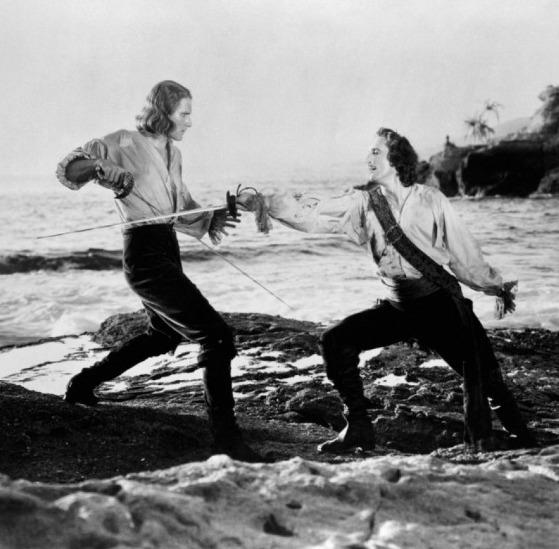
Errol Flynn and Swashbucklers, has there ever been an actor more associated with a particular genre? Possibly, but that does not change the fact that Flynn epitomized the swashbuckling hero in a way no other actor (with the possible exception of Douglas Fairbanks) to ever grace the silver screen has. Michael Curtiz's 1935 film Captain Blood, based on Rafel Sabatini's classic novel of the same name, was Flynn's first starring role, and he tackled it with the gusto of a seasoned professional; his costar (in the first of their eight pairings) was Olivia de Havilland, with the villains portrayed by Lionel Atwill and Basil Rathbone.
The film opens with Dr. Peter Blood being summoned in the night by Jeremy Pitt (Ross Alexander); he then proceeds to aid a friend wounded in the Monmouth rebellion. He is arrested for treason and condemned to death by hanging along with countless other "true rebels". On a whim of King James, Blood and a few others are sent to be sold as slaves in the Caribbean. He is bought by the lovely Arabella Bishop (Olivia de Havilland) and is sent to work on the plantation of her uncle: Colonel Bishop (a deliciously sinister Lionel Atwill). Sparks fly between Blood and the young Miss Bishop, even as Blood resents her immensely for her name and her ownership of him. As luck would have it, the governor of the island has the gout and requires the care of a skilled physician: enter Peter Blood. Blood and his fellow slaves plot escape, and an attack by the Spanish provides them an ideal opportunity. Sneaking aboard their ship in the night, they are able to capture the ship and decimate the Spanish with cannon-fire. Their coup is completed by their being able to escape with the ransom paid for by Colonel Bishop and by their humiliating the Colonel (Can you swim, Colonel?). Desperation dictates their path: they become a crew of buccaneers led by Captain Blood. While Captain Blood's fearsome reputation spreads rapidly throughout the Spanish main, he never forgets Arabella and despises the nature of his profession (he has a strict code of conduct for his crew that other pirates scoff at). An alliance with another pirate, Levasseur (Basil Rathbone), sets Captain Blood on a collision course with both Arabella and the possibility of redemption.
Errol Flynn and Olivia de Havilland, in their first starring roles, are magnetic as Captain Blood and Arabella Bishop. As Colonel Bishop, Lionel Atwill does a wondrous job as a man with both power and an inflated ego that has been spurned and humiliated by a (gasp) slave. Basil Rathbone is adequate, in terms of acting, as the French buccaneer Levasseur, but does what he was really hired to do (Rathbone had a reputation as the best fencer in Hollywood) magnificently. The duel between Captain Blood and Levasseur was both exhilarating and remarkably complex for a film from the thirties. The supporting players (Guy Kibbee, Ross Alexander, Henry Stephenson, among others) all do good jobs with their limited screen-time. Though the other performers give good performances, Flynn dominates the picture with his swagger and charisma. While watching, it comes as a surprise to note that this was his first lead (or even substantial) role; it is not a surprise that this is the role made him a star. Olivia de Havilland is radiant in the role of Arabella Bishop and makes the most of her limited screen-time. The on-screen pairing of de Havilland and Flynn was a risk, as both were unknowns, but the decision was brilliant: who else but Flynn could have played Blood?
The direction in the film is phenomenal, from the action scenes to the clever use of shadows, Curtiz does some of his best work in Captain Blood. Better known for his films Casablanca and The Adventures of Robin Hood (which also stars Flynn, de Havilland, and Rathbone), Michael Curtiz is often regarded as one of the most important and popular directors of early Hollywood. The naval battle scenes (filmed with complex and accurate miniatures) are fantastic and surprisingly realistic considering the lack of CGI. The set design is outstanding: it lends the film a considerable amount of legitimacy and effect on sight, something many other swashbuckling films lack.
A facet of the film that is of particular note is the score, one of the first composed by Erich Wolfgang Korngold. The score is both rousing and memorable, and is a large part of what makes the film so immensely enjoyable. The scores of Korngold are matched in influence only by (possibly) the scores of John Williams, such as those he composed for Star Wars and Superman. What makes Korngold's feat all the more impressive is that the score, which is over ninety percent original material, was composed in a mere three weeks.
Though it may lack the production values and fantastical elements of more recent pirate films (The Pirates of the Caribbean franchise, for example), Captain Blood still sets the bar for pirate adventures, with Flynn and de Havilland truly making it a (please forgive me for this lone nautical pun) voyage to remember.
8/10
Note: This review was previously posted on another blog I wrote.
Subscribe to:
Posts (Atom)