Pixar Animation's 2012 effort is Brave, a fantasy adventure set in Scotland directed by Mark Andrews and Brenda Chapman (who was replaced in the middle of production). Kelly Macdonald voices the flame-haired protagonist, Merida, while Emma Thompson, Billy Connolly, Kevin McKidd, Robbie Coltrane, Julie Walters, and Craig Ferguson also provide voices.
The film opens with a very young Merida, our tomboyish hero, playing hide and seek with her mother (Emma Thompson) while her father, the king (Billy Connolly), looks on. Shortly after recieving her birthday present, a bow, they are attacked by a large bear. Cutting to years later, Merida and her mother can now barely stand each other and her father is missing a leg from their encounter with the bear. Merida spends every spare moment she has practicing archery in the forest, when she doesn't have to practice being a proper, passive princess with her mother. Upon Merida finding out she is to be betrothed very soon (she isn't told until the suitors are practically on their doorstop), her contentious relationship with her mother comes to head. So, naturally, she encounters a witch and accidentally gets her mother turned into a bear, she gets a deadline to reverse the spell, and mother/daughter bonding ensues.
Firstly, I have to say, the animation is up to the usual high standards Pixar sets, though just about every other animation studio now active is up to those same high standards. The Scottish landscapes, in particular, are quite beautiful and detailed. The characters are expressive and fairly realistic looking, but some of the designs are distorted enough to provide a more wacky feel at times. The animation in the action-oriented sequences is very fluid, while not scrimping on the level of detail to be found in the landscapes.
The story, however, is extremely slight and seems like a first, and nowhere near a final, draft. The main problem with the script is that none of the characters are, well, likable: Merida is a spoiled brat, her mother is a tyrannical shrew, and her father (a king no less) is essentially a non-factor in her life aside from approving of her archery. Other issues with the film include no true villain, except for a bear with a way too convenient connection to the main plot, and a vague, poorly defined system of magic that doesn't seem to be a part of the universe at all aside from being a plot contrivance once or twice per act. The moral of the story, parents and children should talk to, not at, each other, is solid but the means of getting to that point are illogical. Merida and her mother both seemingly cave from their previous positions out of guilt, not understanding, when neither has been given a proper reason to do so.
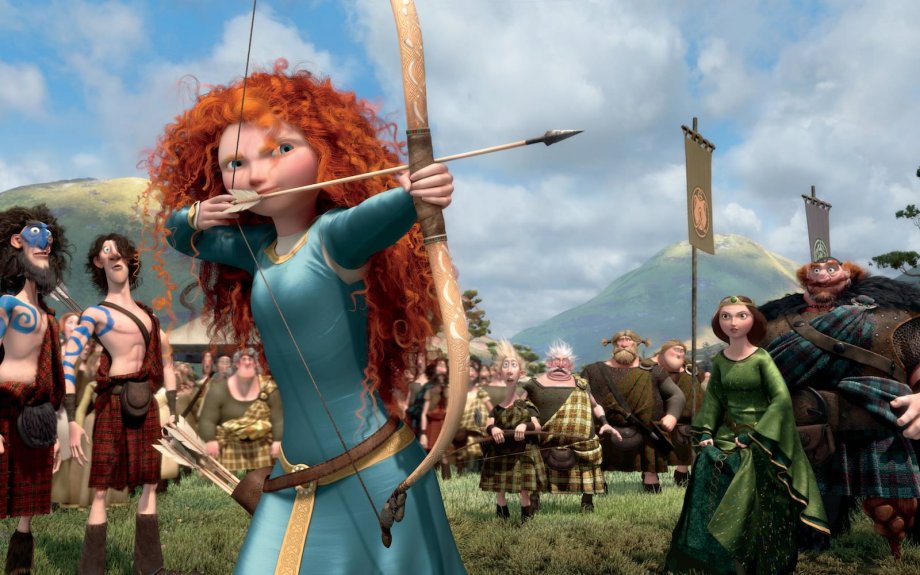
The voice acting is solid, though it seems a bit exaggerated when it comes to the Scottish-ness of it all, even though most of the voice actors are Scottish (or at least British), so I may just be hearing things. Kelly Macdonald is a convincing teenaged girl not wanting to be betrothed to an idiot (all of her choices are very much idiots) but she can't change the content of the paper-thin material she was given to work with. Every one else is competent but not extraordinary in voicing their roles.
In the end, Brave is probably the weakest Pixar film to date, and after a couple of mediocre outings, this is the first film they have done I would say is legitimately bad. Though the spunky heroine and the beautiful animation should keep kids entertained, even if it may be a bit dark for the very young, adults will probably wonder why a ninety minute film could have been able to have had forty minutes cut without losing any of the plot.
3/10
Showing posts with label Animation. Show all posts
Sunday, November 18, 2012
Friday, November 2, 2012
Castle in the Sky (1986)
A gang of pirates, a group of mysterious government agents chasing an orphaned young girl, a stone with mystical powers, and a plethora of familiar tropes from the steampunk aesthetic are just a few of the many pleasures that Hayao Miyazaki's 1986 film Castle in the Sky offers. The first release from Studio Ghibli, the famed Japanese animation powerhouse founded by the renowned animation directors Hayao Miyazaki and Isao Takahata. Made before Miyazaki became the world's premier animator with films such as Princess Mononoke and Spirited Away, it shows him while he was just beginning to incorporate many of the themes and elements present in his later films (as does his previous effort, Nausicaรค of the Valley of the Wind).
The film begins with a girl, Sheeta, under strict watch aboard an airship; a pirate raid provides her with a chance to escape, however she slips off the side of the ship and falls. As a mysterious stone she wears as a pendant begins to glow and slow her fall to a safe speed, a boy of the same age, Pazu, sees her as she falls and catches her. The next morning she wakes up in the boy's home (he is an orphan and lives alone); they become fast friends, though the pirates and government agents are hot on her trail. Sheeta and Pazu make their escape and realize that Sheeta is being pursued because of her connection to the mythical floating island of Laputa. Sheeta is captured by the government agents, led by the dastardly Colonel Muska. Pazu teams up with the pirates to rescue Sheeta, beginning a race to Laputa between Muska and the young pair, with consequences far greater than who gets the treasure.
The animation in the film, as is the case with all Miyazaki films, is both impeccable and gorgeous. The world in which the story takes place, similar to Europe of the early twentieth century (my best guess), is beautifully realized with vivid colors and a level of detail normally not usually seen in animated films. An example of this is present on the airship of the pirate gang, unlike the many films that make advanced vehicles spotless and images of efficiency. That is not the case here; it is how I would imagine a pirate ship would be: it is cluttered, in desperate need of repair, but it gets the job done (not unlike the Millennium Falcon in the Star Wars trilogy). Many of the scenes taking place in the clouds are shockingly realistic, particularly for a hand-drawn animated film.
If one is familiar with other Miyazaki works, many of the themes present will be familiar. There is a subtle environmental message, although it is far less prevalent than in some of his other works. A more prominent theme is that (the prospect of) absolute power corrupts absolutely. Miyazaki, a feminist, has a penchant for having strong, young female characters as the protagonist (in this case, one of the protagonists); Sheeta fits into this category well, courageous and intelligent, she demonstrates from the opening scene she is not a mere damsel in distress.
Castle in the Sky is a thoroughly entertaining animated fantasy film that happens to be the rare family film that is actually enjoyable for the entire family, and not just the little kids. Though it lacks some of the subtlety that has been trademark of more recent Miyazaki films, it is still a truly exceptional family film and a rollicking adventure story that just so happens to be a wonderful to look at.
9/10
Note: I watched the film in the original Japanese with English subtitles and not with the English dubbing.
Additional Note: This review was previously posted on another blog I wrote.
Grave of the Fireflies (1988)
There is seldom a film that cannot only make viewers feel saddened, but that can also make them grieve: Grave of the Fireflies is one of those rare films. Released in 1988 and directed by Isao Takahata, Grave of the Fireflies is one of the most acclaimed films from a studio (Studio Ghibli) that releases nearly every original effort to unanimous acclaim. Focusing on a pair of young Japanese siblings during World War II that are forced by circumstance to fend for themselves amidst all of the falling bombs and limited food rations.
The film begins with a starving boy dying alone in a train station among a crowd that hardly gives him a passing glance, he then begins to narrate his tragic story. During an air raid, Seita, a twelve year old boy, manages to guide himself and his five year old sister, Setsuko, to safety. Upon returning to a makeshift medical clinic, Seita discovers that their mother has been severely wounded (their father is fighting in the war) and their house has been consumed by the flames. Their mother's death leads to them being sent to live with an aunt in the countryside, with a select few possessions that they had buried in their backyard for safety. Soon, however, an initially warm welcome turns to coldness and, eventually, open hostility against the children for not doing their part in the war effort. Seita and Setsuko soon move out of their Aunt's home and take up shelter in an abandoned bomb shelter. A new lease on life quickly becomes desperation as the children slowly succumb to starvation.
Takahata crafted one of the most beautiful (and heartbreaking) animated films to ever be released; set primarily in the Japanese countryside, the gorgeous scenery manages to offset the horrific subject matter just enough to avoid distracting from the film's darker aspects. In the typical anime fashion, the characters have enlarged eyes and exaggerated facial features; these details allow for the effective and easy conveyance of emotions, and the technique is very effective here. The animation, though beautiful, is at times both shocking and horrifying, such as when Seita sees his mother's bloodied and bandaged body after the air raid.
The film's greatest strength is its acknowledgment of what war can really do to the people left behind. Many films about the non-soldiering victims of war seem to portray the adversity as a means towards the affirmation of some noble character's morality (think Schindler's List). In Grave of the Fireflies there is no moral issue, the anti-war message being an exception, the only issue for the characters in this particular film is survival. Throughout the film, Seita and Setsuko demonstrate their desperation and their willingness to do whatever it takes to survive, whether it be scavenging for food or theft.
The film's narrative is strong, though the story is not inherent to WWII Japan; the same narrative (with some tweaks) could have taken place in nearly any war-torn country on the recieving side of an invasion. The supposed anti-American message that some people claim to perceive in the film, is non-existent. In fact, I do not believe that there is any mention of the United States at any time during the film.
Grave of the Fireflies is a truly great film and, despite its being animated (which is not a medium only for children), is both a very adult and profoundly moving effort from director Isao Takahata and Studio Ghibli. I have only one thing to say to you if you are not saddened by this film: you are not human.
10/10
Note: This review was previously posted on another blog I wrote.
Subscribe to:
Posts (Atom)