Showing posts with label Romance. Show all posts

Friday, November 2, 2012

Romeo and Juliet (1968)


William Shakespeare, though often regarded as being history's greatest playwright, is (falsely) regarded as being too "dry" or "dated" by many modern readers.  The irony of this is that the plays of Shakespeare have as much sex (implied sex, but sex) and violence as your average soap opera.  Franco Zeffirelli's 1968 version of Romeo and Juliet is one of the most famous Shakespeare adaptations; this version is unique in that it cast appropriately aged actors to play the star-crossed lovers: the fifteen year old Olivia Hussy and the seventeen year old Leonard Whiting portrayed Juliet and her Romeo.

Romeo and Juliet are the scions of two rival noble families (the Montagues and the Capulets) in Verona, Italy.  At as masquerade ball hosted by the Capulets, a disguised Romeo manages to catch a glimpse of Juliet for the first time and becomes smitten.  The young pair quickly fall for each other and soon make secret vows to wed, though their families' violent feud threatens to derail their romantic plans.  A series of duels and a fatal miscommunication lead up to a tragic climax in the full Shakespearean fashion (everybody dies).

Franco Zeffirelli (the premiere director of Shakespearean adaptations after Laurence Olivier, who narrates this film) chose to adapt Romeo and Juliet following his critically acclaimed version of The Taming of the Shrew.  Zeffirelli did one thing in particular to allow this film to work, he cast actors that were actually of an appropriate age (previous versions had cast thirty-somethings) to play the pair.  Hussy and Whiting were fifteen and seventeen, respectively, during filming and are able to provide legitimacy to the plot; it is difficult to imagine casting thirty-year olds and having them be believable teenage lovers.  Michael York, in an early role, is great as the hot-headed Tybalt, as is John McEnery as the flamboyant Mercutio.

There is little to say about the plot other than that it fits into the mold of the standard Shakespearean tragedy; the dialogue is taken directly from the play and is brilliant (as is to be expected from the Bard).  Hussy and Whiting do well with the material, though they struggle to make their many soliloquies sound both spontaneous and natural.  The plot is considerably trimmed down and simplified from the text, as a runtime of four or five hours is unrealistic for a theatrically released film (though not unheard of).  The main problems that eliminating significant elements from the plot brought about is that it simplified the motivations of many of the characters and all but completely eliminated one of the key players.

Zeffirelli's version of Romeo and Juliet is a competent, if simplified, take on Shakespeare's tragedy about the two lovers that has attractive leads and a talented cast.  The film runs into many of the problems that typically face Shakespeare plays that have been brought to the big screen, but that is to be expected.  In the end, it is perfect for the role that it has been serving for years: being the film that high school students see after reading the play, with twenty-seconds where the teacher "accidentally" fast forwards over nudity.

7/10

Note: This review was previously posted on another blog that I wrote.

Gentlemen Prefer Blondes (1953)


Lorelei Lee is the type of girl that can spot a diamond ring in a man's pocket while performing on stage underneath the bright lights.  Dorothy Shaw, her best friend and fellow showgirl, is only looking for a good time and could care less if her future husband is rich (just as long as he's good looking).  They are the two central characters at the center of Howard Hawks' amiable, if shallow, musical Gentlemen Prefer Blondes.  Marilyn Monroe and Jane Russell star as Lorelei Lee and Dorothy Shaw in the 1953 film, their costars include Charles Coburn, Elliott Reid, and Tommy Noonan.

The film begins with Lorelei and Dorothy performing a musical number on-stage to the delight of a crowd that includes Gus Esmond (Tommy Noonan), Lorelei's wealthy husband-to-be.  Lorelei's reason for loving Gus is that he is willing to do anything she wants, and he has the money to do so.  Gus' father disapproves of their union, he (correctly) thinks that Lorelei is a gold-digger; the elder Esmond forbids Gus from going on a planned trip with Lorelei and Dorothy to Paris: Lorelei and Dorothy go ahead as planned.  The elder Esmond, suspecting Lorelei may do something not becoming a respectable young lady, hires Malone (Elliott Reid), a private detective to spy on her.  While on the ship Lorelei's becomes interested in "Piggy" Beekman (Charles Coburn), the owner of a very profitable diamond mine; Dorothy is interested by the men's Olympic team...and Malone (the Olympic team has a strict curfew).  As Dorothy is charmed by Malone, Lorelei sets her sights on using her "charm" to acquire Piggy's wife's prized diamond tiara (Lorelei just can't resist diamonds).  Dorothy discovers Malone's true reason for taking the trip and plots to beat him at his own game; all the while Lorelei's success at her own "game" threatens to lead to her losing everything: Gus, her freedom, and possibly most important of all: her diamonds.

Monroe and Russell both do solid work as the showgirls looking for love and a good time.  As the ditsy Lorelei, Monroe demonstrates why she is remembered as a capable comic actress.  Russell does her job well, playing the (relatively) straight-woman to Monroe's ridiculously over the top character.  The supporting players perform admirably, but neither they, nor the leading ladies, can compensate for the fact that nearly every character is despicable.  Lorelei is a gold-digger (and proud of it) willing to coerce a man into giving up his wife's most prized possession because it looks pretty.  The film frames this act as a shrewd move by Lorelei; in reality, such an act is both wretched and malicious.  Russell's Dorothy is witty, but in her own way is as equally as shallow as Lorelei.  Elliott Reid is solid as Malone, but he really doesn't have much to do as Russell's love-interest.  Tommy Noonan is convincing as the passive Gus Esmond; but that fact does not help the movie, as a character that is supposed to be likable, it is hard to do little more than crack a bemused smirk at the way he is treated by Lorelei.

The film is beautifully filmed in Technicolor, the colors are vibrant and match the bubbly tone of the film and do the lovely leading ladies justice.  The film, directed by a seasoned Howard Hawks, has well choreographed and entertaining musical numbers; though the music itself is clichéd and underwhelming.  The most famous number, "Diamonds Are a Girl's Best Friend," is deservedly iconic as a musical number, but as the message for a film (the film's message amounts to that, essentially), it is completely superficial and utterly revolting.

Gentlemen Prefer Blondes has many of the typical trademarks of a standard fifties era musical: a predictable plot, spirited leads, and heavily choreographed musical numbers.  Despite its renown and fond place in many a memory, Gentlemen Prefer Blondes amounts to little more than mediocre musical fare with protagonists that are actually quite hard to like.  Though, Marilyn Monroe and Jane Russell truly do shine in the lead roles.

4/10

Note: This review was previously posted on another blog I wrote.

Breakfast at Tiffany's (1961)


The standard run-of-the-mill romantic comedy involves several, almost universal, details: two friends with undeniable chemistry, other romantic interests for each of the would-be lovers, and a schmaltzy scene at the end where they get together.  Blake Edwards' 1961 film Breakfast at Tiffany's is a standard run-of-the-mill romantic comedy in almost every detail, except for one: the two leads are both glorified prostitutes, and that makes all the difference.  Audrey Hepburn stars as Holly Golightly and George Peppard  plays Paul Varjak in this adaptation of Truman Capote's classic novel of the same name.  It was nominated for five Academy Awards and won two for best original score and best song.

The film centers on Paul Varjak, an aspiring (but not successful) writer and kept man, and his befriending and falling in love with his unique and off-beat neighbor Holly Golightly, an escort and gold-digger.  Holly, while intriguing and magnetic, is deeply troubled and has a hidden past that does not stay dormant for long.  Although adapted from the Truman Capote novel, the final product is considerably different from Capote's classic.  One major detail that is changed from the novel is the romance between Holly and Paul (unnamed in the novel); in the novel there isn't one.  The novel has richer themes and is more realistic in the way the plot develops, but the story is considerably less cinematic.

The acting in the film is uniformly adequate, with the exception of two performances that truly elevate the film to heights it would not have reached without them.  Audrey Hepburn, in possibly her most iconic role, as Holly Golightly is nothing short of magnificent and without her performance, the film would not be regarded as a classic.  It should be noted that Marilyn Monroe was Capote's preferred choice to play Holly, and was furious when the studio signed Hepburn.  It should also be noted: the studio made the right choice.  The other performance that must be acknowledged is the portrayal of Doc, Holly's much older husband from a past life, by Buddy Ebsen.  Ebsen makes the absolute most of his few minutes of screen-time and manages to illicit (necessary) reactions of pity and disgust from the audience.  Without Ebsen in the role of Doc, the rest of the film may not have meshed succesfully.  Peppard, though a lead, is merely adequate in his role and is completely overshadowed by Hepburn, who is at her most radiant.  An aspect of the film that detracts from the overall experience is the portrayal of Mr. Yunioshi by Mickey Rooney.  Rooney gives a broad stereotype of an Asian person that can only be described by one word: appalling.  It is completely unnecessary and his limited screen-time almost ruins the film's overall tone.

The film's score, composed by Henry Mancini, is phenomenal and sets the tone beautifully.  The song "Moon River", performed by Hepburn in character as Golightly, fits perfectly into the film and it is easy to see why both the score and the song won Oscars for Mancini.  In addition to the music, the cinematography is absolutely gorgeous and the shots of New York City captured by the crew have almost no equal in the cinema of any era.  The film is a demonstration of how good filming and a great score can elevate a film to new levels.

Breakfast at Tiffany's, though possibly not living up to its literary inspiration, is a very good example of a romantic comedy that knows what it is and makes the absolute most of it.  Though clearly not a comic or dramatic masterpiece, it is a demonstration of Audrey Hepburn in one her greatest roles and at her most luminous.  Overall it is a very good watch that has stood the test of time extremely well.

8/10

Note: This review was originally posted on another blog I wrote.

The Heiress (1949)


Shy and plain, the wealthy Catherine Sloper is courted by the charming and handsome Morris Townsend; her successful father suspects other motives than love for the attention Morris lavishes upon his daughter.  Adapted from Washington Square, the classic novel by Henry James, William Wyler's 1949 film The Heiress stars Olivia de Havilland, Montgomery Clift, and Ralph Richardson.  An examination the relationships between Catherine and Morris and between Catherine and her father, The Heiress showcases Wyler, de Havilland, and Richardson at their absolute best.

The film begins with Catherine Sloper (Olivia de Havilland) preparing for a party she is attending with her father (Ralph Richardson) and aunt, she decides to wear one of her mother's dresses: her father says she looks good in the dress, but not nearly as good as her mother did.  Catherine is both plain and painfully shy, and her father believes that she is of little worth aside from her wealth and will never find a respectable husband, though her aunt seems to believe otherwise.  At the party she meets the charming Morris Townsend (Montgomery Clift), who seems to be very much interested.  Over the course of a few days, Morris calls on Catherine several times, eventually her father invites him to dine with the family; at dinner it becomes apparent that he is penniless, while Catherine is poised to inherit a substantial sum. Morris and Catherine become engaged shortly thereafter, prompting much strife with her bitter father who believes (with very good reason) that he is only after her money.  Catherine and her father's battle of wills leads to a revelation that will shake Catherine to her core, and do irreparable damage to their (already strained) relationship and the relationship between Catherine and Morris.

Olivia de Havilland, as the heiress of the title, is simply phenomenal in the lead; she convincingly portrayed Catherine as the naive and emotionally starved girl she was at the beginning, as well as the bitter and jaded spinster she is at the end.  As the emotionally abusive Dr. Sloper, Ralph Richardson is great; he successfully conveyed  the disappointment, the bitterness, and the longing for the unattainable necessary to make the character work. In particular, his conveyance of the character's idealized vision of his late wife was subtle, but very effective.  It is hardly a stretch to imagine a child would be neglected in a household in which they are not worthy unless they equal the father's idealized vision of the late mother.  As Morris, Catherine's morally ambiguous would-be husband, Montgomery Clift gives one of his best early performances, though he is overshadowed by the masterful performances given by both de Havilland and Richardson.

The film's storyline has the right mix of drama, romance, and surprise to make it both a riveting and a memorable watch.  In contrast to most films of any era, I was unable to discern the ending of The Heiress until a final scene that is both triumphant and sorrowful.  The romance between Catherine and Morris is sweet at the beginning, it is hard not to smile while the love-starved Catherine is being wooed for the first time in her life, and extremely bitter at the end.  Though most romance films focusing on a gold-digging men trying to seduce a homely, but wealthy, woman are typically very black and white in their morality; that is not the case in The Heiress.  It begs a question often dismissed: can a marriage based on looks (Morris) and money (Catherine) be happy, or is love necessary?  Wyler does a very wise thing in the film: he asks that question, but chooses not to answer it, and that makes the film truly memorable.  

The technical aspects of the film are exceptional, it is filmed to great effect in black and white befitting the subject matter.  The makeup on Olivia de Havilland is done well; it makes her look plain (which she wasn't) and like herself, which is often difficult for makeup artists to do, even with today's technology.  The (Academy Award winning) costumes are phenomenal, the entire cast is able to perform well without looking out of place in the 19th century dress.

William Wyler, one of the most versatile directors in cinematic history, crafted a romantic-drama that is disturbing, shocking, and thoroughly memorable.  All in all, The Heiress is a masterpiece of the highest order, featuring one of the greatest performances by Olivia de Havilland (deservedly winning her second Oscar for the film), one of cinema's greatest actresses.

10/10

Note: This review was previously posted on another blog I wrote.

Captain Blood (1935)


Errol Flynn and Swashbucklers, has there ever been an actor more associated with a particular genre?  Possibly, but that does not change the fact that Flynn epitomized the swashbuckling hero in a way no other actor (with the possible exception of Douglas Fairbanks) to ever grace the silver screen has.  Michael Curtiz's 1935 film Captain Blood, based on Rafel Sabatini's classic novel of the same name, was Flynn's first starring role, and he tackled it with the gusto of a seasoned professional; his costar (in the first of their eight pairings) was Olivia de Havilland, with the villains portrayed by Lionel Atwill and Basil Rathbone.

The film opens with Dr. Peter Blood being summoned in the night by Jeremy Pitt (Ross Alexander); he then proceeds to aid a friend wounded in the Monmouth rebellion.  He is arrested for treason and condemned to death by hanging along with countless other "true rebels".  On a whim of King James, Blood and a few others are sent to be sold as slaves in the Caribbean.  He is bought by the lovely Arabella Bishop (Olivia de Havilland) and is sent to work on the plantation of her uncle: Colonel Bishop (a deliciously sinister Lionel Atwill).  Sparks fly between Blood and the young Miss Bishop, even as Blood resents her immensely for her name and her ownership of him.  As luck would have it, the governor of the island has the gout and requires the care of a skilled physician: enter Peter Blood.  Blood and his fellow slaves plot escape, and an attack by the Spanish provides them an ideal opportunity.  Sneaking aboard their ship in the night, they are able to capture the ship and decimate the Spanish with cannon-fire.  Their coup is completed by their being able to escape with the ransom paid for by Colonel Bishop and by their humiliating the Colonel (Can you swim, Colonel?).  Desperation dictates their path: they become a crew of buccaneers led by Captain Blood.  While Captain Blood's fearsome reputation spreads rapidly throughout the Spanish main, he never forgets Arabella and despises the nature of his profession (he has a strict code of conduct for his crew that other pirates scoff at).   An alliance with another pirate, Levasseur (Basil Rathbone), sets Captain Blood on a collision course with both Arabella and the possibility of redemption.

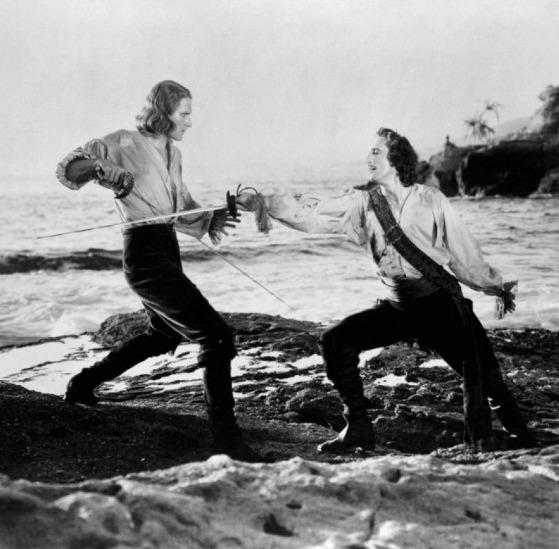
Errol Flynn and Olivia de Havilland, in their first starring roles, are magnetic as Captain Blood and Arabella Bishop.  As Colonel Bishop, Lionel Atwill does a wondrous job as a man with both power and an inflated ego that has been spurned and humiliated by a (gasp) slave.  Basil Rathbone is adequate, in terms of acting, as the French buccaneer Levasseur, but does what he was really hired to do (Rathbone had a reputation as the best fencer in Hollywood) magnificently.  The duel between Captain Blood and Levasseur was both exhilarating and remarkably complex for a film from the thirties.  The supporting players (Guy Kibbee, Ross Alexander, Henry Stephenson, among others) all do good jobs with their limited screen-time.  Though the other performers give good performances, Flynn dominates the picture with his swagger and charisma.  While watching, it comes as a surprise to note that this was his first lead (or even substantial) role; it is not a surprise that this is the role made him a star.  Olivia de Havilland is radiant in the role of Arabella Bishop and makes the most of her limited screen-time.  The on-screen pairing of de Havilland and Flynn was a risk, as both were unknowns, but the decision was brilliant: who else but Flynn could have played Blood?

The direction in the film is phenomenal, from the action scenes to the clever use of shadows, Curtiz does some of his best work in Captain Blood.  Better known for his films Casablanca and The Adventures of Robin Hood (which also stars Flynn, de Havilland, and Rathbone), Michael Curtiz is often regarded as one of the most important and popular directors of early Hollywood.  The naval battle scenes (filmed with complex and accurate miniatures) are fantastic and surprisingly realistic considering the lack of CGI.  The set design is outstanding: it lends the film a considerable amount of legitimacy and effect on sight, something many other swashbuckling films lack.

A facet of the film that is of particular note is the score, one of the first composed by Erich Wolfgang Korngold.  The score is both rousing and memorable, and is a large part of what makes the film so immensely enjoyable.  The scores of Korngold are matched in influence only by (possibly) the scores of John Williams, such as those he composed for Star Wars and Superman.  What makes Korngold's feat all the more impressive is that the score, which is over ninety percent original material, was composed in a mere three weeks.  

Though it may lack the production values and fantastical elements of more recent pirate films (The Pirates of the Caribbean franchise, for example), Captain Blood still sets the bar for pirate adventures, with Flynn and de Havilland truly making it a (please forgive me for this lone nautical pun) voyage to remember.

8/10

Note: This review was previously posted on another blog I wrote.

Singin' in the Rain (1952)


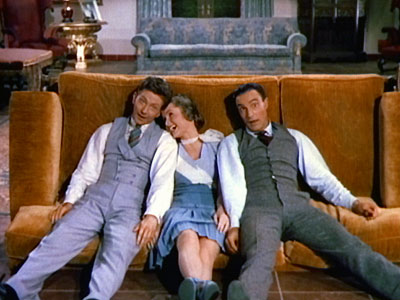
Gene Kelly, one of the true masters of the classic Hollywood musical (along with Fred Astaire, among a select few others), is best remembered for the 1952 classic Singin' in the Rain that he starred in and also co-directed with Stanley Donen.  Kelly's costars were Debbie Reynolds, Donald O'Connor, Jean Hagen, and Cyd Charisse (or Cyd Charisse's legs, depending on your viewpoint).


The film opens with an immensely popular on-screen duo arriving to the premier of their new movie; Don Lockwood and Lina Lamont (whose voice is only slightly less grating than nails on a chalkboard) are commonly linked romantically in their films by the studio and (falsely) by the tabloids.  After an awkward first meeting and an even more awkward second one, Lockwood becomes smitten with a talented wannabe stage-actress named Kathy Selden.  The release of The Jazz Singer heralds the age of the talkies and, as a result, the filming of the  new Lockwood and Lamont picture is fraught with many of the problems facing early sound film; the reactions of a test audience are discouraging (to say the absolute least).  Along with his best friend Cosmo, Kathy, and the studio-head, Don conspires to turn the film into a musical with Kathy dubbing all of Lina's lines and musical numbers; but in Hollywood things are never quite that simple and Lina won't take being usurped by a much more tolerable person like Kathy Selden lying down.


The musical numbers throughout the film are catchy and filled with dance sequences liable to make your jaw drop.  Numbers such as "Make 'Em Laugh" and the titular "Singin' in the Rain" earned their iconic status for their addictive lyrics and the stunning athletic ability demonstrated by the performers (Kelly and O'Connor in particular).  In addition, despite the film's (deservedly) family-friendly moniker, there is a very sultry (and quite memorable) dance sequence between Gene Kelly and Cyd Charisse.

The acting in the film is exceptional for a musical, as usually there is a choice to be made between a good actor or a good singer/dancer, but Kelly, Reynolds, and O'Connor could do both with the best of them.  At times, the film got a bit too hammy for its own good, but those moments were few and far between as Gene Kelly and Stanley Donen managed to maintain the ideal tone for a great majority of the film.  The film's plot is both enjoyable and interesting, with just a dash of historical relevance thrown in for good measure; Lina Lamont is based on an actual actress (though it is a highly unfair characterization of that said actress) that fizzled shortly after the talking pictures rose to prominence, while Don Lockwood's silent-film persona seems to be heavily based off of Douglas Fairbanks.

Remembered as the most beloved of Gene Kelly's musicals, Singin' in the Rain is an infectious and highly enjoyable ride from start to finish that has stood the test of time in a way that very few musicals have matched.  This particular tale of Hollywood celebrity is bound to leave a smile on the face of anyone who watches it, with a villain in Lamont that is just malicious enough for all the cynics out there to be satisfied.

9/10

Note: Lina Lamont constantly exasperatingly exclaims, "What do you think I am, dumb or something?" I feel the need to give her an answer: yes.

Additional Note: This review was previously posted on another blog I wrote.

Thursday, November 1, 2012

Risky Business (1983)


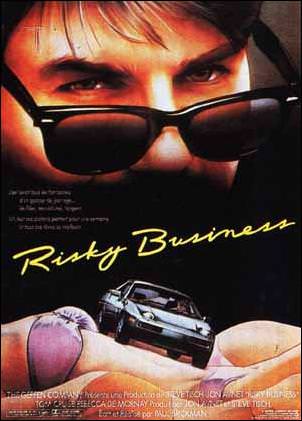
"Sometimes you just gotta say 'What the f*ck', make your move."  That is the advice repeated in many forms to many people by many people throughout the course of the 1983 film Risky Business.  The film, directed by Paul Brickman and starring Tom Cruise, concerns the fortunes of Joel Goodson, a teenage Reaganite living in a wealthy suburb of Chicago.  Functioning equally well on three levels: the film is a capable teen sex romp, romantic comedy-drama, and brutal satire of the money-culture of the eighties.


The film begins with Joel reciting a (steamy) dream he had the night before about a beautiful girl...and his fears of inadequacy.  It is revealed that Joel's parents are going out of town for the week and leaving him to take care of the house, impress the interviewer from Princeton, and to drive the station wagon rather than the Porsche.  His friend Miles gives him the advice stated above and he embarks on a path that sets him on a collision course with the future, love, and Guido the killer pimp.  Alone, he takes Miles' advice and has some fun: he plays cards, he goes driving (hint: he does not take the station wagon), he dances to "Old Time Rock N' Roll", and he calls a call-girl.  The call-girl, Lana is described as what "every white boy off the lake wants," and Joel, presumably off the lake, wants her.  In the morning, he cannot afford her price without going to the bank, he leaves to only return to a house sans Lana and without his mother's prized Steuben glass egg.  He searches for her, finds her, and ends up with a house full of prostitutes, a Porsche in Lake Michigan, a pair of over-sized Ray Ban sunglasses, a series of warnings from an unhinged pimp, and an opportunity to make a lot of money.

The acting in the film is consistently excellent and it is clear why Tom Cruise truly became Tom Cruise after this film.  Rebecca De Mornay, as Lana, takes the typically thankless role of the prostitute/love-interest and gives it unexpected depths in creating a truly fascinating character that deserved more screen-time (and Lana had a considerable amount of screen-time).  As Guido the killer pimp, Joe Pantoliano goes completely unhinged and is both terrifying and endearing: we truly believe him as he says he likes Joel, while simultaneously threatening to kill him.  This film shows Tom Cruise as he was before his personal life got in the way of his career, when he was just a promising young talent.


The film's true worth lies in what it reveals below its surface: the film is a resounding condemnation of the economic principles the eighties stood for.  A conversation between friends early in the film reveals this message clearly.  Joel asks his friends if they would rather do something worthwhile with their lives or just make money.  They looked at him, mildly amused, and responded with a resounding claim of what they wish to accomplish: to make money.  The satire is very effective and almost goes unnoticed; essentially every character in the film is a capitalist first and a person second.  If Joel and Lana weren't so likable, they would be thought of as despicable (he turned his home into a brothel, come on).  It is quite easy to imagine Tom Cruise's Joel turning into the Charlie Sheen character in Oliver Stone's Wall Street after a decade or so.

Risky Business was released in 1983 and is clearly an eighties film, almost painfully so.  From the fashion to the score to the attitudes, the film practically screams its release date.  Luckily for the film, it does almost nothing to hinder its effect; if anything, the fact that it is dated only adds to the satirical aims condemning the culture to which all of these little capitalists so cheerfully belong.

Brutally satiric, wickedly funny, and proudly raunchy, Risky Business is a film that has earned its reputation and deserves to be regarded among the best of the coming of age films.  Its stars, Tom Cruise and Rebecca De Mornay, shine and give star-making performances.  Cruise used the (well-deserved) momentum from this film to end up being one of the biggest stars in the world; De Mornay did not become the big star that she should have been following this film, but she did a stellar job none the less.  The film has many merits, few pitfalls, and is well worth your time.  Follow Miles' advice, say "What the f*ck" and watch Risky Business.

9/10

Note: This review was previously posted on another blog I wrote.