Showing posts with label Foreign Language. Show all posts
Friday, November 2, 2012
Cinema Paradiso (1988)
In a list of great films about the raw power of cinema, Italian director Giuseppe Tornatore's 1988 film Cinema Paradiso would almost always come in first. There is not much I could say about this film that has not already been said, it won the Best Foreign Language Film Oscar and the Special Jury Prize at the Cannes Film Festival among countless other honors. If you appreciate the power of the silver screen Cinema Paradiso will undoubtedly make you smile.
The film primarily concerns the growing up of young Salvatore "Toto" Di Vita and his relationships with his mentor Alfredo, his first love Elena, and his town's movie theater (the titular Cinema Paradiso). Told mostly through flashbacks, Salvatore is a successful film director returning home for the first time in thirty years for the funeral of Alfredo. It focuses on Salvatore as a young boy when he first made a connection with Alfredo (the theater's projectionist) and his adolescent years when he became the theater's projectionist and experienced the pangs of young love.
The film is enjoyable all of the way through; that being said, the first half regarding the younger Salvatore and his falling in love with cinema is by far superior to the portion focusing on the adolescent Salvatore (which is also quite good). The story is unabashedly manipulative, and while I usually dislike that particular trait: it works. Some parts of the film tend to drag, but it is by no means a boring film and I can all but guarantee that a smile will form on your face (if one hadn't already) the moment the credits begin to roll.
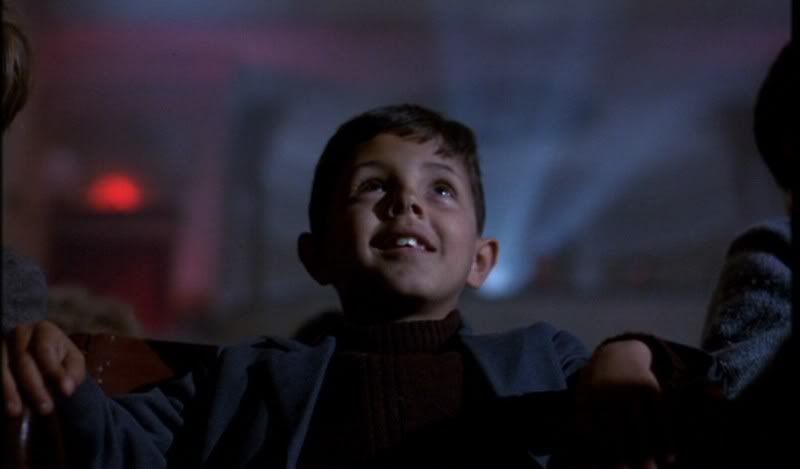
If the film has a weak element, of which there are almost none, it would be the acting. The actors that play Salvatore (all three ages) and Alfredo do exemplary jobs; and in the case of Alfredo: an extraordinary job. Philippe Noiret can only be described as masterful in this heartbreaking performance (you will tear up when he says his goodbyes to Salvatore). In stark contrast to Noiret's performance, many of the supporting characters are portrayed as wooden or caricatured and while it does not hinder the film on the whole, it is frustrating none the less.
The film, while clichéd and manipulative, has a raw power that is just unmatched when it comes to almost every other film about the coming of age of a young man. Part of this power must be attributed to the medium through which Salvatore finds himself: cinema. The kiss-montage at the end of the film exemplifies this perfectly and gives the film a fitting send-off.
As a fan of all genres, there are few traits I relish more in a film than the ability to blend genres successfully: Cinema Paradiso is near-perfect blend of drama, comedy, and romance. If you are a fan of cinema and understand that a good film is so much more than just a time-waster: Cinema Paradiso demands to be seen.
9/10
Note: I felt it fitting that my blog, which sprung from my love of film, begins with the review of a film about the love of film.
Additional Note: This review was previously posted on another blog I wrote.
Grave of the Fireflies (1988)
There is seldom a film that cannot only make viewers feel saddened, but that can also make them grieve: Grave of the Fireflies is one of those rare films. Released in 1988 and directed by Isao Takahata, Grave of the Fireflies is one of the most acclaimed films from a studio (Studio Ghibli) that releases nearly every original effort to unanimous acclaim. Focusing on a pair of young Japanese siblings during World War II that are forced by circumstance to fend for themselves amidst all of the falling bombs and limited food rations.
The film begins with a starving boy dying alone in a train station among a crowd that hardly gives him a passing glance, he then begins to narrate his tragic story. During an air raid, Seita, a twelve year old boy, manages to guide himself and his five year old sister, Setsuko, to safety. Upon returning to a makeshift medical clinic, Seita discovers that their mother has been severely wounded (their father is fighting in the war) and their house has been consumed by the flames. Their mother's death leads to them being sent to live with an aunt in the countryside, with a select few possessions that they had buried in their backyard for safety. Soon, however, an initially warm welcome turns to coldness and, eventually, open hostility against the children for not doing their part in the war effort. Seita and Setsuko soon move out of their Aunt's home and take up shelter in an abandoned bomb shelter. A new lease on life quickly becomes desperation as the children slowly succumb to starvation.
Takahata crafted one of the most beautiful (and heartbreaking) animated films to ever be released; set primarily in the Japanese countryside, the gorgeous scenery manages to offset the horrific subject matter just enough to avoid distracting from the film's darker aspects. In the typical anime fashion, the characters have enlarged eyes and exaggerated facial features; these details allow for the effective and easy conveyance of emotions, and the technique is very effective here. The animation, though beautiful, is at times both shocking and horrifying, such as when Seita sees his mother's bloodied and bandaged body after the air raid.
The film's greatest strength is its acknowledgment of what war can really do to the people left behind. Many films about the non-soldiering victims of war seem to portray the adversity as a means towards the affirmation of some noble character's morality (think Schindler's List). In Grave of the Fireflies there is no moral issue, the anti-war message being an exception, the only issue for the characters in this particular film is survival. Throughout the film, Seita and Setsuko demonstrate their desperation and their willingness to do whatever it takes to survive, whether it be scavenging for food or theft.
The film's narrative is strong, though the story is not inherent to WWII Japan; the same narrative (with some tweaks) could have taken place in nearly any war-torn country on the recieving side of an invasion. The supposed anti-American message that some people claim to perceive in the film, is non-existent. In fact, I do not believe that there is any mention of the United States at any time during the film.
Grave of the Fireflies is a truly great film and, despite its being animated (which is not a medium only for children), is both a very adult and profoundly moving effort from director Isao Takahata and Studio Ghibli. I have only one thing to say to you if you are not saddened by this film: you are not human.
10/10
Note: This review was previously posted on another blog I wrote.
Thursday, November 1, 2012
Yojimbo (1961)
It is a truly strange thing for a Samurai film to have all but invented a new genre of film: the Spaghetti Western. It may be strange, but Akira Kurosawa's Yojimbo was directly adapted into Sergio Leone's A Fistful of Dollars and star Toshiro Mifune's unnamed protagonist was the basis for Clint Eastwood's star-making character: the Man with No Name. Released in 1961, Yojimbo was one of the sixteen collaborations between Kurosawa and Mifune (of which nearly every one is a classic).
Greatly influenced by American Western films, particularly those directed by John Ford, Yojimbo is much more "Western" than most Japanese films. The setting of the film is undeniably influenced by the Western: a small dusty town riddled with crime. The main differences are that the drink of choice is sake instead of whiskey, and the fights involve samurai swords, not revolvers. Although Yojimbo is a homage to the Western genre, it has a significant element of parody; for example, Kurosawa totally disregards the morality presented in most Westerns. Toshiro Mifune's unnamed hero is almost completely amoral and is one of cinema's prime examples of the anti-hero.
Toshiro Mifune, the most famous Japanese actor of his time, does some of his best work in the film playing the morally-ambiguous samurai that becomes nearly superhuman with a blade in his hand. Mifune, a skilled dramatic actor, also has great comic timing that shines through the entire film. His interactions with most of the characters are marked by their humor: from the restaurant owner who gives him free food to the crime lords bidding for his services. The humor present throughout the film is what makes it a particularly special movie-going experience: it combines the virtues of the over-serious Westerns that were Yojimbo's primary inspirations with light parody. The humor in the film comes in between moments of gritty realism: the first thing the protagonist sees when he walks into the town is a dog with a severed human hand in its mouth.
The film is an example of crowd-pleaser in its purest form; it has a lead with a sharp tongue and an even sharper sword, plenty of action sequences, villains you love to hate, and a lead with legitimate star-power. Yojimbo is hardly Kurosawa's most important or greatest film, but it is enjoyable from start to finish and enormously influential.
8/10
Note: This review was previously posted on another blog I wrote.
Subscribe to:
Posts (Atom)
