Showing posts with label Silent Film. Show all posts

Friday, November 2, 2012

The Mark of Zorro (1920)


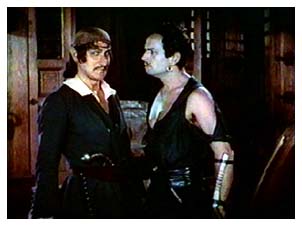
A tavern full of corrupt soldiers complains of a masked vigilante fighting for the poor and the oppressed: Zorro.  Douglas Fairbanks stars as the dashing hero in one of his first swashbuckling roles (in one of the first swashbucklers) in the first cinematic adaptation of the iconic Zorro character: The Mark of Zorro.  Directed by Fred Niblo, one of early cinema's most important innovators, the silent film was released in 1920 and became a huge hit at the box office, turning the athletic Fairbanks from a comic actor into a swashbuckling superstar.

The film is set in a Spanish controlled California, where the government has been increasingly oppressive and corrupt to the natives and the poor.  A few months prior to the beginning of the film, the apparently foppish Don Diego Vega has returned home from being educated in Spain.  Shortly thereafter, reports began circulating about a masked vigilante, Zorro, terrorizing those who abuse their power and oppress the weak.  Don Diego's father, frustrated with his effete and seemingly idle son, informs him that he needs to marry; the lovely Lolita Pulido, of a good family with current financial troubles, is his fiancĂ©-to-be of choice.  Lolita despises (with good reason) Don Diego for his behavior and rudeness, (while courting, it is probably best not to say finding a wife is "such a nuisance") but falls for the charming and dashing Zorro.  As the manhunt for Zorro heats up, Lolita and everyone else will be shocked by Zorro's (timely) revelation of his true identity: Don Diego Vega.

Douglas Fairbanks, though not a great actor in the traditional sense, had the tools that made him a (if not the) ideal swashbuckling hero: he sparkled with ebullience in every scene, he had a charisma and natural screen-presence almost unmatched among the screen-stars of any decade, and he had a prodigious athletic ability that make his stunts (done without the use of special effects) breathtaking both then and now.  The supporting players are game and charismatic, the two qualities required of a supporting actor in a film such as this.  Though every performer does their job well, Fairbanks truly steals the show; it is no mystery why he was asked to portray many of the other great swashbuckling heroes after this film (D'Artagnan, Robin Hood, the son of Zorro).

Though The Mark of Zorro is a silent film, the use of the intertitles does not slow the film's pace or hinder the enjoyment of it.  The film's lack of special effects and its relatively low quality picture could have doomed a film this action heavy, but Niblo's direction and Fairbanks athleticism prevented this high-quality adventure from being a disaster.  The sword-fighting  scenes in the film, though lacking in the (relative) realism and skill demonstrated by those performed by Basil Rathbone and Errol Flynn (among other actors) years later, are enjoyable and exhilarating nonetheless.  The score, comprised of organ music, is fitting the film and is essential is creating the correct tone for the film; the fact that it is a silent film necessitates the use of the music in setting the tone for the action.  

As the film in which Douglas Fairbanks proved his merits as a swashbuckling hero, it is fitting that The Mark of Zorro be both gloriously pulpy and entertaining from the first moment to the last: the film delivers on both counts; though the film does not contain much in the way of depth.  All in all, The Mark of Zorro is a thoroughly memorable adaptation of Johnston McCulley's classic pulp novel The Curse of Capistrano, despite the lack of special effects or spoken dialogue.

8/10

Note: This review was previously posted on another blog I wrote.

The Black Pirate (1926)


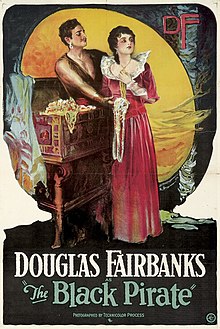
There are certain films that become truly surprising, years after their release, for reasons that have absolutely nothing to do with its storyline or acting; The Black Pirate, Albert Parker's 1926 swashbuckler starring Douglas Fairbanks, has become surprising because it is a silent film that just so happens to be in Technicolor (albeit two-tone, but Technicolor nonetheless).  One of a series of swashbuckling vehicles for Fairbanks released during the 1920s, The Black Pirate casts the athletic superstar as a young Duke seeking revenge for his father's death by taking the guise of a unnamed buccaneer and joining the company of pirates that did the deed.

A group of pirates blow up a captured ship, via the ship's powder magazine, with all of the occupants still on board.  The ship's sole survivors, a Duke and his son, are washed ashore on a deserted island; the father soon dies, leaving his signet ring and dukedom to his son, who vows to avenge his father's death.  Through a mixture of coincidence and convenience, the pirates disembark on the same island to bury their horde of treasure.  The son, adopting the mysterious (and catchy) moniker of the Black Pirate, walks up to the pirates and proclaims his desire to join the crew.  Following the proving of his worth (he has a victorious duel with the captain and he captures a large ship singlehandedly), the crew enthusiastically endorses their new recruit as fit for being their new captain, much to the dismay of the previous first mate.  What follows is a series acrobatic fights, the predictable wooing of a for-some-reason-their princess, and the inevitable revelation of his true identity.

The Black Pirate, is one Fairbanks' weaker swashbucklers in terms of both plot and character.  While almost all silent films rely on formula, formula does not have to be used in a boring manner: and The Black Pirate certainly uses it in a boring manner.  Absolutely nothing distinguishes it from the countless other revenge on the high seas flicks that have been released over the years, except for Douglas Fairbanks.  The plot of the film boils down to one clichĂ©d scene after another, with a damsel in distress, portrayed by Billie Dove, thrown in for good measure.  Douglas Fairbanks is at his uncannily acrobatic best here (some of his stunts are jaw-dropping), though it is a shame he can't elevate the material beyond the piece of (mildly) diverting fluff it is.

The real appeal of The Black Pirate lies in the fact that it is an intriguing curio from the silent era; it is one of the first films to be released entirely in color, albeit in two-tone Technicolor (which has a limited spectrum in comparison to later Technicolor).  In fact, Fairbanks, who was heavily involved with the film's production, invested a considerable amount of money in developing the process that made color films a reality.  The Black Pirate was recently selected for preservation in the National Film Registry: it did not get that recognition because of its merits, it got it because of its (very) early use of Technicolor.

The Black Pirate is not a particularly good silent swashbuckler, especially when compared with other Fairbanks films, but it is a fairly competent if underwhelming pirate flick.  The film's primary appeal is the viewing of a 1920s silent film in color; the strangeness wears off eventually, but it is enough to make it worth a watch if you have an interest in early cinema.


5/10

Note: This review was previously posted on another blog I wrote.
The Kid (1921)


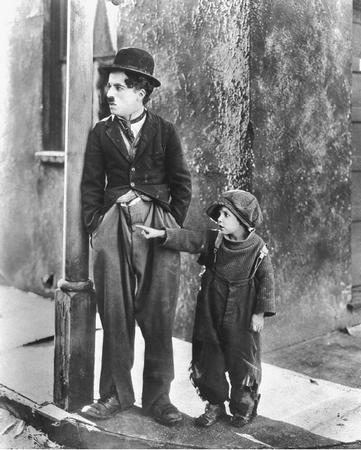
Charlie Chaplin, potentially the biggest star to have ever come out of Hollywood, secured his enduring and unrivaled legacy with The Kid (he received a twelve minute standing ovation when he accepted his honorary Academy Award), a feature film that managed to seamlessly blend Chaplin's (considerable) comedic and dramatic talents.  Released in 1921, the film costarred the popular child-actor Jackie Coogan as the titular kid and Chaplin's frequent collaborator Edna Purviance as the kid's long-lost mother.


The film opens with a women holding a newborn son wandering around a city without a place to go or a means to feed her child; she reluctantly (and tearfully) leaves her child in a nice automobile located in an affluent area with a note pleading for them to take care of the child.  Through unforeseen events, the child winds up with the Tramp, Chaplin's lovable vagabond, who, after trying to pass off the infant on several people, becomes attached to the child and christens him John (Coogan's given name).  A few years pass and the Kid has become the Tramp's partner in crime and surrogate son.  A doctor, apalled at the squalor the two live in, informs the government that the Kid is not the Tramps biological son and has him taken away.  The Tramp's desperate attempts to recover the only family he has coincide with the mother's (who has become a success on the stage, that constantly regrets giving up her child) realization that the plucky child she befriended on the poor side of town is actually her long lost son.


Chaplin, one of the three great silent comics during the twenties (along with Buster Keaton and Harold Lloyd), set himself apart from the pack for two main reasons: his being the ultimate auteur (he produced, directed, wrote, scored, and acted for The Kid) and his understanding that gags can make a comedy funny, but pathos can make a comedy great.  His performance in The Kid is one of his best: it is at times incredibly funny, at times tragic, and at times both.  A rooftop chase to regain the Kid is both incredibly emotional and laced with humor throughout, very few actors can do this well, and none could do this as well as Chaplin.

The plot is simple (as is often the case with silent films), though it is both highly effective and fitting for Chaplin's strengths as an actor and director as well as fitting for the Tramp persona.  Hardly an hour long (give or take a few minutes), The Kid may lack complexity, but it more than makes up for it with its raw emotional power and the performances of Chaplin and Jackie Coogan as the lovable ne'er-do-wells at the heart of the story.  The Kid is also admirable because of its economy, there is not a scene in the film that does not forward the plot or develop the characters in some way (though there is a dream sequence that runs a bit long), and in an age of incessant CGI and transforming robots, that is something that should be cherished.

The Kid is Charlie Chaplin's first feature film, as well as being one of the best, most enduring films he ever made, and just about every film he made can be classified as a cinematic classic.  The Kid is, and will remain, a great film that should be seen by everybody at some point, even if they don't really care for silent film.

10/10

Note: This review was previously posted in another blog I wrote.